
electronics-journal.com
10
'26
Written on Modified on
NVIDIA Partners with Rebellions and SK Telecom on Sovereign AI
Three tech leaders combine advanced networking, custom processors, and data centers to build Korea’s next-generation sovereign infrastructure for high-performance and energy-efficient artificial intelligence computing.
www.nvidia.com
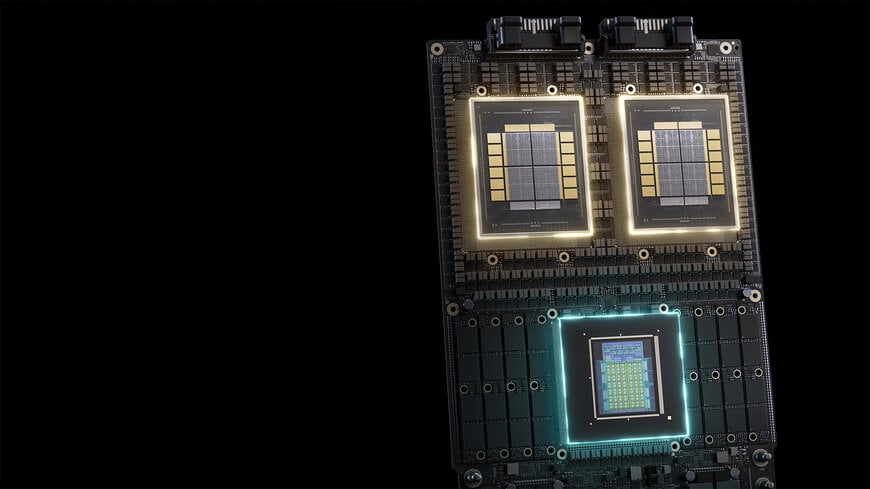
NVIDIA, Rebellions, and SK Telecom have established a technical framework to deploy heterogeneous sovereign AI infrastructure across South Korea's telecommunications and industrial computing sectors. The initiative integrates specialized neural processing units with established GPU fabrics to address the processing and energy requirements of large-scale artificial intelligence models.
System Integration and Engineering Roles
The operational architecture combines complementary hardware and facility management layers. NVIDIA provides the interconnect standard and system blueprints, Rebellions supplies targeted inference silicon, and SK Telecom executes facility-level deployment.
Integration relies on the NVIDIA NVLink Fusion interface, which links third-party custom accelerators into standard scale-up fabrics. Rebellions utilizes this protocol to couple its Rebel R200 processors directly to host platforms. The hardware layout adheres to the NVIDIA MGX rack reference specifications, which standardize thermal dissipation profiles, power distribution buses, and physical enclosure dimensions. This shared standard allows data center operators to incorporate mixed-architecture server nodes without reconfiguring base physical plant assets.
Workload Partitioning and Inference Operations
The infrastructure implements a disaggregated inference processing pipeline. In generative model serving, operations divide into prompt processing, known as the prefill stage, and token generation, known as the decode stage.
The architecture allocates computationally dense prefill calculations to NVIDIA graphics processing units, which leverage high parallel throughput to ingest multi-token prompts. Token decoding routes across high-speed fabric to Rebellions Rebel R200 processors, which feature memory-bandwidth-optimized architectures designed for continuous single-token emission. This functional division aims to maximize token generation efficiency while reducing power consumption during inference runs on multitrillion-parameter mixture-of-experts networks.
Industrial Deployment Context
SK Telecom will integrate the heterogeneous computing clusters into its regional AI data center network. The physical systems are scheduled to host the operator's proprietary base models, including the A.X K2 system, as well as public-sector workloads coordinated by the Ministry of Science and ICT.
Regarding the technical architecture, Jensen Huang, founder and CEO of NVIDIA, stated: "With NVLink Fusion, Korea’s chipmakers can connect their custom ASICs to NVIDIA’s AI factory platform, tightly coupling their processors with NVIDIA compute to run AI workloads."
Sunghyun Park, cofounder and CEO of Rebellions, noted: "By integrating Rebellions’ purpose-built silicon and system design with NVIDIA’s NVLink Fusion, high-speed interconnects and rack-scale design expertise, and SKT’s model and data center operations capabilities, we will deliver low-latency and energy-efficient inference for frontier models at scale."
Hardware availability and facility integration of the Rebel R200 systems are scheduled for operational installation in 2028.
Edited by Evgeny Churilov, Induportals Media - Adapted by AI.
www.nvidia.com
