
electronics-journal.com
09
'26
Written on Modified on
Dispensable Thermal Interface Materials for Electronic Heat Dissipation
FUCHS Lubricants Co. has introduced a portfolio of thermal interface materials designed to optimize heat dissipation in power electronics and semiconductor devices.
www.fuchs.com
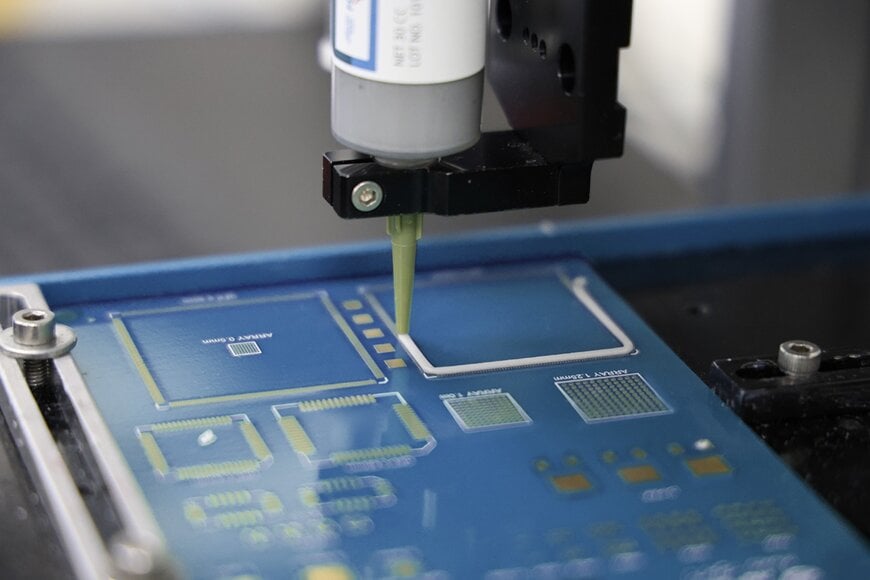
FUCHS Lubricants Co. has released its initial portfolio of thermal interface materials (TIMs), marking the manufacturer's expansion into electronic thermal management. The materials are engineered to displace air gaps between heat-generating components and heat sinks, facilitating thermal transfer in automotive control systems, data center processors, and microelectronics.
Mechanisms of Electronic Thermal Management
As electronic architectures achieve higher power densities in smaller physical footprints, accumulated heat degrades system reliability. Thermal interface materials address this by filling microscopic surface imperfections and macroscopic air gaps between components, which otherwise act as thermal insulators. By establishing continuous thermal pathways, the formulated materials mitigate localized hot spots and maintain component operating temperatures within specified parameters.
Dispensable Solutions and Mechanical Applications
The product range encompasses several formulations engineered for specific mechanical interfaces and assembly requirements. The thermal greases are designed to achieve low bond line thicknesses and high surface wetting, enabling efficient heat transfer while preserving the ability to disassemble and rework components. For permanent architectural requirements, thermally conductive epoxies and potting compounds utilize low-shrinkage formulations to encapsulate components without inducing mechanical stress during the curing phase.
To accommodate wider hardware gaps and irregular surface topographies, putty formulations and two-part liquid gap fillers (LGF) conform to the existing hardware using minimal compression force. This mechanism protects pressure-sensitive elements while providing structural stability under increased thermomechanical stress. Pre-cured pad formats are also available as customized die cuts for repeatable assembly sequences.
Chemical Variations for Semiconductor Manufacturing
The materials are available in both silicone and non-silicone base chemistries. Non-silicone formulations specifically target low-outgassing requirements to prevent contamination, which can compromise optical sensors, adhesion interfaces, and sensitive microelectronics. The materials are formulated for physical compatibility with automated dispensing equipment and screen-printing hardware. Regarding the technical requirements of electronic assembly, Soeren Bergner, Business Development Manager for Thermal Interface Materials, noted that entering this sector "extends our specialty-materials expertise to a new engineering challenge," as successful implementation requires matching material rheology to both the device architecture and the production process.
Additional Context
This section details technical specifications and competitive benchmarking not included in the original news release.
In the industrial thermal interface materials sector, the product line competes directly with established thermal management portfolios such as Henkel’s Bergquist line, Dow’s DOWSIL thermal materials, and Parker Chomerics. Competitive benchmarking for liquid gap fillers and thermal greases typically centers on bulk thermal conductivity, usually measured in watts per meter-kelvin (W/m·K), which standardizes between 1.5 and 7.0 W/m·K for mid-range to high-performance microelectronics. For non-silicone, low-outgassing variants, aerospace and automotive benchmarks frequently reference the ASTM E595 standard, which requires a Total Mass Loss (TML) of less than 1.0 percent and a Collected Volatile Condensable Material (CVCM) limit of less than 0.1 percent to prevent material deposition on sensitive optics or electrical contacts. Additionally, the viability of dispensable TIMs in automated assembly lines is evaluated based on their structural stability over time and achievable minimum bond line thickness (BLT), which directly dictates the thermal resistance at the component interface.
Edited by Aishwarya Mambet, Induportals Editor, with AI assistance.
www.fuchs.com
