
Desktop HPC Cluster for Scientific AI Development
NVIDIA DGX Spark HPC Developer Kit links four GB10 Grace Blackwell nodes for multi-node simulation, MPI development and AI workloads before supercomputer scale-out.
www.nvidia.com
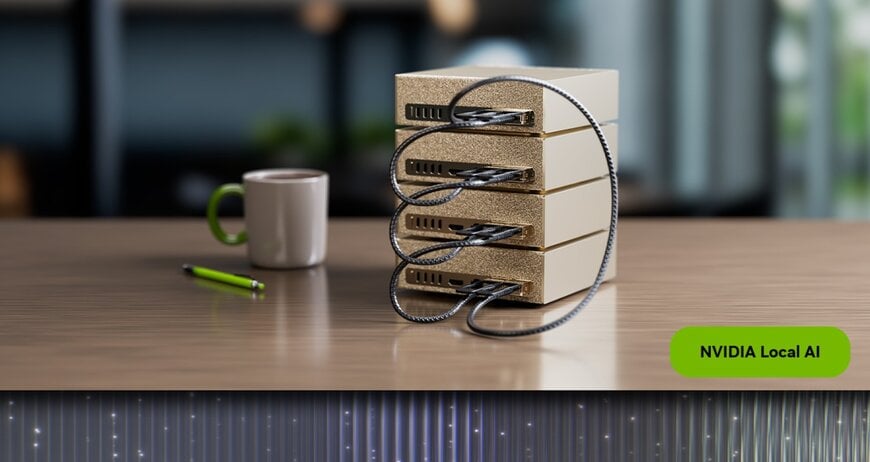
In high-performance computing, code development and debugging often compete with production jobs for time on shared GPU clusters. Researchers can wait hours or days in a queue just to test whether a parallel application scales correctly across nodes. NVIDIA addresses this bottleneck with the DGX Spark HPC Developer Kit, a four-node desktop cluster introduced at SC26, the international supercomputing conference held in Chicago from November 15 to 20, 2026.
The kit targets universities, research laboratories and engineering teams working on materials science, molecular dynamics, computational fluid dynamics, climate modelling and life sciences.
Why Multi-Node Development Needs Local Hardware
Scientific codes based on MPI must be tested on more than one node to reveal communication, load-balancing and memory-distribution issues. A single workstation cannot reproduce this behaviour, while a full supercomputer allocation is expensive for iterative debugging. A small, self-contained cluster allows developers to build, test and profile multi-node applications before moving them to larger systems.
Ring Topology Without a Network Switch
The kit combines four NVIDIA DGX Spark systems, each based on the GB10 Grace Blackwell Superchip. Every node connects directly to its two neighbours over NVIDIA ConnectX-7 networking, forming a ring that requires no network switch. This simplifies installation and reduces cost and space requirements for an office or laboratory environment.
Memory, Storage and Model Capacity
With four nodes, the cluster provides 512 GB of combined memory and 20 TB of NVMe storage. Using the NVFP4 4-bit floating-point format, it can run AI models of up to 700 billion parameters locally, such as DeepSeek V4.1.
Software Stack for HPC Applications
NVIDIA plans to provide an installation playbook for the NVIDIA HPC SDK, which includes GPU-accelerated C, C++ and Fortran compilers, mathematical libraries and MPI tools. NVIDIA has demonstrated LAMMPS with Kokkos for materials simulation and NAMD for molecular dynamics on four systems. GROMACS, OpenFOAM, WRF and NVIDIA NIM microservices such as OpenFold3 and Boltz-2 have been validated by the developer community.
Research Use Cases
NVIDIA describes several workflows: agent-assisted simulation, AI surrogate models that replace slow simulation steps, for example in wing-design optimisation, and dimensionality reduction of large problems before supercomputer time is booked. Early users report concrete results on single DGX Spark systems. Kvantify used NVIDIA cuQuantum to simulate quantum-chemistry circuits with up to 70 qubits and 975 gates. The Rubin Lab at UC Berkeley's Innovative Genomics Institute used Evo 2 to predict bacterial traits from genomes, obtaining results about 15 times sooner than through its cluster queue. The Hartwig Group at UC Berkeley performed LoRA fine-tuning of Nemotron 3 Super 120B-A12B on one device using NVFP4.
Availability
The DGX Spark HPC Developer Kit is available through NVIDIA Marketplace and OEM partners including Acer, ASUS, Dell Technologies, GIGABYTE, H3C, HP, Lenovo, MSI and xFusion.
Additional Context:
This section details technical specifications and competitive benchmarking not included in the original product announcement.
Small development clusters have long been used in HPC centres as test partitions that mirror production systems. The DGX Spark kit moves this concept to the desk by using a unified CPU-GPU superchip with coherent memory rather than discrete accelerator cards. Its ring interconnect suits development and moderate-scale runs, whereas production supercomputers rely on switched fabrics such as InfiniBand for thousands of nodes. The kit is therefore positioned as a development and prototyping platform rather than a replacement for data center clusters.
Edited by Evgeny Churilov, Induportals Media - Adapted by AI.
