
electronics-journal.com
17
'26
Written on Modified on
Heterogeneous HPC and AI for Science at SC26
AMD presents Lux at Oak Ridge, Instinct MI430X GPUs and quantum error-correction tools for converged simulation and AI workloads.
www.amd.com
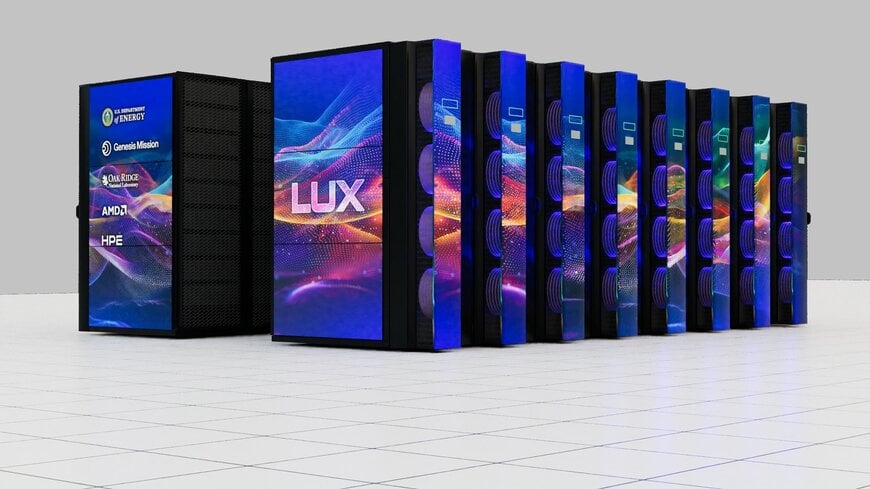
At SC26, the International Conference for High Performance Computing, Networking, Storage and Analysis, taking place from 15 to 20 November 2026 at McCormick Place in Chicago, AMD is presenting supercomputer deployments, quantum-classical collaborations and open-source software that combine HPC simulation and AI on heterogeneous platforms for research, energy and national security applications.
Core Technology and System Architecture
Scientific computing increasingly couples physics-based simulation with AI models, which requires CPUs, GPUs and networks able to handle both double-precision and lower-precision workloads. AMD addresses this with EPYC CPUs, Instinct GPUs, Pensando networking and the ROCm open software stack. The Instinct MI430X is designed for both high-precision simulation and AI for Science, and AMD research across 47 workload configurations in 11 applications examines where FP64 emulation is viable and where codes require native double precision. 6th Gen EPYC processors, formerly codenamed Venice, provide up to 1.6 TB/s of memory bandwidth, PCIe Gen 6 and frequencies of up to 5.3 GHz, while Venice-X will add 1,152 MB of L3 cache per socket. AMD AI NICs allow a single Ethernet fabric to carry both AI training and MPI-based simulation traffic.
Deployment and Implementation
The Lux SI + HPC supercomputer, built by HPE with EPYC CPUs, Instinct MI355X GPUs and Pensando networking, is open to scientific users at the U.S. Department of Energy's Oak Ridge National Laboratory (ORNL) as the first dedicated AI Factory for the Genesis Mission. It ranks No. 14 on the TOP500 with 220.79 petaflops of HPL performance. In Europe, LUMI-AI in Finland combines Instinct MI430X GPUs with 6th Gen EPYC processors, the Dawn expansion in the United Kingdom adds MI355X GPUs integrated by Dell Technologies, and AMD and Eviden were selected to build Alice Recoque, the first exascale system in France.
Industry Applications
Target users include national laboratories, research centres and organisations in energy and national security. For quantum computing, AMD is working with IBM and the Quantum Science Center at ORNL on a codesign platform for quantum error correction, has expanded its partnership with PsiQuantum, and contributes to openQSE, a community effort for vendor-neutral quantum-HPC interfaces. AMD HPC Assistant, an open-source agentic AI tool developed with CSC on LUMI, supports job submission, GPU profiling and kernel optimisation, while a Kubernetes reference architecture with Rancher Government Solutions targets secure HPC and AI scheduling.
Operational Impact and Performance Metrics
According to AMD, its technology is used in 202 TOP500 systems, including four of the ten fastest and four of the ten most energy-efficient. The open-source Pelagos decoder simulation tool, released with IBM, showed 6.23x end-to-end throughput scaling from one to eight MI355X GPUs on Lux.
Additional Context:
This section details technical specifications and competitive benchmarking not included in the original product announcement.
The November 2026 TOP500 list ranks supercomputers by measured HPL performance. China's LineShine leads at 2.198 exaflop/s, followed by the AMD-based El Capitan (1.809 exaflop/s) and Frontier (1.353 exaflop/s). The Intel-based Aurora (1.012 exaflop/s) and the NVIDIA GH200-based JUPITER Booster (1.000 exaflop/s) come next. El Capitan and Frontier are the two fastest GPU-accelerated systems on the list. By processor, the TOP500 project lists 199 systems (39.8%) with AMD CPUs and 251 (50.2%) with Intel CPUs. AMD's own figure of 202 counts systems using any AMD technology. In GPU installed base, NVIDIA leads: 110 systems use Hopper-generation GPUs, compared with 34 using AMD Instinct. On the Green500 energy-efficiency ranking, NVIDIA GH200 systems hold the top three places, led by KAIROS at 73.28 GFlops/W. The highest-placed AMD Instinct system, AMD Ouranos, ranks ninth at 66.46 GFlops/W.
Edited by Natania Lyngdoh, Induportals editor, with AI assistance.
www.amd.com
