
electronics-journal.com
07
'26
Written on Modified on
Multilayer Inductors for Automotive Power-Over-Coax Signal Filtration
TDK expands its line of compact passive components designed to separate power and data signals within advanced vehicle camera networks.
www.tdk.com
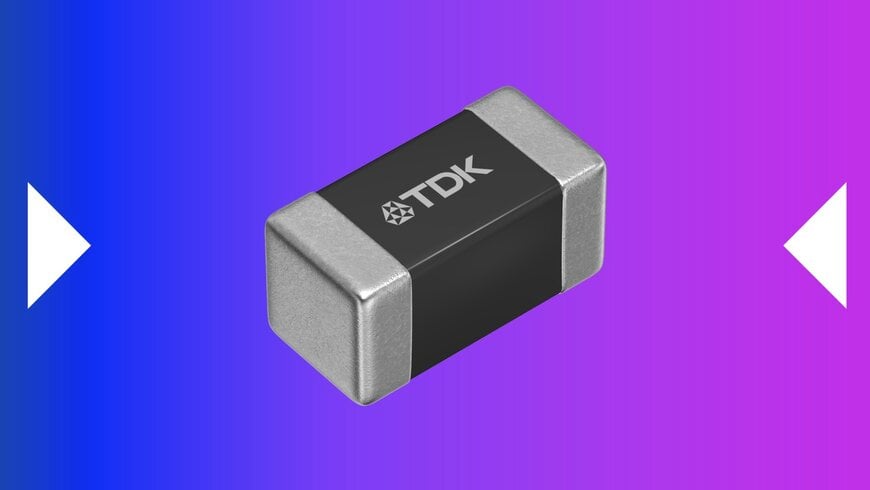
TDK Corporation is releasing an expansion to its MLJ1608-G series of multilayer inductors engineered specifically for automotive power-over-coax (PoC) circuits. This hardware addresses the filtration requirements of advanced driver-assistance systems (ADAS) by enabling simultaneous power and high-frequency data transmission across a single physical medium within the automotive data ecosystem.
Consolidation of Vehicle Wiring Architectures
Automotive PoC systems transmit electrical power and data simultaneously over a single coaxial cable. This architecture is primarily utilized in automotive cameras integrated into ADAS. As vehicles incorporate multiple environmental sensors at the front, rear, and sides, the raw visual data is routed to an electronic control unit (ECU) for processing. Traditional hardware architectures required separate physical cabling for power delivery and data transmission. By consolidating these functions into a single coaxial cable, PoC networks reduce the total number of cables in a vehicle, which directly decreases wire harness volume, lowers overall vehicle weight, and minimizes structural complexity.
High-Impedance Filtration Mechanisms
To function effectively, PoC systems require a wideband filter composed of multiple inductors to cleanly separate the direct current (DC) power from the high-frequency data signals prior to processing. The expanded MLJ1608-G series utilizes proprietary material and structural designs to maintain high impedance across a frequency range from 300 MHz to 2 GHz.
The component provides a baseline inductance of 1.2 μH, compared to the 0.56 μH typical of legacy products. In the specific 100 to 700 MHz frequency band, this configuration yields 1.7 to 2 times higher impedance than standard components, delivering effective noise suppression. The inductor is manufactured using multilayer processing technologies, resulting in a compact 1608 form factor measuring 1.6 by 0.8 by 0.8 millimeters. This AEC-Q200 compliant footprint allows tier-one automotive suppliers to reduce the overall physical volume of integrated camera modules.
Additional Context
This section details technical specifications and competitive benchmarking not included in the original news release.
In the automotive PoC inductor market, manufacturers must balance required inductance and impedance against physical footprint limitations. Comparable filtration components are produced by companies such as Murata Manufacturing and Taiyo Yuden. Murata’s LQW series (such as the LQW32FT) is widely utilized for PoC filtration, relying on a wire-wound construction to achieve high broadband impedance and manage high current loads.
While wire-wound inductors traditionally offer superior high-frequency impedance, they often require larger physical footprints. The TDK MLJ1608-G series competes by utilizing a multilayer construction process rather than wire-winding. This approach allows the component to maintain a highly compact 1608 (1.6 mm x 0.8 mm) surface-mount footprint while still achieving the 1.2 μH inductance necessary to suppress noise across the megahertz and gigahertz bands. This structural trade-off specifically targets ultra-compact ADAS camera modules where printed circuit board real estate is severely constrained.
Edited by Aishwarya Mambet, Induportals Editor, with AI assistance.
www.tdk.com
