
electronics-journal.com
01
'26
Written on Modified on
High-Temperature DC-Link Film Capacitors for Automotive Power Electronics
TDK Corporation presents B3272*A/G/T series film capacitors operating up to 135 °C to resolve thermal stress in electric vehicle inverters.
www.tdk.com
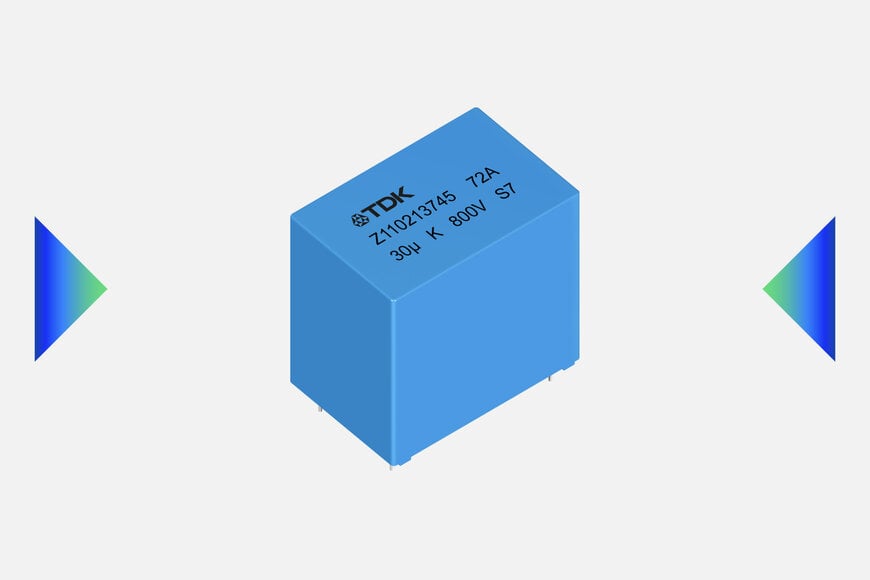
High-voltage power conversion stages in electric vehicles and industrial drives demand robust passive filtering capable of withstanding severe thermal environments without operational derating. To expand thermal headroom in space-constrained power electronic assemblies, TDK Corporation has introduced the B3272*A/G/T series of DC-link film capacitors qualified for continuous operation at case temperatures up to +135 °C.
Thermal Constraints in Modern Conversion Architectures
Traction inverters, on-board charging units, automotive direct-current converters, and industrial variable-frequency drives are subjected to mounting electrical and thermal loads. As power conversion topologies adopt wide-bandgap semiconductors, switching frequencies increase, enabling magnetic components to shrink. However, packaging high-current switching stages into compact enclosures creates localized hot spots.
Standard DC-link components often act as the primary thermal bottleneck in power electronics designs. When capacitors require steep voltage or current derating above moderate ambient thresholds, system architects are forced to introduce bulky heat sinks, liquid cooling loops, or oversized passive arrays. Maintaining high capacitance density and reliable ripple current handling under elevated ambient temperatures has therefore become an essential design requirement.
Dielectric Material Innovation and Electrical Characteristics
The B3272*A/G/T series addresses thermal degradation through the integration of an EPN dielectric, a specialized polymer formulation blending polypropylene with cyclic olefin copolymer. Previously demonstrated in the manufacturer's ModCap UHP power capacitors, this dielectric blend raises thermal endurance while maintaining high breakdown strength and dielectric self-healing characteristics. Consequently, the components operate continuously without voltage derating up to +105 °C, maintaining functional ratings up to +135 °C under specified derating conditions.
The product line spans rated direct-current voltage ranges from 800 V to 1200 V and nominal capacitance values from 1.0 µF to 60 µF. To accommodate diverse physical layouts, the capacitors are manufactured across three standard lead spacings: 27.5 mm, 37.5 mm, and 52.5 mm.
Mechanical Configurations and Parasitic Inductance Optimization
Minimizing parasitic loop inductance is critical in fast-switching converter bridges to suppress destructive voltage overshoots during transient switching events. The B3272*A/G/T portfolio provides both 2-pin and 4-pin contact terminals. The 4-pin G-type variants, such as the 52.5 mm lead-spacing B32728G, provide low-inductance busbar and circuit interfaces that limit parasitic inductance and improve mechanical stability against mechanical vibration.
For height-restricted enclosures, such as low-profile automotive electronics bays, the series includes low-profile T variants that reduce vertical component clearance without compromising voltage insulation. The encapsulation comprises a flame-retardant plastic casing and an epoxy resin sealing system, both certified compliant with UL 94 V-0 safety standards. The series is qualified under the automotive AEC-Q200E standard, complies with RoHS environmental directives, and delivers a projected operating lifetime of 100,000 hours under rated voltage at +85 °C. Circuit design simulation is supported through verified SPICE models and the web-based Capacitor Life And Rating Application calculation suite.
Additional Context:
This section details technical specifications and competitive benchmarking not included in the original product announcement.
Standard metallized polypropylene (MKP/BOPP) film capacitors have long served as the benchmark technology for DC-link stages in motor drives and traction inverters due to their self-healing behavior, high ripple current endurance, and low dielectric dissipation factor (tan delta). Nevertheless, conventional polypropylene films suffer structural softening and elevated dielectric losses at temperatures above +105 °C, often restricting continuous operation to maximum case temperatures between +105 °C and +115 °C with substantial voltage derating.
Alternative dielectric formulations, such as polyphenylene sulfide (PPS) and polyethylene terephthalate (PET), tolerate higher operational temperatures but exhibit drawbacks including lower dielectric breakdown fields, higher cost, or elevated dielectric loss at high frequencies. Incorporating cyclic olefin copolymer into a polypropylene matrix balances these trade-offs by elevating the glass transition temperature while preserving the low dielectric dissipation characteristic of pure polyolefins.
In traction inverters operating with silicon carbide power modules, junction temperatures routinely approach +150 °C to +175 °C. Capacitors rated for +135 °C operation without derating up to +105 °C allow power engineers to locate DC-link filtering elements in closer physical proximity to the switching bridge, directly reducing DC-bus trace lengths, lowering stray inductance below 15 nH, and reducing total cooling infrastructure mass.
Edited by Natania Lyngdoh, Induportals editor, with AI assistance.
www.tdk-electronics.tdk.com
