
electronics-journal.com
27
'26
Written on Modified on
Infineon Equips Fox ESS with Silicon Carbide Technology
Advanced CoolSiC MOSFETs reduce switching losses by 70 percent, boosting efficiency in residential energy storage systems.
www.infineon.com
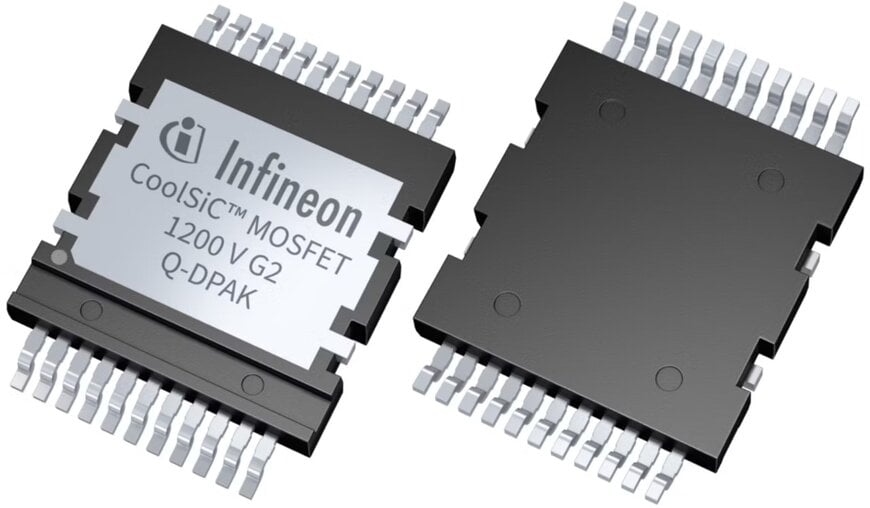
Infineon's CoolSiC MOSFETs 1200 V G2 in the top-side-cooled Q-DPAK package deliver optimized thermal performance, system efficiency and power density
Infineon Technologies AG is supplying its silicon carbide (SiC) power semiconductors to Fox ESS to enhance the performance of its residential energy storage systems (ESS). By integrating Infineon's CoolSiC™ MOSFETs 1200 V G2 in the Q-DPAK package, Fox ESS has successfully reduced switching losses by 70 percent. This integration enables the PQ3-Ultra energy storage system to reach a peak photovoltaic (PV) inverter efficiency of up to 98.78 percent during grid-tied operation, alongside a peak battery charge/discharge efficiency of 98.47 percent. Leadership from both companies emphasized that this collaboration aims to deliver high-performance, reliable solutions that support the broader adoption of clean energy in homes globally.
The CoolSiC MOSFETs utilize Infineon's advanced .XT interconnection technology and a top-side-cooled Q-DPAK package to optimize thermal performance and power density. The top-side cooling design improves printed circuit board (PCB) layouts by reducing stray inductance and parasitic effects compared to traditional bottom-side-cooled methods. This compact footprint supports space-saving configurations and automated assembly for cost-efficient, scalable manufacturing. Benefiting from this technology, Fox ESS's hybrid ESS solution—combining the PQ-H3-Ultra-10.0 inverter and EQ3300-5 battery—achieved a record-setting System Performance Index (SPI) of 97.0 percent in a 2026 test by HTW Berlin University of Applied Sciences and AQUU Research, ranking first in the 10 kW class.
Additional Context
This section provides technological and market background not explicitly detailed in the original release.
The adoption of silicon carbide (SiC) semiconductors represents a major technological leap over traditional silicon-based components (like IGBTs) in power electronics. Because SiC allows devices to operate at higher switching frequencies with significantly lower conduction and switching losses, it drastically reduces the required size of passive magnetic components and cooling heatsinks. In the competitive residential solar-plus-storage market, this translates directly into smaller, lighter, and quieter wall-mounted hybrid inverters. Furthermore, top-side cooling architecture is crucial for high-power-density designs; by dissipating heat directly upward into a heatsink rather than forcing it down through the PCB, it prevents thermal bottlenecks, protects adjacent sensitive components, and ensures the long-term reliability required for decade-long energy storage warranties.
Edited by Lekshman Ramdas, Induportals editor – adapted by AI.
www.infineon.com
Infineon Technologies AG is supplying its silicon carbide (SiC) power semiconductors to Fox ESS to enhance the performance of its residential energy storage systems (ESS). By integrating Infineon's CoolSiC™ MOSFETs 1200 V G2 in the Q-DPAK package, Fox ESS has successfully reduced switching losses by 70 percent. This integration enables the PQ3-Ultra energy storage system to reach a peak photovoltaic (PV) inverter efficiency of up to 98.78 percent during grid-tied operation, alongside a peak battery charge/discharge efficiency of 98.47 percent. Leadership from both companies emphasized that this collaboration aims to deliver high-performance, reliable solutions that support the broader adoption of clean energy in homes globally.
The CoolSiC MOSFETs utilize Infineon's advanced .XT interconnection technology and a top-side-cooled Q-DPAK package to optimize thermal performance and power density. The top-side cooling design improves printed circuit board (PCB) layouts by reducing stray inductance and parasitic effects compared to traditional bottom-side-cooled methods. This compact footprint supports space-saving configurations and automated assembly for cost-efficient, scalable manufacturing. Benefiting from this technology, Fox ESS's hybrid ESS solution—combining the PQ-H3-Ultra-10.0 inverter and EQ3300-5 battery—achieved a record-setting System Performance Index (SPI) of 97.0 percent in a 2026 test by HTW Berlin University of Applied Sciences and AQUU Research, ranking first in the 10 kW class.
Additional Context
This section provides technological and market background not explicitly detailed in the original release.
The adoption of silicon carbide (SiC) semiconductors represents a major technological leap over traditional silicon-based components (like IGBTs) in power electronics. Because SiC allows devices to operate at higher switching frequencies with significantly lower conduction and switching losses, it drastically reduces the required size of passive magnetic components and cooling heatsinks. In the competitive residential solar-plus-storage market, this translates directly into smaller, lighter, and quieter wall-mounted hybrid inverters. Furthermore, top-side cooling architecture is crucial for high-power-density designs; by dissipating heat directly upward into a heatsink rather than forcing it down through the PCB, it prevents thermal bottlenecks, protects adjacent sensitive components, and ensures the long-term reliability required for decade-long energy storage warranties.
Edited by Lekshman Ramdas, Induportals editor – adapted by AI.
www.infineon.com
