
electronics-journal.com
29
'26
Written on Modified on
Contactless Payment Tokenization Integration for Active Smart Wearables
Infineon Technologies has developed a ready-to-integrate hardware and software architecture to enable digital card tokenization and near-field communication transactions on wearable computing devices.
www.infineon.com
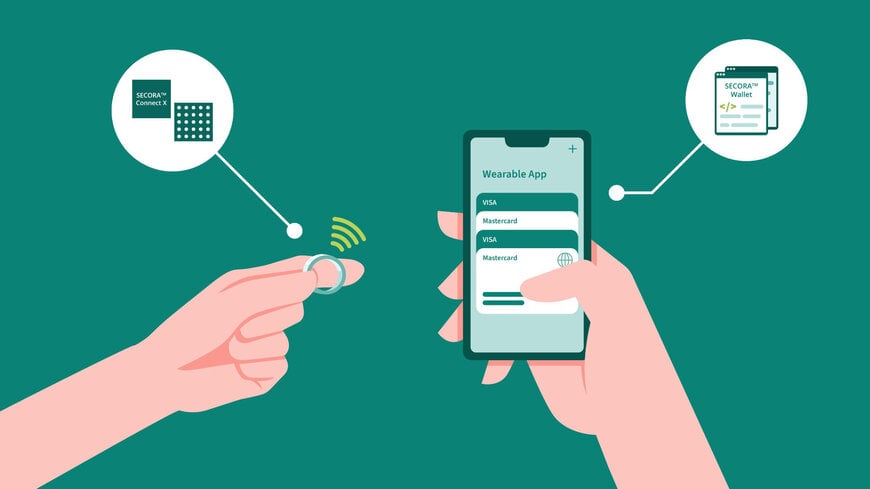
SECORA™ Connect X, combined with Infineon’s SECORA™ Wallet and SECORA™ Token Requestor (integrated with Mastercard MDES and Visa VTS), enables smart wearables to become fully functional payment devices with card digitization and custom wallet apps.
The deployment of near-field communication modules in smart rings, sports watches, and fitness trackers requires hardware capable of localized credential storage and transaction processing. To address integration requirements for wearable device manufacturers, Infineon provides a hardware and software system incorporating a Secure Element, digital wallet infrastructure, and tokenization services linked to primary payment networks. This architecture allows original equipment manufacturers to implement point-of-sale transaction capabilities directly within active wearables.
Hardware Architecture and Secure Credential Storage
The core hardware system functions as a near-field communication payment card emulation device. It integrates a Secure Element that processes transactions using local storage for payment credentials rather than relying on cloud-based authentication during the transaction. This localization reduces latency at the point of sale and maintains security perimeters directly on the wearable device. The hardware requires fewer external electronic components, which structurally limits power consumption and extends the operational battery life of the host wearable. The architecture supports Java Card and GlobalPlatform standards and includes pre-certified applets. Developers utilize one megabyte of integrated memory to program localized near-field communication and Bluetooth applications, accommodating the spatial constraints of miniaturized wearable formats.
Payment Tokenization and Network Integration
To process transactions, the system utilizes a proprietary digital wallet and token requestor mechanism to digitize standard payment cards. Acting as a token requestor, the system connects directly with the Mastercard Digital Enablement Service and Visa Token Service. This protocol replaces primary account numbers with specialized payment tokens. Storing these tokens directly on the Secure Element isolates the payment data from the device’s primary operating system. Tolgahan Yildiz, Head of the Trusted Mobile Connectivity and Transactions Product Line at Infineon, notes that the hardware "turns wearables into payment devices certified by Visa and Mastercard with worldwide acceptance at all contactless POS terminals, without the need for a phone or digital wallet." He adds that manufacturers "can launch their own branded payment services across a wide range of smart wearables." Original equipment manufacturers integrate the wallet capability into their proprietary applications using a provided software development kit, which is compatible with both iOS and Android operating systems.
Application Scope and Industry Standardization
While the primary implementation targets active smart wearables, Infineon also designates a complementary architecture for internet of things hardware, including augmented and virtual reality headsets, computing peripherals, and gaming consoles. The development and deployment of these systems align with standard specifications maintained by EMVCo, FiRa, GlobalPlatform, ISO, Java Card Forum, and the NFC Forum. The technology will be presented at the Money2020 trade show in Amsterdam, Netherlands, scheduled for June 2 to 4, 2026.
Additional Context: Technical Specifications and Competitive Benchmarking
This section details technical specifications and competitive benchmarking not included in the original product announcement. Within the wearable transaction sector, integrated Secure Element architectures are standard practice to meet stringent Europay, Mastercard, and Visa certification requirements. Competitors such as NXP Semiconductors and STMicroelectronics utilize comparable monolithic controllers integrating near-field communication routing and Secure Elements. The standard memory capacity for similar secure microcontrollers typically ranges between 1.5 and 2 megabytes of flash memory, placing the one-megabyte Infineon module within standard operational parameters for applet execution. The primary differentiation in this component category relies on the software abstraction layer. By acting directly as a designated token requestor for global payment networks, the module reduces the software engineering burden on original equipment manufacturers, bypassing the need to independently establish and certify tokenization backend servers.
Edited by an industrial journalist, Lekshman Ramdas, with AI assistance.
www.infineon.com
The deployment of near-field communication modules in smart rings, sports watches, and fitness trackers requires hardware capable of localized credential storage and transaction processing. To address integration requirements for wearable device manufacturers, Infineon provides a hardware and software system incorporating a Secure Element, digital wallet infrastructure, and tokenization services linked to primary payment networks. This architecture allows original equipment manufacturers to implement point-of-sale transaction capabilities directly within active wearables.
Hardware Architecture and Secure Credential Storage
The core hardware system functions as a near-field communication payment card emulation device. It integrates a Secure Element that processes transactions using local storage for payment credentials rather than relying on cloud-based authentication during the transaction. This localization reduces latency at the point of sale and maintains security perimeters directly on the wearable device. The hardware requires fewer external electronic components, which structurally limits power consumption and extends the operational battery life of the host wearable. The architecture supports Java Card and GlobalPlatform standards and includes pre-certified applets. Developers utilize one megabyte of integrated memory to program localized near-field communication and Bluetooth applications, accommodating the spatial constraints of miniaturized wearable formats.
Payment Tokenization and Network Integration
To process transactions, the system utilizes a proprietary digital wallet and token requestor mechanism to digitize standard payment cards. Acting as a token requestor, the system connects directly with the Mastercard Digital Enablement Service and Visa Token Service. This protocol replaces primary account numbers with specialized payment tokens. Storing these tokens directly on the Secure Element isolates the payment data from the device’s primary operating system. Tolgahan Yildiz, Head of the Trusted Mobile Connectivity and Transactions Product Line at Infineon, notes that the hardware "turns wearables into payment devices certified by Visa and Mastercard with worldwide acceptance at all contactless POS terminals, without the need for a phone or digital wallet." He adds that manufacturers "can launch their own branded payment services across a wide range of smart wearables." Original equipment manufacturers integrate the wallet capability into their proprietary applications using a provided software development kit, which is compatible with both iOS and Android operating systems.
Application Scope and Industry Standardization
While the primary implementation targets active smart wearables, Infineon also designates a complementary architecture for internet of things hardware, including augmented and virtual reality headsets, computing peripherals, and gaming consoles. The development and deployment of these systems align with standard specifications maintained by EMVCo, FiRa, GlobalPlatform, ISO, Java Card Forum, and the NFC Forum. The technology will be presented at the Money2020 trade show in Amsterdam, Netherlands, scheduled for June 2 to 4, 2026.
Additional Context: Technical Specifications and Competitive Benchmarking
This section details technical specifications and competitive benchmarking not included in the original product announcement. Within the wearable transaction sector, integrated Secure Element architectures are standard practice to meet stringent Europay, Mastercard, and Visa certification requirements. Competitors such as NXP Semiconductors and STMicroelectronics utilize comparable monolithic controllers integrating near-field communication routing and Secure Elements. The standard memory capacity for similar secure microcontrollers typically ranges between 1.5 and 2 megabytes of flash memory, placing the one-megabyte Infineon module within standard operational parameters for applet execution. The primary differentiation in this component category relies on the software abstraction layer. By acting directly as a designated token requestor for global payment networks, the module reduces the software engineering burden on original equipment manufacturers, bypassing the need to independently establish and certify tokenization backend servers.
Edited by an industrial journalist, Lekshman Ramdas, with AI assistance.
www.infineon.com
