
electronics-journal.com
17
'26
Written on Modified on
Embedded Motor Controller Integrates Vector Control for Automotive Actuators
TDK Corporation has expanded its semiconductor portfolio with an integrated motor controller designed to drive brushless and brushed DC motors in smart automotive actuators.
www.tdk.com
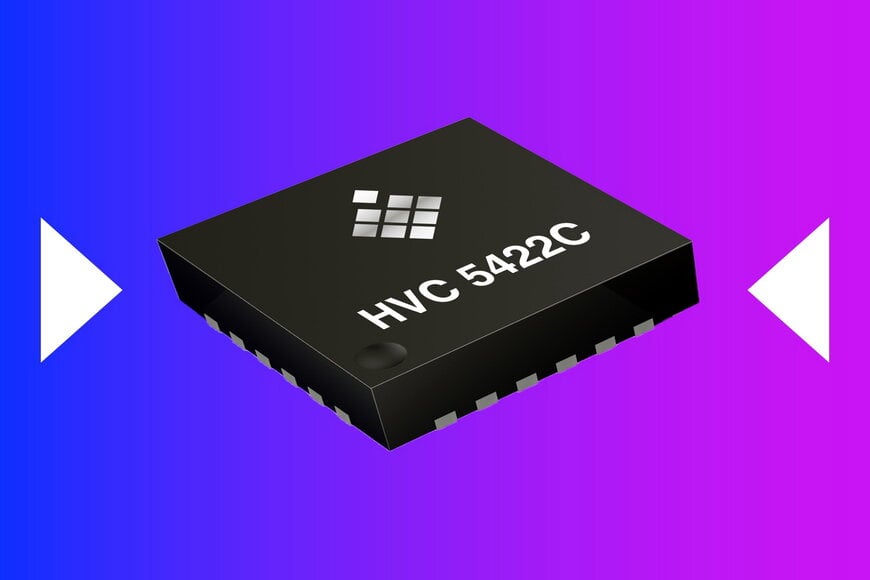
The cooperation between development and manufacturing divisions has yielded the Micronas HVC 5422C, an embedded motor controller designed for thermal management systems, active grille shutters, valves, and airflow control in combustion, hybrid, and electric vehicles. This system-on-chip integrates motor control, communication interfaces, and diagnostic functions into a single silicon die to reduce overall bill-of-materials costs and physical footprint in space-constrained automotive environments.
Architecture and Memory Upgrades for Smart Actuators
The device integrates an Arm Cortex-M3 processor core running alongside three integrated half-bridges capable of delivering up to 1 A peak drive current. Compared to previous iterations within the HVC 5x series, the flash memory capacity has been increased to 64 KB, complemented by 4 KB of EEPROM and 1 KB of non-volatile register space.
This expanded memory envelope allows automotive engineers to deploy advanced field-oriented control algorithms. Field-oriented control reduces torque ripple and electromagnetic interference, which directly minimizes acoustic noise in passenger cabin applications such as HVAC damper drives and seat comfort systems. Furthermore, the 64 KB flash capacity provides the physical memory overhead required to execute over-the-air software updates, allowing manufacturers to update motor-control parameters and diagnostic routines post-production.
Peripheral Integration and Security Protocols
Operating as a single-chip actuator driver, the device supports both sensored and sensorless motor-control methodologies, including back-electromotive force sensing. Connectivity is handled by an integrated Local Interconnect Network transceiver supporting auto-addressing protocols for bus-configured actuator networks.
For peripheral connectivity, the controller provides seven general-purpose input/output pins and an integrated 3.3 V voltage regulator capable of powering external position sensors or Hall-effect sensors. Intellectual property protection and software integrity are maintained via a hardware-based 256-bit cryptographic encryption engine, preventing unauthorized read-out or modification of the compiled application code after programming. The entire system is housed in a thermally efficient 5 x 5 mm² PQFN24 package.
Additional Context
This section details technical specifications and competitive benchmarking not included in the original product announcement.
Within the automotive smart actuator market, integrated motor controllers must balance processing power, thermal dissipation, and silicon footprint. For benchmark comparison, the Micronas HVC 5422C competes with alternative automotive-qualified solutions like the Infineon TLE9877QXW40 and the STMicroelectronics L99PM62GXP.
While both the Micronas HVC 5422C and the Infineon TLE9877QXW40 utilize an Arm Cortex-M3 processor core alongside 64 KB of flash memory, their physical implementations differ significantly. The Infineon device relies on a gate driver architecture requiring external power stage bridges, whereas the HVC 5422C integrates three half-bridges directly onto the silicon to drive up to 1 A peak current. This on-chip integration allows the HVC 5422C to achieve a highly compact footprint of 5 x 5 mm² in a PQFN24 package.
In contrast, the STMicroelectronics L99PM62GXP features integrated power stages capable of delivering up to 1.5 A peak current and supports both LIN and CAN communication interfaces, but it relies on a proprietary 32-bit core and requires a larger 10 x 10 mm² PowerSSO-36 package. By comparison, the HVC 5422C offers a significant reduction in physical board space over both the STMicroelectronics device and the 7 x 7 mm² package of the Infineon solution, though applications demanding more than 1 A peak drive current still require external bridges or larger alternative controllers.
Edited by Evgeny Churilov, Induportals Media - Adapted by AI.
www.micronas.tdk.com
