
electronics-journal.com
06
'26
Written on Modified on
Single-Photon Counting Module for the Near-Infrared Spectrum
HTDS distributes a silicon avalanche technology optimized for high-precision spectral analysis and quantum communications.
www.htds.fr
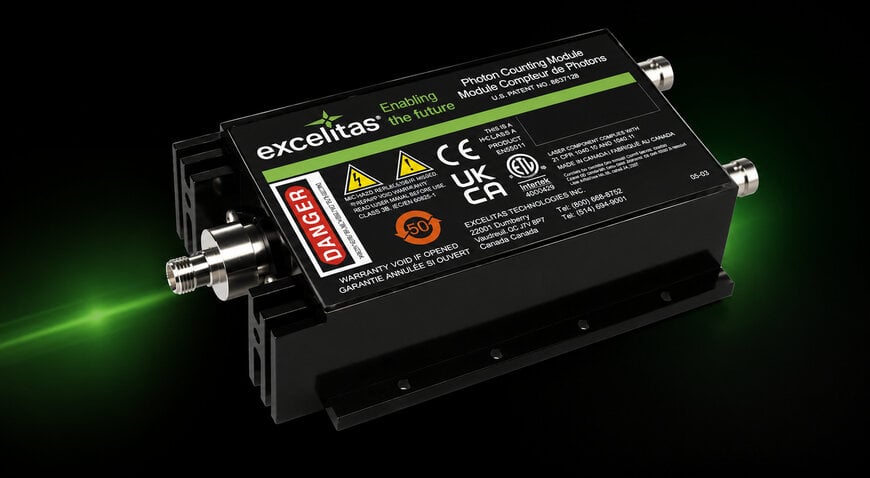
The commercial collaboration between HTDS and Excelitas Technologies introduces a self-contained detection device designed for scientific and industrial instrumentation. This system relies on a silicon avalanche photodiode operating in Geiger mode to secure the counting of extremely low light fluxes within the infrared spectrum.
Spectral Band Optimization and Photon Detection Efficiency
Conventional silicon detectors suffer a significant loss of sensitivity beyond 1000 nm. The architecture of the SPCM-1064 single-photon counting module addresses this limitation by targeting the spectral band between 905 nm and 1064 nm. This spectrum integrates directly into high-precision optical data ecosystems, notably for Raman spectroscopy, time-resolved photoluminescence, and quantum key distribution.
The device achieves a typical photon detection efficiency of 58% at 905 nm, 57% at 830 nm, and 10% at 1064 nm. Its 500 µm active area ensures a homogeneous reception that simplifies optical coupling with divergent beams or multimode fibers. This geometric configuration reduces mechanical alignment tolerances and the recurring calibration requirements of the instruments.
Timing Specifications and Signal Management
The metrological performance relies on an integrated active quenching electronics system that allows the processing of photonic events with the following specifications:
- A typical timing resolution of 600 ps for precise chronological event discrimination.
- A dead time limited to 44 ns ensuring measurement linearity up to 21 million counts per second.
- An afterpulsing rate below 3% ensuring the statistical fidelity of time-correlation measurements.
The module is available in several versions selected according to the dark count rate, with maximum thresholds set at 1500 cps, 1000 cps, or 500 cps. Power supply is provided via a single +5 V voltage. A time-gating function allows the sensor to be activated during synchronized detection windows, which improves the signal-to-noise ratio by eliminating background noise outside the window of interest.
Additional Context: This section details technical specifications and competitive benchmarking not included in the original product announcement
In the single-photon detection market at 1064 nm, engineers face a strict trade-off between detection efficiency and thermal complexity. Standard silicon detectors typically display an efficiency below 1% at this wavelength. Conversely, competing technologies based on Indium Gallium Arsenide (InGaAs) offer higher quantum efficiency (often between 20% and 30% at 1064 nm) but suffer from two major constraints: a significantly higher dark count rate and a reduced active area, often oscillating between 25 µm and 50 µm.
The SPCM-1064 module positions itself as an intermediate solution. With a 10% efficiency at 1064 nm, it compensates for its lower yield compared to InGaAs by offering a ten times larger active area (500 µm) and a controlled thermal noise rate without requiring heavy cryogenic cooling, facilitating its integration into compact industrial instruments.
Edited by Sucithra Mani, Induportals editor – adapted by AI.
www.htds.com
Additional Context: This section details technical specifications and competitive benchmarking not included in the original product announcement
In the single-photon detection market at 1064 nm, engineers face a strict trade-off between detection efficiency and thermal complexity. Standard silicon detectors typically display an efficiency below 1% at this wavelength. Conversely, competing technologies based on Indium Gallium Arsenide (InGaAs) offer higher quantum efficiency (often between 20% and 30% at 1064 nm) but suffer from two major constraints: a significantly higher dark count rate and a reduced active area, often oscillating between 25 µm and 50 µm.
The SPCM-1064 module positions itself as an intermediate solution. With a 10% efficiency at 1064 nm, it compensates for its lower yield compared to InGaAs by offering a ten times larger active area (500 µm) and a controlled thermal noise rate without requiring heavy cryogenic cooling, facilitating its integration into compact industrial instruments.
Edited by Sucithra Mani, Induportals editor – adapted by AI.
www.htds.com
