
electronics-journal.com
01
'26
Written on Modified on
Integrated Active and Passive High-Voltage Circuit Protection
Sensata Technologies introduces the STPS500P series PyroFuse, featuring dual-trigger redundancy for rapid fault interruption.
www.sensata.com
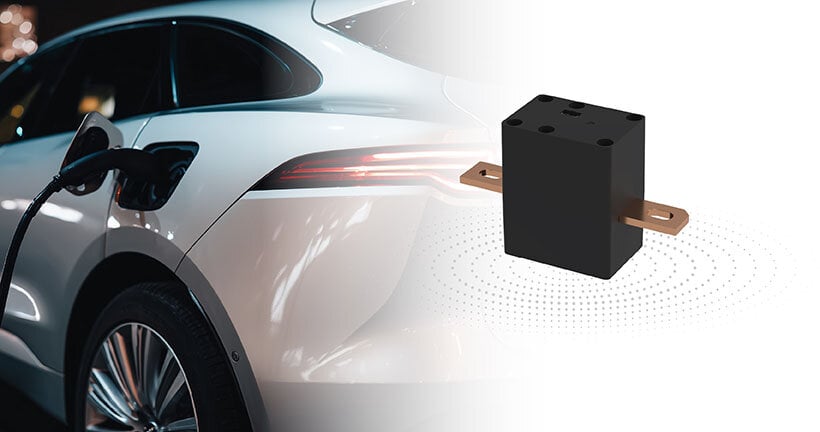
Sensata’s new Active+ Passive PyroFuse is an advanced high‑voltage protection device that delivers fast, redundant fault interruption to improve safety, simplify system design, and support the evolving demands of electrified vehicles and systems.
Sensata Technologies has launched the "Active + Passive" (A+P) PyroFuse, a high-voltage protection device that integrates both signal-triggered pyrotechnic protection and current-driven passive interruption into a single package. The STPS500P series is engineered to provide redundant fault protection for high-voltage architectures in electric vehicles, charging infrastructure, and industrial electrification systems, addressing the design limitations inherent in traditional single-mode protection devices.
Dual-Mechanism Fault Interruption
The A+P PyroFuse employs a hybrid architecture to ensure circuit interruption under diverse failure conditions:
Sensata Technologies has launched the "Active + Passive" (A+P) PyroFuse, a high-voltage protection device that integrates both signal-triggered pyrotechnic protection and current-driven passive interruption into a single package. The STPS500P series is engineered to provide redundant fault protection for high-voltage architectures in electric vehicles, charging infrastructure, and industrial electrification systems, addressing the design limitations inherent in traditional single-mode protection devices.
Dual-Mechanism Fault Interruption
The A+P PyroFuse employs a hybrid architecture to ensure circuit interruption under diverse failure conditions:
- Active Triggering: Responds to external control signals from the Battery Management System (BMS) or vehicle control unit, facilitating system-wide coordinated safety responses.
- Passive Triggering: Utilizes a mechanically driven, current-sensitive mechanism that responds directly to electrical fault conditions.
This dual-trigger design provides device-level redundancy, ensuring circuit isolation even if upstream sensors or electronic control signals are unavailable. Unlike conventional passive fuses that rely on the thermal melting of an alloy—a process inherently dependent on the magnitude of the fault current and thermal mass—the A+P PyroFuse uses a current-driven trigger that enables millisecond-level response times independent of specific current levels.
System-Level Optimization
By delivering faster fault interruption, the A+P PyroFuse mitigates peak energy exposure during short-circuit events. This rapid response reduces the short-circuit current withstand requirements for downstream components, such as contactors and busbars. Consequently, OEMs can optimize high-voltage architectures by reducing component sizing and minimizing the overall footprint, weight, and system complexity. The STPS500P series is designed to complement Sensata's existing portfolio of contactors and sensors, providing a unified hardware solution for integrated safety management in high-voltage electrified platforms.
Additional Context: This section details technical specifications not included in the original announcement
In high-voltage (HV) DC applications, circuit protection is significantly more challenging than in AC systems because DC lacks a natural "zero-crossing" to extinguish electrical arcs. When a contactor or fuse opens a DC circuit, the persistent current flow often creates a sustained, high-temperature plasma arc that can damage surrounding hardware. Traditional fuses often fail to clear high-current faults fast enough to prevent damage to expensive power electronics (like SiC MOSFETs) or welding of contactor tips. Pyrotechnic fuses ("PyroFuses") solve this by using a small chemical charge to physically sever the current path, effectively "chopping" the circuit in milliseconds. By layering this with a passive, current-driven trigger, the STPS500P series effectively bypasses the thermal inertia (the $I^2t$ limitation) of traditional melt-fuses. This is critical for modern 800V EV architectures, where the energy stored in the battery pack can cause catastrophic damage to the electrical distribution network within the first few milliseconds of a short circuit.
Edited by Lekshman Ramdas, Induportals editor – adapted by AI.
www.sensata.com
System-Level Optimization
By delivering faster fault interruption, the A+P PyroFuse mitigates peak energy exposure during short-circuit events. This rapid response reduces the short-circuit current withstand requirements for downstream components, such as contactors and busbars. Consequently, OEMs can optimize high-voltage architectures by reducing component sizing and minimizing the overall footprint, weight, and system complexity. The STPS500P series is designed to complement Sensata's existing portfolio of contactors and sensors, providing a unified hardware solution for integrated safety management in high-voltage electrified platforms.
Additional Context: This section details technical specifications not included in the original announcement
In high-voltage (HV) DC applications, circuit protection is significantly more challenging than in AC systems because DC lacks a natural "zero-crossing" to extinguish electrical arcs. When a contactor or fuse opens a DC circuit, the persistent current flow often creates a sustained, high-temperature plasma arc that can damage surrounding hardware. Traditional fuses often fail to clear high-current faults fast enough to prevent damage to expensive power electronics (like SiC MOSFETs) or welding of contactor tips. Pyrotechnic fuses ("PyroFuses") solve this by using a small chemical charge to physically sever the current path, effectively "chopping" the circuit in milliseconds. By layering this with a passive, current-driven trigger, the STPS500P series effectively bypasses the thermal inertia (the $I^2t$ limitation) of traditional melt-fuses. This is critical for modern 800V EV architectures, where the energy stored in the battery pack can cause catastrophic damage to the electrical distribution network within the first few milliseconds of a short circuit.
Edited by Lekshman Ramdas, Induportals editor – adapted by AI.
www.sensata.com
