
electronics-journal.com
25
'26
Written on Modified on
Automotive 8Tx8Rx Imaging Radar Transceivers for Centralized Architectures
Infineon enters mass production with the CTRX8188F radar MMIC to support centralized automotive processing architectures.
www.infineon.com
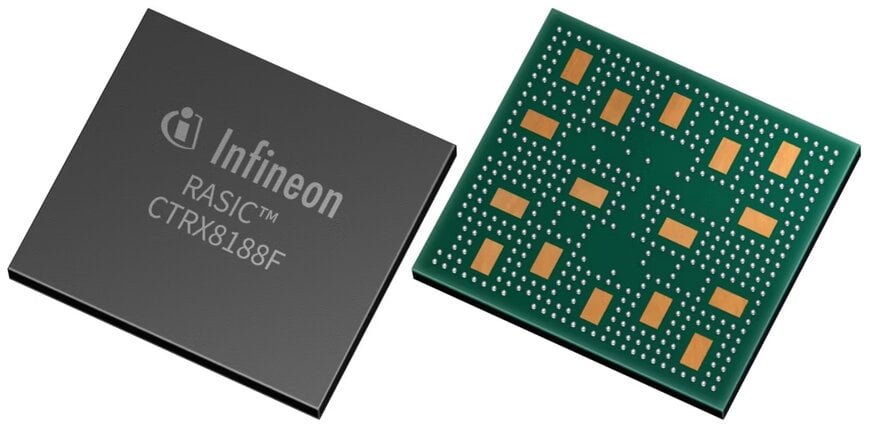
Infineon Technologies has initiated mass production of the RASIC CTRX8188F, a next-generation 8Tx8Rx radar transceiver designed for automotive 4D and high-definition (HD) imaging radar systems. The Monolithic Microwave Integrated Circuit (MMIC) is engineered to support the shift toward centralized radar architectures, where raw sensor data is routed directly to a central vehicle compute platform for Advanced Driver Assistance Systems (ADAS) and autonomous driving applications.
Sensor Capabilities and Scalable Architecture
Fabricated using second-generation CMOS technology, the CTRX8188F transceiver enables high-resolution target detection, allowing the system to identify vulnerable road users at distances up to 400 meters. The silicon architecture supports cascading configurations exceeding 32Tx32Rx channels, providing hardware scalability to address the full spectrum of imaging radar tiers, from entry-level ADAS to high-end automated driving platforms. By facilitating centralized processing, the sensor bypasses local edge-processing limitations, transmitting raw radar data to major automotive Systems-on-Chip (SoCs) via a highly configurable MIPI CSI-2 interface. This interface ensures broad compatibility with existing SerDes (Serializer/Deserializer) and asymmetric Ethernet communication protocols.
Edge Processing and Regulatory Prototyping
While optimized for centralized data aggregation, the MMIC also maintains support for traditional edge processing architectures when paired with microcontrollers such as the AURIX TC45. To streamline integration and shorten development timelines, the hardware is supported by the CARKIT development platform, which provides evaluation modules and software for rapid system prototyping. Furthermore, the RF performance parameters comply with the Chinese Level 2 ADAS GB regulation ("Safety Requirements for Combined Driver Assistance Systems in Intelligent and Connected Vehicles"), accommodating stringent signal-to-noise ratio requirements for global Level 2+ deployments.
Additional Context: This section details technical specifications not included in the original announcement
In automotive radar engineering, the transition to 8Tx8Rx (8 transmitters, 8 receivers) Multiple-Input Multiple-Output (MIMO) architectures exponentially increases the virtual antenna array compared to standard 3Tx4Rx systems. A single 8Tx8Rx MMIC generates 64 virtual channels, drastically improving the angular resolution required to distinguish between closely spaced objects (such as a pedestrian standing next to a parked vehicle). Furthermore, traditional "edge-processed" radar modules compute target tracks (point clouds) locally on a dedicated microcontroller before sending low-bandwidth object data via the CAN bus to the vehicle's ECU. Conversely, a "centralized" architecture utilizes the MIPI CSI-2 interface—originally designed for high-speed camera video feeds—to stream uncompressed, raw analog-to-digital (ADC) radar data over high-speed SerDes links. This topology allows a central, high-performance SoC to run advanced machine learning algorithms (such as early sensor fusion with optical cameras) directly on the raw radar data cube, significantly reducing decision latency and system-wide hardware costs.
Edited by Lekshman Ramdas, Induportals editor – adapted by AI.
www.infineon.com
