
electronics-journal.com
30
'26
Written on Modified on
Vacuum Sensor Technology for High-Precision Industrial Measurement Tasks
Micro-Epsilon configures non-contact sensors for measurements in the semiconductor industry, optics, and aviation.
www.micro-epsilon.com
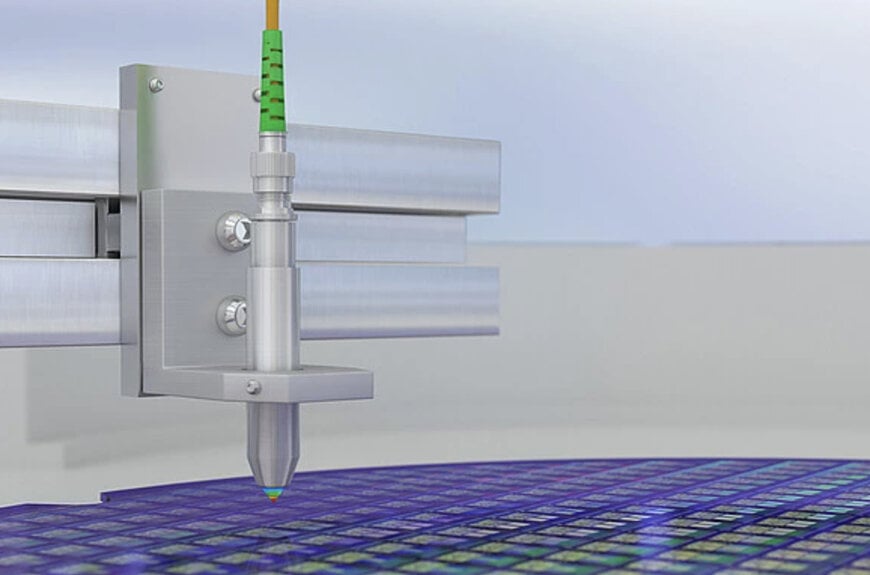
Measurement tasks under vacuum conditions require sensor technologies that operate without performance loss in extreme environments. The non-contact measurement systems from Micro-Epsilon deliver stable data across various vacuum classes. These systems are designed for direct use in a vacuum or for measurements from the outside through vacuum windows by utilizing adapted materials and optimized housing designs. The main application areas of this sensor technology are in semiconductor manufacturing, the optical industry, as well as aerospace engineering.
Technological Diversification by Measurement Principles
The choice of sensor technology depends on the physical requirements of the measurement task. For precise distance measurement in thermally and mechanically demanding processes such as laser welding or additive manufacturing, laser sensors from the optoNCDT series are used. These optical systems capture distances without contact and at high frequencies to monitor geometric deviations in real time within the digital supply chain of manufacturing.
For applications requiring nanometer-level accuracy, confocal sensors from the confocalDT series are utilized. This technology is primarily used for the thickness measurement of wafers in the semiconductor industry or during the inspection of display glass. In addition, absolute interferometers deliver high-precision distance and thickness measurements in wafer lithography, where the phase shift of light is used to determine position.
For environments where optical systems are impaired by dust or gas emissions, alternative physical measurement principles are available. These include eddy current-based inductive sensors from the induSENSOR series for measurement on conductive materials, as well as capacitive sensors from the capaNCDT series for distance and thickness measurement methods with maximum resolution in the sub-nanometer range. Furthermore, magneto-inductive sensors from the mainSENSOR series offer a reliable solution for detecting displacement and position.
Quality Assurance and System Integration in the Cleanroom
All components intended for vacuum use undergo standardized manufacturing and inspection processes to prevent outgassing in the vacuum. A central component of this quality assurance is the regular execution of testing procedures such as TENAX sampling. These tests ensure that the sensors do not emit volatile organic compounds that could contaminate the sensitive processes in semiconductor or optical equipment.
The mechanical design is optimized for a minimal footprint. By integrating the controller directly into the sensor housing or via dedicated vacuum cable gland feeds, installation effort is reduced. Integration into existing machine control systems takes place via standardized, intelligent interfaces that enable direct data transfer to higher-level quality assurance systems.
Additional Context: This section details technical specifications and competitive benchmarking not included in the original product announcement
When integrating sensor technology into the automotive data ecosystem or into highly automated semiconductor production plants, the achievable vacuum level up to an ultra-high vacuum of ten to the power of minus nine millibar and thermal stability determine technological suitability. The sensor solutions from Micro-Epsilon compete directly with specialized measurement systems from manufacturers such as Keyence or the capacitive systems from PI Physik Instrumente.
In direct comparison to capacitive systems from PI, which are traditionally used in the ultra-high vacuum range of semiconductor lithography for positioning mirrors and wafer stages, the confocal and interferometric systems from Micro-Epsilon are characterized by a higher tolerance against tilting of the measurement object. While capacitive sensors must be aligned extremely parallel to the measurement object, confocal sensors tolerate a larger acceptance angle of the reflected light.
A major benchmark in a vacuum is the temperature resistance during the so-called bake-out of the vacuum chamber, where temperatures of over 180 degrees Celsius are reached to remove residual gases. While standard catalogue sensors from Keyence are often optimized for use at atmospheric pressure or at most in a rough vacuum and require dedicated cooling, the UHV special designs of the capacitive and interferometric series from Micro-Epsilon are inherently temperature-resistant due to the absence of internal electronic components in the sensor head and are free of magnetic materials, which qualifies them for use near electron beam sources.
Edited by Maria Brueva, Induportals editor – adapted by AI.
www.micro-epsilon.com
