
electronics-journal.com
15
'26
Written on Modified on
Deploying Digital Infrastructure for Spaceborne Artificial Intelligence Inference
Microchip Technology and Planetek Italia integrated hardware-accelerated machine learning on satellites to process orbital Earth observation data under strict power and radiation constraints.
www.microchip.com
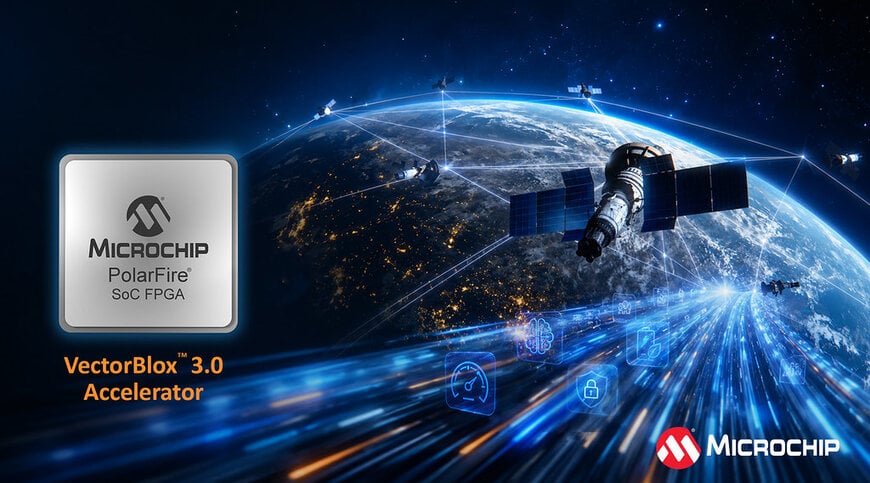
Microchip Technology and Planetek Italia have implemented a low-power edge computing architecture using sparse neural networks to run real-time payload algorithms in orbit. This digital infrastructure targets mission-critical aerospace applications, enabling autonomous processing directly on satellite hardware.
Operational Constraints in Space Environments
Space missions demand high-performance computing to handle multi-sensor payloads, yet onboard systems must operate within extremely restricted power envelopes and survive harsh radiation. Planetek Italia addressed these challenges by executing artificial intelligence algorithms directly on its AI-eXpress-1 satellite, deployed in 2025. This real-time processing required an integrated hardware and software solution capable of executing heavy convolutional neural network models reliably in orbit.
Sparsity-Based Acceleration on PolarFire Platforms
The technical solution pairs Planetek Italia's orbital software pipelines with Microchip's PolarFire System-on-Chip (SoC) Field Programmable Gate Array (FPGA) architecture and the VectorBlox 3.0 Software Development Kit (SDK). Microchip's SDK utilizes sparsity-based model compression, which optimizes neural network deployment by identifying and skipping zero-valued mathematical operations. This mechanism directly reduces the required clock cycles and memory bandwidth, enabling complex models to run with minimal power consumption.
The PolarFire SoC provides the underlying hardware platform. It features single-event-upset immunity and radiation resilience, which are critical for preventing memory corruption caused by cosmic radiation in Low Earth Orbit. Planetek Italia managed the software integration, compiling and deploying its custom Earth observation models via the VectorBlox toolchain.
Orbital Deployments and Spacecraft Navigation
This collaborative architecture was validated on the AI-eXpress-1 satellite. Key workloads included real-time object detection and semantic scene analysis. Additionally, the system supports the Spacecraft Pose Network v2 algorithm, which processes vision data to estimate the relative position and orientation of nearby objects. This capability enables autonomous navigation tasks, including satellite proximity operations, space debris removal, and autonomous docking.
Technical Performance and Reliability Benefits
By executing inference at the orbital edge, the system reduces satellite-to-ground data transmission requirements, generating actionable intelligence directly on the payload. The PolarFire FPGA architecture ensures long-term operational reliability through anti-tamper protection and secure boot mechanisms, while the sparsity-optimized SDK maintains mathematical accuracy while lowering the computational overhead of the neural networks.
Edited by Evgeny Churilov, Induportals Media - Adapted by AI.
www.microchip.com
