
electronics-journal.com
16
'26
Written on Modified on
Synopsys Accelerates Virtual Prototyping for Infineon AURIX RC1 Automotive Microcontrollers
New Virtualizer Development Kit enables automotive teams to build electronics digital twins, validate complex software stacks early, and speed up physical AI deployment.
www.synopsys.com
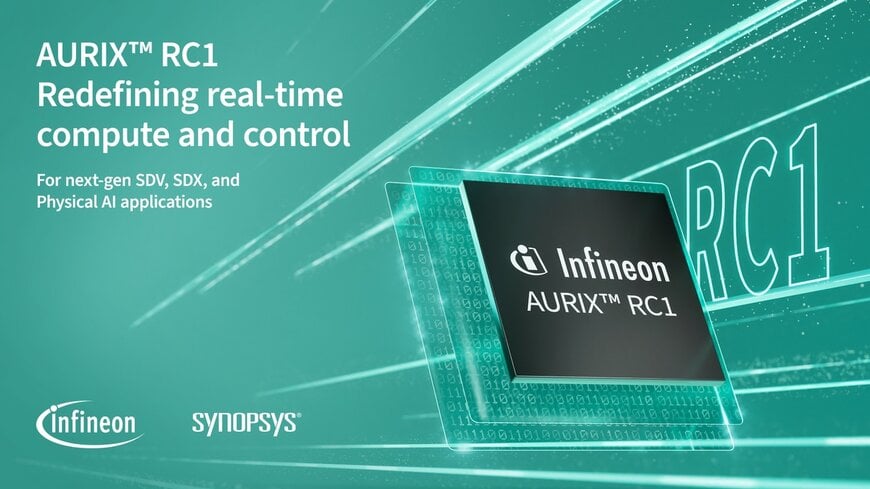
Modern vehicle architectures require automotive engineering teams to manage more than 600 million lines of software code across hundreds of suppliers while compressing development timelines. To decouple software engineering from physical silicon availability in software-defined vehicles and physical artificial intelligence systems, Synopsys and Infineon Technologies have introduced a virtual prototyping solution for the new Infineon AURIX RC1 microcontroller family.
Overcoming Hardware Dependencies in Automotive Software Engineering
As artificial intelligence and centralized computing architectures become central to vehicle functionality, waiting for physical microcontroller silicon creates bottlenecks in the automotive development lifecycle. Large original equipment manufacturers frequently spend hundreds of millions of dollars each year on physical test vehicles, with more than half of that expenditure dedicated to software and electronics testing.
According to Synopsys analysis from its 2025 Automotive Executive Guide, virtualizing vehicle electronics for design, integration, and testing can reduce these hardware-related development costs by 20 to 60 percent. By shifting software integration earlier in the engineering workflow — a methodology known as shifting left — engineering teams can detect architectural conflicts before physical prototypes are manufactured.
Architecture and Virtual Prototyping Workflow
The Synopsys Virtualizer Development Kit (VDK) provides a software-based virtual prototype of the Infineon AURIX RC1 microcontroller, a scalable multicore real-time cluster computing platform based on an open RISC-V instruction set architecture. Rather than relying on physical evaluation boards, developers execute target binary code directly on a functional simulation model of the microcontroller.
The RC1 VDK integrates into the Infineon DRIVECORE software portfolio, allowing compiler, debugger, AUTOSAR, and open-source ecosystem partners to verify toolchain and middleware compatibility prior to silicon fabrication. Within automotive electronic control unit (ECU) workflows, the virtual model scales from single virtual ECUs to interconnected networks of virtual ECUs and complete electronics digital twins.
Pre-Silicon Validation and Ecosystem Integration
Deploying a virtual prototype of the AURIX RC1 architecture addresses three primary engineering requirements across the automotive supply chain:
Early Architecture Evaluation: Tier 1 suppliers and automotive manufacturers can benchmark workloads and make platform-selection decisions before physical silicon samples arrive.
Accelerated Software Bring-Up: Engineering teams can integrate the virtual microcontroller into next-generation ECU software stacks and achieve up to 90 percent software validation ahead of physical system availability, reducing integration defects during hardware-in-the-loop and vehicle testing.
Open RISC-V Ecosystem Enablement: Because the AURIX RC1 transitions to an open RISC-V architecture, early access to a validated virtual model ensures that third-party operating systems, safety libraries, and development tools are ready at silicon launch.
Thomas Schneid, vice president of Software and Ecosystem Management at Infineon, noted that the AURIX RC1 introduces an open architecture based on RISC-V supported by a holistic ecosystem of software, tools, and services designed to simplify migration and preserve existing customer investments.
Marc Serughetti, vice president of Product Management at Synopsys, stated that the decade-long collaboration between the two companies enables automotive OEMs and Tier 1 suppliers to scale system validation from individual virtual ECUs to full electronics digital twins across the vehicle electronics architecture.
Additional Context
This section details technical specifications and competitive benchmarking not included in the original product announcement.
The introduction of the AURIX RC1 marks a notable architectural shift for Infineon, whose previous AURIX TC2xx, TC3xx, and TC4xx microcontroller generations relied on the proprietary TriCore processor architecture. Adopting an open RISC-V architecture aligns with broader automotive industry efforts to standardize instruction sets, reduce single-vendor lock-in, and foster open-source software collaboration in safety-critical real-time domains.
In automotive functional safety and real-time control, virtual prototyping platforms like Synopsys Virtualizer operate alongside established industry standards such as ISO 26262 for road vehicle functional safety and the AUTOSAR Classic and Adaptive platforms. Virtual ECUs are standardized across the industry using interfaces such as the Functional Mock-up Interface (FMI) and IEEE 1666 SystemC TLM-2.0 (Transaction-Level Modeling), which allow fast, instruction-accurate or cycle-approximate simulation models to connect with plant models and vehicle bus simulations.
Comparable virtual prototyping environments in the automotive semiconductor sector include Arm Virtual Hardware, Cadence Helium Virtual and Hybrid Studio, and ETAS virtual ECU solutions. While hardware-in-the-loop (HIL) test benches remain mandatory for final electrical and physical timing verification, pre-silicon virtual prototypes operate at higher simulation speeds than register-transfer-level (RTL) emulation and enable continuous integration and automated regression testing in cloud environments without physical hardware constraints.
Edited by Evgeny Churilov, Induportals Media - Adapted by AI.
www.synopsys.com
