
electronics-journal.com
13
'26
Written on Modified on
Electronics digital twins support software-defined system development
Synopsys presents a cloud-enabled development platform for virtual validation of automotive and physical AI systems within complex semiconductor and software ecosystems.
www.synopsys.com
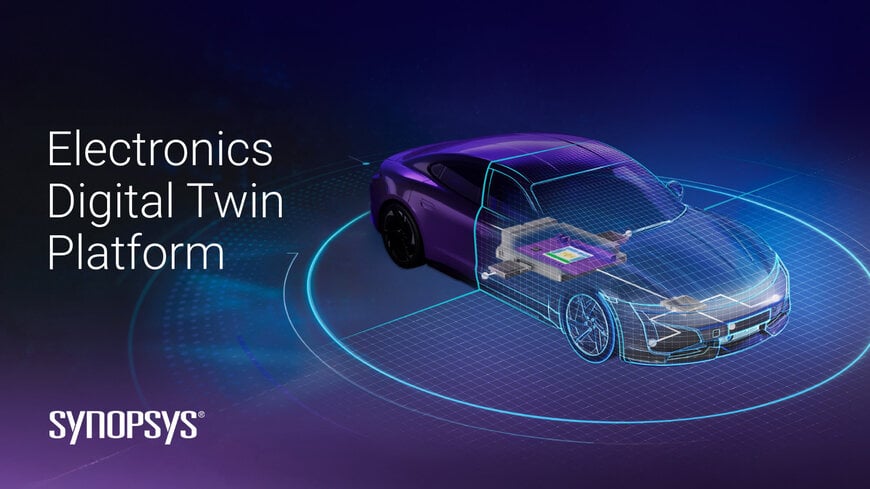
Electronics digital twins are increasingly used to support early software validation and system integration in software-defined products. In this context, Synopsys, Inc. introduced its Electronics Digital Twin (eDT) platform to support development workflows for automotive electronics and physical AI systems.
Virtual validation addressing software complexity in automotive systems
The platform targets industries such as automotive electronics, semiconductor design, and AI infrastructure, where development increasingly depends on tight integration between silicon, software, and system validation. Automotive programmes can involve more than 600 million lines of code, multiple software suppliers, and compressed development timelines, increasing the need for earlier validation processes.
The Electronics Digital Twin platform is designed to support software-defined development processes through a shift-left methodology, allowing software development and validation to begin before physical hardware is available. For automotive OEMs, this enables validation of up to 90 percent of vehicle software prior to hardware availability, supporting earlier detection of integration issues and reducing reliance on physical prototypes.
This approach supports development models aligned with the automotive data ecosystem, where continuous software updates and lifecycle management are becoming standard engineering requirements.
Cloud-based development environments for distributed engineering teams
The platform enables the creation of cloud-based Electronics Digital Twin environments referred to as eDT Labs. These environments combine Synopsys tools, ecosystem partner technologies, virtual silicon models, software stacks, and scalable compute resources.
Typical engineering use cases include early evaluation of systems-on-chip and microcontrollers through virtual prototypes, enabling architecture selection before silicon availability. Preconfigured toolchains also allow software teams to begin development earlier in the project cycle, while shared environments support collaboration between OEMs, Tier suppliers, and tool providers.
Integration with continuous integration and continuous testing workflows allows engineering teams to automate validation processes and improve software quality through repeatable testing procedures.
Platform components for building and operating digital twin environments
The eDT platform integrates virtualization technologies, AI-enabled development tools, debugging and testing environments, and reference architectures for building electronics digital twins. System integration is supported through the open-source SIL Kit framework from Vector and Synopsys, enabling communication between virtual electronic control units, simulation models, and software components.
The ecosystem also includes partner technologies covering silicon models, simulation tools, debugging environments, analysis platforms, and software IP.
Operational features include role-based access management, encrypted access, administrative monitoring tools, license management, and workflow orchestration. Interfaces include graphical environments, command-line interfaces, and test APIs for integration into software factory environments and digital supply chain workflows.
Flexible compute deployment models for large-scale simulations
The platform supports deployment through software-as-a-service environments or customer-managed cloud infrastructure. When deployed on AWS infrastructure using AWS Graviton4 processors, the platform provides computing capacity intended for large-scale automotive software validation and virtual vehicle testing workloads.
The platform also supports Arm-based virtual development environments through integration with Arm Zena CSS in Synopsys Virtualizer, enabling hardware-aligned virtualization with instruction set architecture compatibility and binary software portability for early validation of production software stacks.
The combined platform approach reflects the broader transition from hardware-centric validation to virtual-first engineering workflows, particularly in automotive and physical AI development where software complexity and system integration requirements continue to increase.
www.synopsys.com
Edited by industrial journalist, Aishwarya Mambet — AI-powered.
