
electronics-journal.com
12
'26
Written on Modified on
Four-Channel PXI Waveform Generators Raise Test Stimulus Density
Pickering Interfaces’ PXI and PXIe arbitrary waveform generator family targets avionics, engine control and sensor simulation testing where chassis space limits stimulus channels.
www.pickeringtest.com
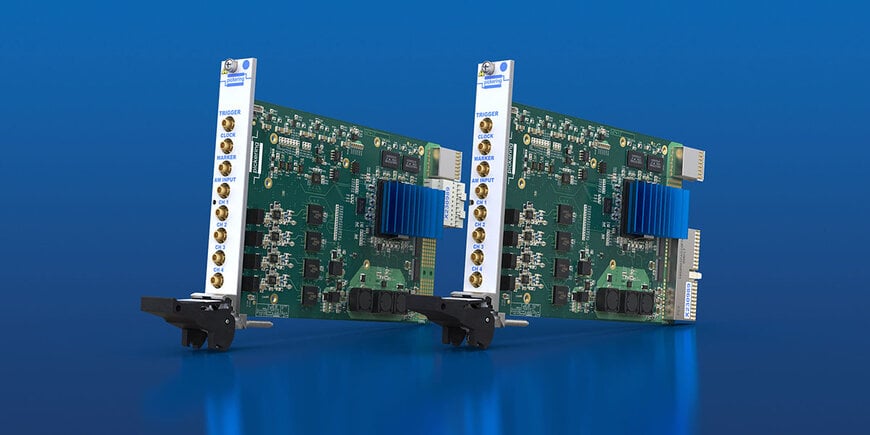
Pickering Interfaces has introduced the 41-621 PXI and 43-621 PXIe arbitrary waveform generators. Two- and four-channel modules fit into a single 3U slot and provide synchronized stimulus generation for avionics functional test, full authority digital engine control (FADEC) testing, multi-channel sensor simulation and upgrades of legacy automated test equipment (ATE). The family was presented at electronica 2026, held 10–13 November at Messe München in Munich, Germany.
Channel Density in Modular Test Systems
In aerospace and automotive test, the number of stimulus channels often decides how big and how expensive a test system becomes. FADEC and avionics test benches must reproduce many sensor signals at once, and every extra slot adds to the chassis size, cost and wiring. Pickering states that the four-channel version provides the highest channel density for PXI/PXIe arbitrary waveform generators operating above 20 MHz. It offers twice as many channels per slot as comparable two-channel modules. The company estimates that the four-channel version costs about 40% less per channel than competing solutions.
Signal Generation Architecture
Each channel uses a 16-bit digital-to-analog converter running at up to 250 MSamples/s, with 128 MSamples of onboard waveform memory. Outputs reach up to 20 Vpp into a high-impedance load. That voltage range lets the modules drive many sensor inputs directly, without external amplification. Sine waves are generated up to 40 MHz. Standard and user-defined arbitrary waveforms are supported, so engineers can reproduce complex sensor signals such as resolver, position or vibration profiles.
Built-in modulation and sweep functions include AM, FM, chirp, frequency-shift and phase-shift keying, pulse-width modulation and frequency sweeps. Channels can be synchronized and phase-aligned within one module and across several modules. Coordinated multi-channel stimulus of this kind is needed when testing control units that process related signals, such as multiple engine sensors.
Product Line Manager Tom Sarfi described the design goal: "Engineers need to reproduce increasingly complex signals while keeping test systems compact, affordable and supportable."
Platform Options and Software Integration
Both two- and four-channel versions come in PXI and PXIe formats. The PXI models also work in Pickering's LXI and LXI/USB modular chassis, so they can be controlled over Ethernet or USB without a PXI controller. Software support covers LabVIEW, Python and C#. A soft front panel lets users configure common waveforms, import custom waveforms and set up sweeps.
Lifecycle Support for Legacy ATE Upgrades
Defense and aerospace test systems often stay in service for decades, so product availability is a key selection factor. The modules come with a three-year warranty, and Pickering says its long-term support typically runs 15–20 years or more. This makes the modules suitable for replacing obsolete stimulus instruments in existing ATE.
Additional Context
This section details technical specifications and competitive benchmarking not included in the original news release.
A widely used comparison point in the PXIe format is NI's PXIe-5433, a 16-bit waveform generator available with one or two channels. It offers 80 MHz bandwidth, sample rates up to 800 MS/s and 512 MB of onboard memory per module. For a single channel, the NI module provides higher bandwidth and sample rate. Pickering's four-channel module provides twice the channel count per slot, at 250 MSamples/s and a 40 MHz sine output range. The trade-off is between signal bandwidth and channel density. Applications such as FADEC and multi-sensor simulation, which need many synchronized low-to-mid-frequency channels, benefit from higher density. RF-adjacent or high-speed digital stimulus work favors higher-bandwidth instruments.
Edited by Aishwarya Mambet, Induportals Editor, with AI assistance.
www.pickeringtest.com
