
electronics-journal.com
09
'26
Written on Modified on
STMicroelectronics Expands Industrial IoT Capabilities with Advanced SIM and Zephyr
ST87M01 modules introduce SoftSIM integration, factory-level SGP.32 remote profile provisioning, and open-source Zephyr compatibility to simplify supply chains and streamline development for industrial IoT applications.
www.st.com
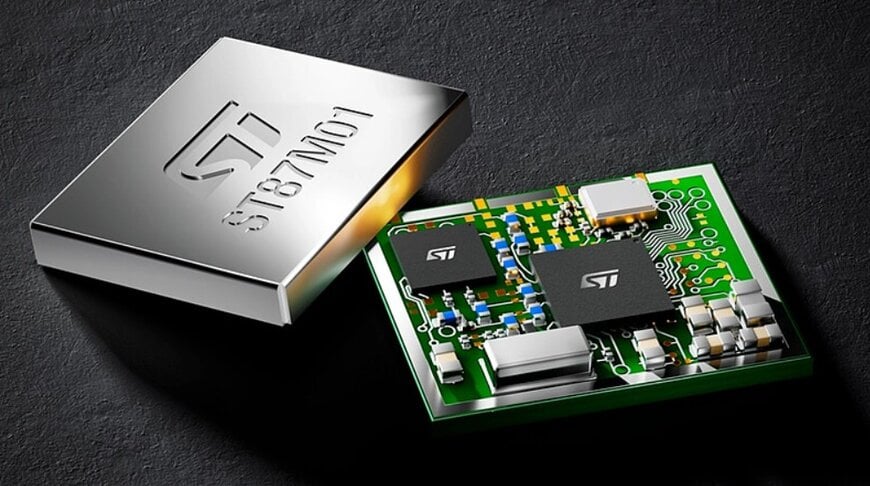
Global deployments of massive Internet of Things infrastructure frequently confront severe logistics and engineering hurdles when managing physical Subscriber Identity Module hardware across diverse regional carriers. In industrial automation, smart grid monitoring, and municipal utility infrastructure, the mechanical footprint, assembly cost, and localized inventory demands of conventional SIM cards restrict hardware scalability and accelerate battery degradation.
To resolve these field provisioning constraints, STMicroelectronics has expanded the architectural capabilities of its ST87M01 industrial cellular module series by integrating software-defined SIM technology, standardized factory profile loading, and open-source operating system compatibility.
Embedded Processing Architecture Eliminates Physical SIM Hardware
Managing dedicated hardware SIM components or separate soldered cryptographic chips introduces supply chain fragmentation when manufacturing hardware for worldwide distribution. Integrating the Onomondo SoftSIM solution directly within the ST87M01 processing subsystem removes the requirement for discrete SIM hardware, dedicated slots, or external SIM controllers.
By executing SIM functionality within the local processing core as firmware, the architecture lowers hardware procurement bills of materials, avoids contact wear, and eliminates mechanical vulnerabilities in vibrating industrial environments. Removing the physical transceiver communication layer associated with external SIM chips directly reduces overall power consumption, extending operating lifetimes in unpowered, battery-dependent monitoring nodes.
Standardized In-Factory Cellular Provisioning via SGP.32
Handling multiple regional network operator configurations traditionally forces original equipment manufacturers to stock carrier-specific hardware variants or rely on complex legacy provisioning schemes. Leveraging the GSMA SGP.32 specification, the ST87M01 series enables equipment manufacturers to perform in-factory profile provisioning directly on assembly lines.
Production facilities can flash mobile network operator profiles over the air during testing stages rather than managing regional Stock Keeping Units. Because the SGP.32 standard covers both initial production-line provisioning and ongoing operational lifecycle management, field engineers can switch network operators remotely across an operational lifespan without architectural reconfiguration. At the Enlit exhibition, STMicroelectronics demonstrates these in-factory profile downloads, highlighting how standardized profile workflows eliminate operator-specific hardware inventory.
Open-Source Integration and Protocol Stacks Under Zephyr RTOS
Embedded firmware development often stalls due to proprietary driver stacks that complicate hardware portability and peripheral coordination. Integration of the ST87M01 into the open-source Zephyr real-time operating system ecosystem resolves these integration bottlenecks through public driver repositories.
Available on GitHub, the native Zephyr driver exposes core application-layer networking protocols, including User Datagram Protocol, Transmission Control Protocol, Hypertext Transfer Protocol, Message Queuing Telemetry Transport, and Constrained Application Protocol. The software package also natively handles Global Navigation Satellite System tracking, Wi-Fi location sniffing, and Received Signal Strength Indicator reporting, letting developers implement positioning logic without constructing bespoke peripheral communication layers.
Engineering Specifications and Industrial Certifications
Engineered for ultra-low-power field monitoring, the ST87M01 family complies with 3GPP LTE Cat NB2 Release 15 standards, providing comprehensive global sub-gigahertz and cellular band coverage. The module is housed in a compact 12.8 mm by 10.6 mm Land Grid Array package suited for space-restricted industrial sensors, pipeline monitors, and smart meters.
System variants support integrated GSMA-certified embedded SIM profiles, Assisted-GNSS, Wireless M-Bus for sub-metering telemetry, and Wi-Fi assisted location services. For global operational compliance, the hardware carries regulatory and carrier certifications including Global Certification Forum, European Union Radio Equipment Directive, RED Delegated Act cybersecurity compliance, Federal Communications Commission and Innovation, Science and Economic Development Canada, PTCRB, Anatel, and Icasa.
Massimiliano Brambilla, General Manager of the Multisegment ASIC and Application Specific Division at STMicroelectronics, stated that software-based connectivity and SIM management expand the family to address next-generation IoT demands, while Zephyr framework integration makes the module accessible across the embedded open-source ecosystem.
Additional Context
This section details technical specifications and competitive benchmarking not included in the original product announcement.
The transition toward the GSMA SGP.32 standard marks a definitive technical evolution from earlier SGP.02 machine-to-machine specifications. The older SGP.02 model relied on centralized Subscription Manager Secure Routing servers and complex SMS-driven triggers that proved inefficient and bandwidth-intensive for constrained LPWAN devices operating on low-throughput NB-IoT channels. In contrast, SGP.32 delegates profile retrieval orchestration directly to an IoT Profile Assistant running locally on the device or cellular module, drastically reducing handshake overhead and network transport demands.
Within the industrial LPWAN module sector, competitive benchmarks include the Nordic Semiconductor nRF9160 and nRF9151 architectures, the Quectel BC660K-GL, and the Telit Cinterion ME910 series. While several competing LPWAN platforms support conventional embedded SIM chips (MFF2 form factor) or proprietary soft-SIM layers, the integration of native SGP.32 support directly alongside a 3GPP Release 15 modem core in an LGA package under 140 square millimeters remains an emerging benchmark.
Moreover, official inclusion in the mainline Zephyr Project driver ecosystem provides distinct build-system advantages over proprietary RTOS platforms, allowing deterministic scheduling, modular networking stacks, and straightforward compliance with European RED-DA product cybersecurity mandates.
Edited by Evgeny Churilov, Induportals Media - Adapted by AI.
www.st.com
