
electronics-journal.com
06
'26
Written on Modified on
Linkpower Licenses Ceva Bluetooth Low Energy IP for Industrial Microcontrollers
The expanded partnership builds on automotive success to deliver ultra-low-power, reliable wireless connectivity solutions for next-generation industrial automation, asset tracking, and smart equipment.
www.ceva-ip.com
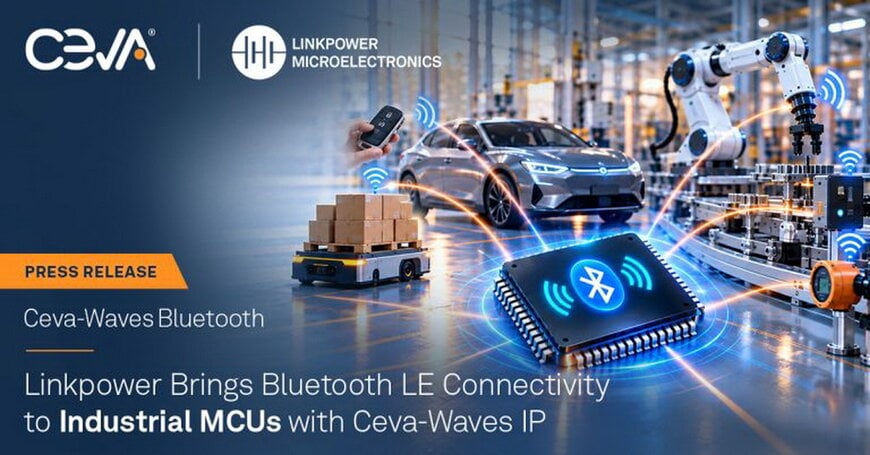
Ceva and Wuxi Linkpower Microelectronics expanded their semiconductor licensing agreement to integrate standards-based Bluetooth Low Energy silicon intellectual property into next-generation industrial microcontrollers. This partnership targets the operational shift from wired architectures to wireless field communications across industrial automation, distributed sensor arrays, asset tracking networks, and connected plant equipment.
Industrial Operational Requirements
Industrial field installations require continuous signal integrity under harsh electromagnetic conditions while maintaining minimal energy footprints. Transitioning remote monitoring nodes and field instruments to battery-operated or energy-harvested topologies demands microcontrollers that limit peak current draw without compromising link stability. Developing custom RF and baseband processing subsystems internally increases silicon tape-out cycles, protocol certification risks, and total integration complexity for semiconductor manufacturers.
Technical Division and System Architecture
Under the agreement, Ceva supplies the Ceva-Waves Bluetooth Low Energy intellectual property blocks, encompassing the physical layer modem, baseband controller, and protocol stack. Linkpower integrates this proven IP directly into its microcontroller silicon architectures, managing full SoC fabrication, peripheral logic implementation, and package-level thermal and electrical validation.
The integrated BLE IP operates compliant with Bluetooth SIG standards, delivering deterministic connection intervals, ultra-low power consumption profiles during sleep and active states, and a compact silicon footprint. This layered baseband and software structure handles real-time packet scheduling, enabling the host processor cores within Linkpower microcontrollers to focus compute capacity on local sensor analytics and control loops.
Deployment and Functional Use Cases
The resulting microcontroller lines scale Linkpower's commercial connectivity portfolio from its established automotive digital key platform, the L651, into high-reliability manufacturing sectors. The industrial MCUs are engineered for immediate deployment within machine monitoring units, automated material-handling gateways, and process telemetry nodes.
Integrating pre-validated wireless IP eliminates board-level RF component count, directly lowering system bill-of-materials costs and improving physical resistance to mechanical vibration and environmental interference. Standardized wireless interfaces simplify retrofit integration into established factory networks without rewiring physical infrastructure.
Operational Impact
"Linkpower Microelectronics is focused on bringing Bluetooth Low Energy connectivity to industrial devices where power efficiency, reliability, and cost are critical," stated Bruce Ye, CEO of Linkpower Microelectronics. "Expanding our collaboration with Ceva allows us to utilize their IP as we develop our next generation of connected industrial MCUs."
"Our Bluetooth IP portfolio combines ultra-low-power operation, a compact silicon footprint, and proven interoperability, giving customers the flexibility to develop wireless solutions while reducing development complexity and time to market," stated Tal Shalev, Vice President and General Manager of the Wireless IoT Business Unit at Ceva.
The collaboration reduces validation overhead for industrial edge nodes, ensuring compliant RF links and extending maintenance cycles across autonomous industrial control systems.
Edited by Evgeny Churilov, Induportals Media - Adapted by AI.
www.ceva-ip.com
