
electronics-journal.com
02
'26
Written on Modified on
TDK launches EDC programmable DC-DC power supplies
The scalable 1.5 kW and 3 kW units streamline DC-grid architectures for renewables and data centers.
www.tdk.com
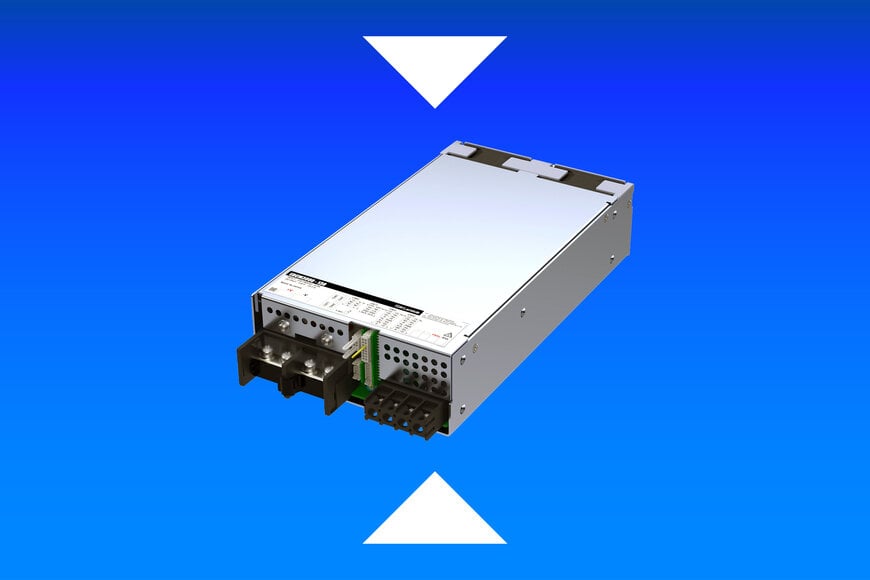
TDK Corporation has introduced the TDK-Lambda EDC series, a new line of programmable DC-DC power supplies engineered to support the rapid expansion of emerging DC-grid architectures. Available in 1.5 kW and 3 kW models, the compact series facilitates direct DC-to-DC connections, eliminating the costly and complex DC-to-AC-to-DC conversion stages traditionally required in distributed power networks. By streamlining this power flow, the EDC series is ideally suited for modern applications driven by renewable energy and battery storage, including solid oxide fuel cell systems, hydrogen generators, and high-power electric vehicle chargers.
Highly scalable architecture and smart diagnostics
To accommodate demanding industrial load requirements, the EDC units offer extensive physical scalability; engineers can connect up to three units in series or up to ten units in parallel. A built-in leader/follower functionality allows this cluster of power supplies to operate seamlessly as a single, coordinated high-power system. Furthermore, the inclusion of RS-485 (Modbus RTU) communication enables the remote monitoring of critical telemetry—such as operating hours, alarm histories, and fault diagnostics—facilitating predictive maintenance in large multi-unit installations. For integration flexibility, the power supplies feature fully programmable constant-voltage (CV) and constant-current (CC) control, alongside legacy analog programming interfaces (1–5 V and 4–20 mA).
Additional Context: DC microgrid efficiency and CC/CV charging topologies
This section details power conversion physics and electrochemical load management not included in the original press release.
In traditional AC-grid infrastructures, integrating renewable energy involves significant inefficiencies. Solar panels and battery energy storage systems (BESS) natively generate and store Direct Current (DC). To distribute this power, it must be inverted to Alternating Current (AC), only to be rectified back to DC at the end-use point, such as a data center server rack or an EV charger. Each conversion stage incurs switching and conduction losses, often dissipating 5% to 10% of the total energy as heat. Emerging DC-grid architectures bypass these AC inversion steps entirely, requiring highly efficient, isolated DC-DC converters to step voltages up or down. Furthermore, the ability to strictly regulate both Constant Current (CC) and Constant Voltage (CV) is critical for electrochemical loads. For example, in green hydrogen generation, an electrolyzer stack requires precise CC control to maintain a stable chemical reaction rate and gas output. Conversely, charging a massive lithium-ion battery bank requires a dynamic CC/CV profile: the system delivers a constant bulk current until the battery reaches its peak voltage threshold, at which point it automatically switches to CV mode, tapering the current down to safely top off the cells without causing thermal runaway.
Edited by an industrial journalist, Lekshman Ramdas, with AI assistance.
www.tdk.com
