
electronics-journal.com
14
'26
Written on Modified on
Dual-Range MEMS Pressure Sensor for Altitude and Depth Measurement
STMicroelectronics introduces a compact piezoresistive sensor designed to streamline circuitry in wearable electronics by combining atmospheric and deep-water pressure monitoring.
www.st.com
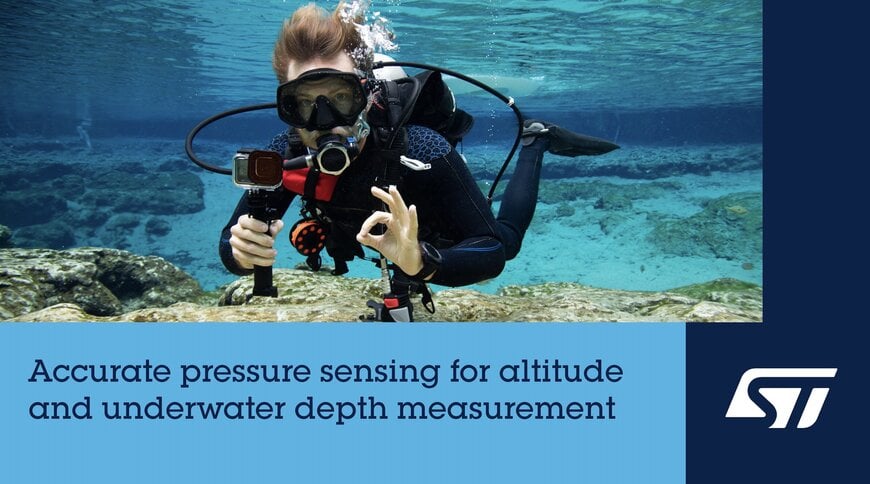
STMicroelectronics is releasing the LPS27DEWO, a dual-scale micro-electromechanical systems (MEMS) pressure sensor that integrates altitude and underwater depth tracking into a single component. This hardware is engineered to reduce printed circuit board space and lower bill-of-materials costs for manufacturers developing outdoor equipment, sports cameras, smart rings, and smartwatches.
Technical Architecture and Wearable Electronics Integration
The LPS27DEWO provides two selectable full scales within a single module, eliminating the need for separate barometric and hydrostatic sensors in consumer electronics. The component features a 2.7mm by 2.7mm 10-lead Land Grid Array (LGA) footprint and is enclosed in a 1.7mm-high cylindrical metal lid. This specific package geometry is designed to facilitate O-ring sealing integration while maintaining high overpressure resistance in constrained spaces like smart rings. To maintain measurement stability in variable environments, the module utilizes a specialized black potting gel. This compound prevents photons from penetrating the sensor cavity, thereby eliminating light-induced measurement errors that frequently affect sensitive semiconductor junctions under direct sunlight or intense illumination.
Performance Metrics in Underwater and Atmospheric Environments
In aquatic environments, the sensor supports an extended pressure range of 6060 hPa, which corresponds to accurate depth readings at approximately 50 meters. This measurement capacity allows the device to supply precise depth and pressure data for recreational divers ascending from 40 meters, which serves as the critical threshold for tracking decompression stops. For environmental durability, the sensor maintains structural integrity when exposed to water pressure equivalents of 110 meters. By minimizing signal noise in the primary sensing element, the architecture achieves an accuracy of ±0.5% at full-scale, ensuring dependable elevation calculations in terrestrial settings and precise hydrostatic pressure readings underwater.
Additional Context
This section details technical specifications and competitive benchmarking not included in the original news release.
Within the wearable electronics and dive computing markets, the LPS27DEWO competes with established hydrostatic pressure sensors such as the TE Connectivity MS5837-30BA. While the MS5837-30BA is standard in dedicated dive computers and underwater robotics due to its extreme 30-bar (approx. 300 meters) operational range, it features a larger 3.3mm by 3.3mm by 2.75mm footprint. The STMicroelectronics component sacrifices this extreme depth capacity in favor of substantial miniaturization (2.7mm by 2.7mm by 1.7mm) and dual-use atmospheric profiling. This makes the LPS27DEWO highly optimized for everyday consumer wearables that require shallow-water dive tracking (up to 50 meters) without the spatial penalty of a dedicated industrial marine sensor. Furthermore, while companies like Bosch Sensortec dominate the ultra-compact barometric altitude sensor market (e.g., BMP388/BMP581), those atmospheric sensors lack the water-resistant potting and cylindrical metal lids required for hydrostatic depth measurements, highlighting the distinct dual-environment niche of the LPS27DEWO.
Edited by Aishwarya Mambet, Induportals Editor, with AI assistance.
www.st.com
