
electronics-journal.com
14
'26
Written on Modified on
Compact Low-Voltage eFuse ICs
Toshiba Electronic Devices and Storage Corporation introduces the TCKE5 Series of low-voltage eFuse ICs, protecting compact industrial rails and portable electronics from overcurrent and short-circuit faults.
www.global.toshiba
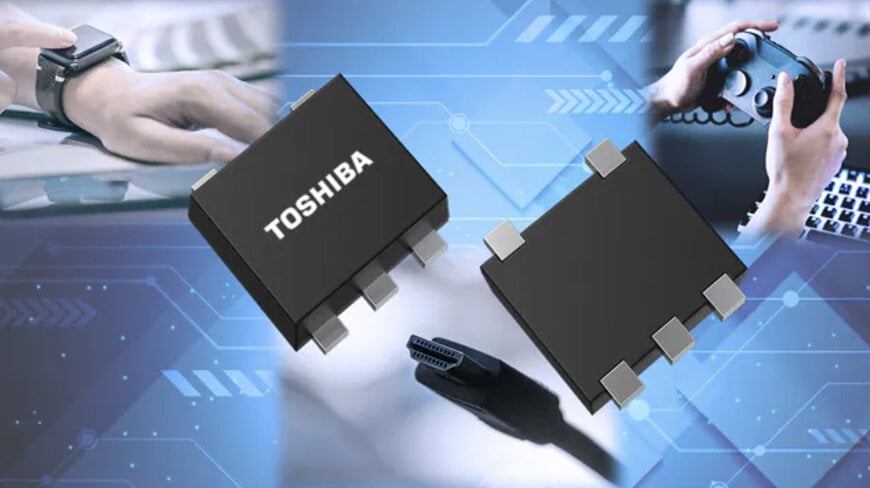
Modern portable electronics, IoT hardware, and wearable devices increasingly rely on low-voltage power distribution rails, such as 1.8V architectures, to minimize power consumption and extend operational longevity. However, protecting these low-voltage lines from overcurrent and short-circuit faults presents a persistent engineering challenge because traditional physical fuses lack adaptability and struggle to meet the space-constrained demands of high-density printed circuit board layouts.
To address this component-level vulnerability, Toshiba Electronic Devices and Storage Corporation launched the TCKE5 Series, a lineup of four electronic fuse ICs engineered to support low-voltage input ranges from 1.7V to 5.5V. Comprising the TCKE501UA, TCKE501UL, TCKE502UA, and TCKE502UL, this series delivers integrated power line protection for space-sensitive applications like SD memory cards, portable consumer electronics, and industrial edge sensors. Shipments for the new lineup commenced on October 13, 2026.
Operating Principles and System Architecture
The TCKE5 series functions as an active electronic protection circuit designed to replace or supplement conventional physical fuses, such as glass tube or chip current fuses. The architecture operates across a wide input voltage range of 1.7V to 5.5V, marking Toshiba's first eFuse product family optimized for 1.8V power rails.
Overcurrent protection is governed by an adjustable detection threshold, designated as IOCP, which engineers can configure using an external resistor (RILIM) connected to the device. When a fault condition causes current to exceed this threshold, the integrated control circuit cuts off the output. To eliminate nuisance tripping caused by transient peak currents during standard startup or dynamic load shifts, the system incorporates a typical overcurrent protection mask time (tOCP) of 2.4 milliseconds. For severe short-circuit events, a fast-trip comparator operating at a typical threshold (ISHORT) of 2.8A engages a rapid response time of approximately 1.3 microseconds to shut down output current.
Industrial Application Integration
The ICs are housed in a thin, surface-mount SOT-353F (UFV) package measuring 2.0 by 2.1 by 0.7 millimeters, which significantly reduces the required printed circuit board mounting footprint. This mechanical profile allows engineers to implement robust power protection in highly constrained form factors without compromising board real estate.
The series provides distinct configuration options to accommodate diverse system power sequencing and recovery requirements. Designers can select between auto-retry variants, which automatically restore circuit operation after a fault clears, and latch-type variants, which maintain an open state until an external reset signal is applied. Additionally, varied slew-rate options allow precise management of turn-on rise times, which range from 400 microseconds to 1450 microseconds depending on the selected operating voltage and part configuration, helping to control inrush current.
Technical Specifications
The electrical and mechanical parameters of the TCKE5 family are defined under standard test conditions where VIN is 3.3V, RILIM is 13.3 kilohms, RLOAD is 100 ohms, CIN and COUT are 1 microfarad, and Ta is 25 degrees Celsius. The input voltage operating range spans from 1.7V to 5.5V, with an absolute maximum input voltage rating of -0.3V to 6.0V. The operating junction temperature ranges from -40 degrees Celsius to 125 degrees Celsius. Continuous output current is rated from 0 to 1.0A for direct current, with pulse ratings up to 2.0A. On-resistance typically measures 75 milliohms with a maximum of 100 milliohms across the full input voltage range at a 1.0A load. The overcurrent threshold spans from a minimum of 0.88A to a maximum of 1.12A when using a 6.8 kilohm resistor. The overcurrent mask time has a typical duration of 2.4 milliseconds, while the short-circuit response time operates at a typical speed of 1.3 microseconds. Package dimensions measure 2.0 by 2.1 by 0.7 millimeters in the SOT-353F outline.
Target applications include power management and circuit protection in USB devices, HDMI interfaces, laptop computers, and gaming consoles.
Additional Context:
This section details technical specifications and competitive benchmarking not included in the original product announcement.
In contemporary power electronics, traditional mechanical fuses and standard polymeric positive temperature coefficient resettable fuses are increasingly inadequate for low-voltage, high-density systems due to slow response times, high resistance at low voltages, and component degradation over repeated trip cycles. Semiconductor-based eFuse ICs like the TCKE5 series overcome these limitations by offering deterministic trip thresholds, adjustable current limits via external resistors, and low, stable on-state resistance.
Compared to larger eFuse options designed for 12V or 18V industrial rails, such as Toshiba's higher-voltage WSON-packaged series, the TCKE5 series fills a critical niche for sub-5V micro-architectures where board height and area are severely restricted. By pushing active electronic fuse protection down into the 1.7V to 5.5V operational window within a micro-sized SOT-353F footprint, the design eliminates the thermal and voltage-drop penalties traditionally associated with discrete protection circuitry on low-voltage rails.
Edited by Sucithra Mani, Induportals editor – adapted by AI.
www.toshiba.com
