
electronics-journal.com
09
'26
Written on Modified on
Xaar at TechBlick 2026
From October 21-22 in Berlin, Germany, Xaar presents high-viscosity fluid-deposition architectures for scalable manufacturing of printed and production electronics.
www.xaar.com
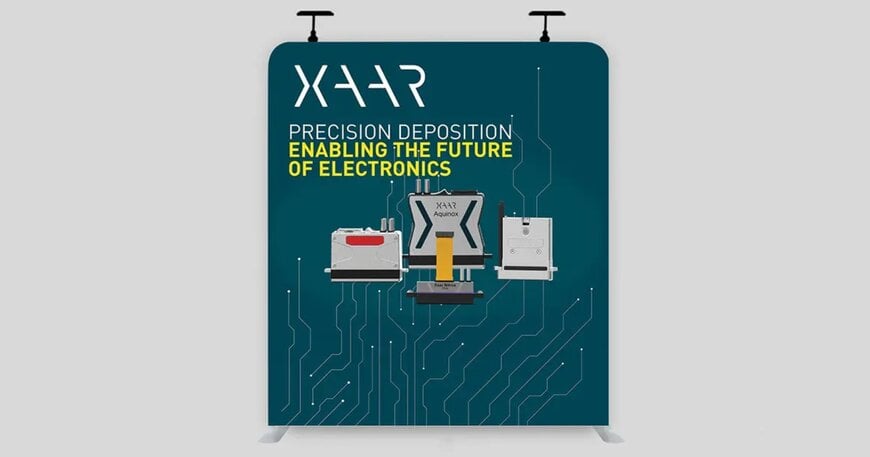
Techblick’s The Future of Electronics RESHAPED 2026, held at the Estrel Convention Center in Berlin, showcases manufacturing solutions across the printed electronics supply chain, where Xaar is demonstrating industrial inkjet deposition for electronic production applications.
Core Technology and System Architecture
The presented system architecture addresses the deposition limits of conventional industrial inkjet systems, which traditionally operate within low-viscosity fluid envelopes. Engineering modifications in printhead architecture and dynamic fluid management enable the jetting of high-viscosity and heavily loaded functional fluids. Controlled recirculation directly behind the nozzle plates prevents particulate sedimentation and stabilizes fluid rheology, allowing consistent droplet ejection across production widths. The integration of high-viscosity fluid management allows manufacturers to deposit functional materials directly onto rigid and flexible substrates without clogging or rheological degradation.
Deployment or Implementation
Implementation occurs at Stand E02, where technical specialists present operational sample components produced through digital inkjet deposition. System integration focuses on embedding drop-on-demand piezo printheads into automated, roll-to-roll and sheet-fed production lines. In addition, an engineering presentation titled "Beyond Low-Viscosity Limits: Rethinking Inkjet for Production Electronics Manufacturing" defines the physical and operational parameters required to transfer inkjet deposition into high-volume electronic fabrication environments.
Industry Applications
Target sectors encompass additive electronics, flexible circuits, hybrid electronics, wearable devices, and smart technical textiles. Specific functional use cases include the direct-to-substrate application of polymer thick films, conductive inks, dielectric barriers, structural adhesives, and protective encapsulation coatings. Replacing subtractive photolithographic processes and contact-based screen printing with digital non-contact deposition eliminates tooling changeover times, minimizes chemical waste, and simplifies the production of complex multi-layer circuitry.
Operational Impact and Performance Metrics
Managing fluid recirculation and nozzle dynamics yields process stability during extended production runs. Jetting fluids with elevated solids loading enables the formation of thicker single-pass deposits, reducing required curing cycles and eliminating secondary processing stages.
"Advances in technology have vastly expanded the possible applications of inkjet in the printed electronics sector. Through intelligent printhead design and fluid management, uniform, repeatable deposition of materials such as polymer thick films, adhesives and protective coatings are now not just possible, but scalable," states Neil Cook, Head of Strategic Marketing at Xaar.
By matching printhead waveform parameters with material rheology, the architecture provides repeatable material deposition, delivering tighter dimensional tolerances and improved layer uniformity required for commercial device scaling.
Edited by Evgeny Churilov, Induportals Media - Adapted by AI.
www.xaar.com
