
electronics-journal.com
22
'26
Written on Modified on
Silicon Photonics Testing with Optoelectronic Network Analysis
MSSCORPS integrates the Anritsu VectorStar ME7848A opto-electronic network analyzer into its MSS HG inspection equipment for accurate, stable silicon photonics device testing.
www.anritsu.com
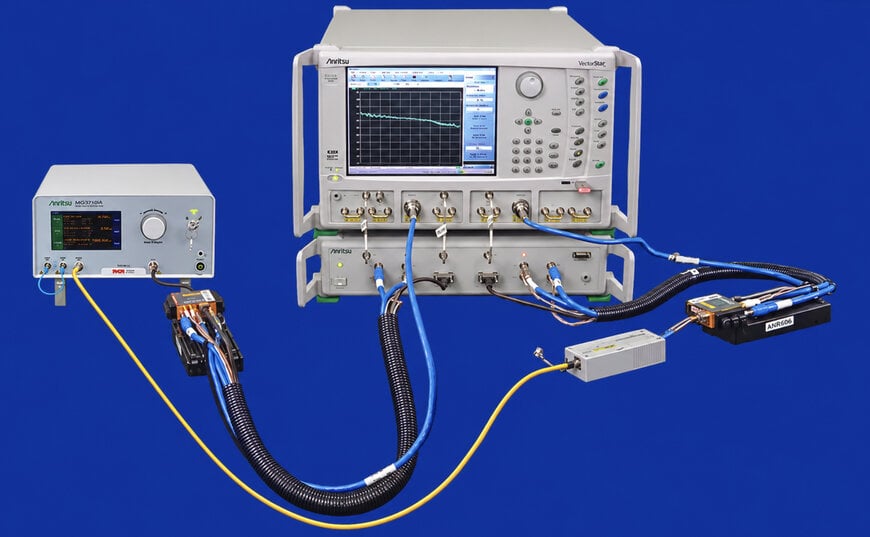
MSSCORPS, a Taiwanese provider of semiconductor materials and failure analysis services, has integrated the VectorStar ME7848A opto-electronic network analyzer (ONA) from Anritsu Corporation into its MSS HG inspection equipment. The cooperation targets silicon photonics testing for semiconductor wafer manufacturers, IC designers and co-packaged optics (CPO) packaging vendors.
Partners and Their Roles
MSSCORPS, founded in 2005 and headquartered in Hsinchu, Taiwan, provides materials analysis, failure analysis and reliability analysis, with laboratories in Zhubei and Tainan as well as facilities in Japan and mainland China. Its equipment development division converts patented analytical techniques into inspection systems such as the MSS HG platform. Anritsu, a Japanese communications test and measurement company, contributes the optoelectronic and high-frequency measurement technology.
Why Silicon Photonics Requires Optoelectronic Measurement
Silicon photonics combines optical and electrical functions on one chip, so devices must be characterised along optical-to-electrical (O/E), electrical-to-optical (E/O) and optical-to-optical (O/O) paths. As data rates in high-speed optical communications and CPO increase, test equipment must measure these conversions accurately at very high frequencies while also locating sources of optical loss. Combining MSSCORPS inspection expertise with an established measurement platform addresses both requirements within one equipment architecture.
How the ONA System Works
The VectorStar ME7848A uses a modular approach to perform O/E, E/O and O/O measurements at wavelengths of 850 nm, 1310 nm and 1550 nm, with rapid switching between measurement modes. Results are referenced to the MN4765B O/E calibration module, which provides full NIST traceability. Measured parameters include responsivity, such as frequency response and conversion efficiency, as well as transfer function, group delay, optical loss, balanced measurements and E/E measurements. The system supports high-frequency configurations at 70 GHz, 110 GHz, 145 GHz and up to 170 GHz.
Integration into the MSS HG Platform
MSSCORPS used the Anritsu technology to carry out technical validation of its MSS HG equipment, verifying that production units achieve the accuracy and stability required for silicon photonics testing. Beyond standard configurations, the MSS HG equipment is set to integrate further optional functions, including ONA, eye diagram analysis and BERT (bit error rate tester), through a flexible architecture. The aim is a single silicon photonics testing platform covering optical-loss localisation and high-speed signal integrity.
"Our selection of Anritsu's technology and platform is based on its leading position in optoelectronic and high-frequency testing. By combining Anritsu's highly stable and scalable test solutions, including ONA and BERT, we can ensure accurate and versatile optical-loss localization with MSS HG equipment," said Gino Liu, Chairman of MSSCORPS.
Applications and Expected Impact
Target users include wafer fabs, IC design houses and CPO packaging vendors that need traceable characterisation of photonic devices. NIST-traceable calibration reduces measurement uncertainty between laboratories, while frequency coverage up to 170 GHz supports the evaluation of next-generation high-speed optical interconnects. Combining ONA, eye diagram and BERT functions in one inspection system can also reduce the number of separate test stations and handling steps during device validation.
Edited by Sucithra Mani, Induportals editor – adapted by AI.
www.anritsu.com
