
electronics-journal.com
23
'26
Written on Modified on
LIN Motor Driver ICs for Automotive Thermal Management
Melexis MLX81352 and MLX81354 fourth-generation LIN motor drivers deliver 1 A drive current for valves, grille shutters and charge-port actuators in vehicles.
www.melexis.com
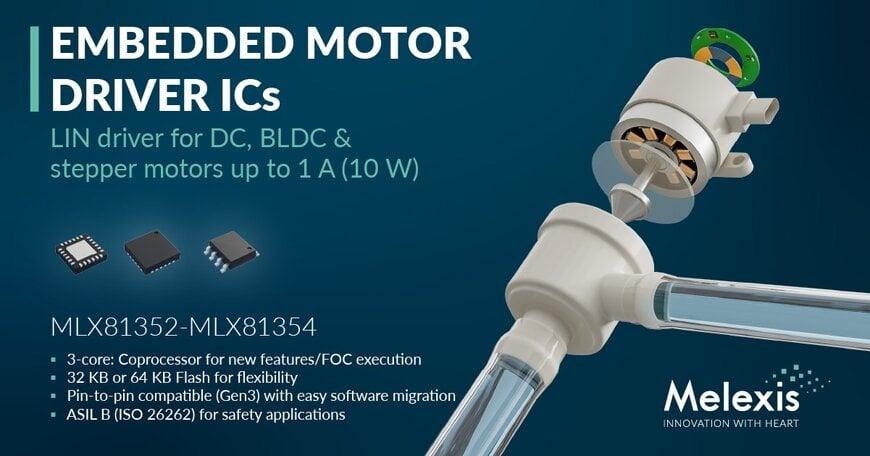
Modern vehicles contain a growing number of small electric actuators, and thermal management is one of the fastest-growing areas. Heat pumps and advanced temperature-control systems in electrified vehicles use several valves and actuators to regulate coolant and refrigerant flow, and each of them needs compact, reliable and low-cost motor control.
Why thermal management needs higher-torque LIN actuators
Valves for coolant and refrigerant circuits, active grille shutters, charge-port flaps and high-end seat fans are typically controlled as LIN slave nodes. Engineers must balance higher motor torque, system integration and automotive reliability against pressure to reduce cost per node. Thermal water valves and expansion valves in particular require more torque than many earlier body-electronics actuators.
Melexis addresses this with the MLX81352 and MLX81354, its fourth generation of automotive LIN motor drivers. Both integrate a motor driver rated at up to 1 A (10 W), allowing a single chip to control higher-power mechatronic actuators.
Memory options and software migration
The MLX81352 integrates 32 KB of Flash memory for applications whose software fits a smaller footprint at a lower price point. The MLX81354 doubles this to 64 KB, leaving room for additional application software and functions. The two devices are pin-compatible, so one hardware design can serve both memory configurations.
Both are also compatible with the previous-generation MLX81332 and MLX81334. Existing application software can be ported with minimal development effort, which shortens the move of established actuator designs to the new platform.
How the integrated architecture works
The devices are built on high-voltage silicon-on-insulator (SOI) technology, which allows analog power stages and digital logic to be combined on one die. A three-core architecture with the MLX16-FX microcontroller and dedicated coprocessor resources runs motor-control software while reducing the need for external components. The integrated LIN interface complies with LIN 2.x, SAE J2602 and ISO 17987-4 for LIN slave nodes.
Peripherals include a configurable 24 MHz to 40 MHz RC clock, eight general-purpose I/Os, one high-voltage input, UART, SPI and I2C master or slave interfaces, five 16-bit motor PWM timers and two 16-bit general-purpose timers. Differential current sensing, temperature monitoring and integrated protection functions support operation in harsh automotive environments.
Qualification and power supply
The MLX81352 and MLX81354 are AEC-Q100 qualified and designed for safety applications according to ASIL B under ISO 26262. Internal voltage regulators allow direct operation from a 12 V battery across a 5.5 V to 28 V operating range. Standby current is typically 25 µA, with a maximum of 50 µA in sleep mode, and the devices can wake up via LIN, external pins or an internal wake-up timer. Low quiescent current matters because many actuator nodes remain connected to the battery while the vehicle is parked.
Marc Lambrechts, Product Line Director at Melexis, said: "The MLX81352/54 allow existing software to be readily ported, while giving customers the flexibility to choose the memory capacity they need."
Additional Context
This section details technical specifications and competitive benchmarking not included in the original product announcement.
LIN, standardised as ISO 17987, is widely used as a low-cost sub-bus for actuators and sensors that do not require the bandwidth of CAN. Integrating the microcontroller, LIN transceiver and motor output stage in one device reduces component count at each actuator node. A common alternative architecture is represented by Infineon's MOTIX TLE987x family, which combines an Arm Cortex-M3 microcontroller with a three-phase bridge driver that controls external MOSFETs. That approach suits higher-current brushless DC drives such as pumps and fans, whereas devices with an integrated 1 A output stage, such as the MLX81352 and MLX81354, target compact actuators where no external power transistors are required.
Edited by Evgeny Churilov, Induportals Media - Adapted by AI.
www.melexis.com
