
electronics-journal.com
05
'26
Written on Modified on
AI-Powered Electronic Design Automation for Custom Semiconductors
Synopsys expands industrial collaborations to integrate foundational models into hardware engineering workflows and optimize complex integrated circuit architectures.
www.synopsys.com
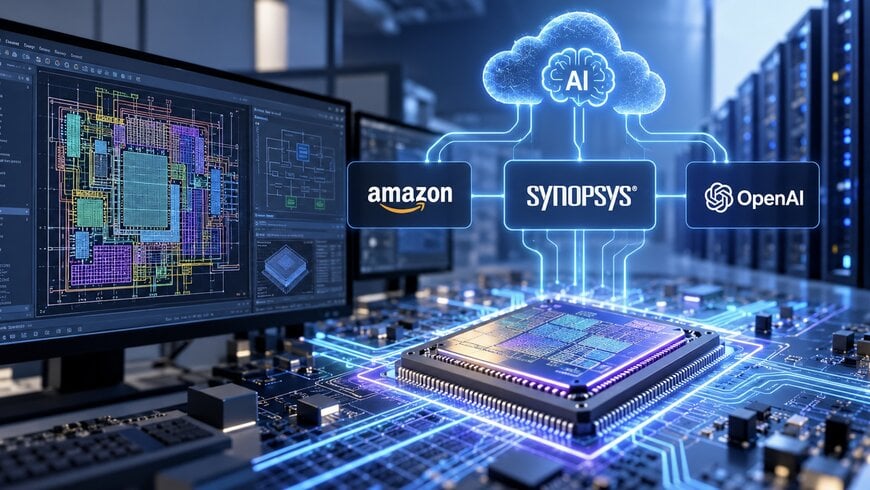
Synopsys has established technical agreements with Amazon and OpenAI to implement agent-based artificial intelligence frameworks within electronic design automation workflows. These integrations target custom silicon engineering for cloud computing infrastructure and advanced logic processors.
Industrial Context and Target Applications
The semiconductor industry requires extensive computational resources to map, simulate, and verify integrated circuits for hyperscale data centers, automotive control units, and industrial automation. As transistor density increases, manual verification and traditional logic simulation create significant operational bottlenecks. Addressing this complexity requires distributed compute infrastructure and specialized algorithmic routing, necessitating multi-partner collaboration. Primary applications for this technology include data center processing, machine learning hardware, and edge computing architectures, where optimized silicon directly improves thermal management and process stability.
System Architecture and Technical Responsibilities
The engineering framework operates on two distinct development tracks. In the first integration, Synopsys and OpenAI are building a domain-specific model tailored for semiconductor design workflows. OpenAI utilizes licensed hardware automation frameworks from Synopsys to structure the model, mapping frontier artificial intelligence capabilities directly to hardware description languages and engineering verification parameters. Both entities share research and go-to-market responsibilities under a joint revenue model.
In the concurrent deployment, Synopsys provisions Amazon with application-optimized semiconductor intellectual property, simulation environments, and structural analysis software. Conversely, Synopsys relies on Amazon Elastic Compute Cloud (Amazon EC2) and Amazon Bedrock to accelerate its internal engineering processes, moving heavy computational workloads onto scalable server nodes.
Infrastructure Integration and Deployment
Deployment involves continuous bilateral integration between software and hardware environments. Synopsys is optimizing its software suites to execute natively on Amazon’s custom Trainium and Graviton processing architectures. By migrating layout routing and logic simulation tasks to a cloud-based framework, hardware engineers gain the ability to distribute verification workloads across thousands of parallel server instances rather than relying on constrained local physical hardware.
Expected Impact and Process Optimization
The Amazon agreement, structured at over one billion US dollars, shifts the operational framework toward volume-based licensing and royalty structures based on production scale. Technically, integrating specialized models into the hardware design cycle introduces measurable throughput improvements, automating the exploration of physical design options and reducing the total cycles required to reach a verified silicon schematic.
"As our chip designs become increasingly sophisticated and AI transforms the engineering process itself, Synopsys helps us accelerate the entire development cycle and deliver more powerful and efficient computing platforms," stated Peter DeSantis, SVP of Foundational AI, Custom Silicon & Quantum Computing at Amazon.
Greg Brockman, President and Co-Founder of OpenAI, noted the operational mechanism of the partnership: "Together with Synopsys, we are transferring this work to chip design, helping engineers explore more design options and get to a working chip faster."
Edited by Aishwarya Mambet, Induportals Editor, with AI assistance.
www.synopsys.com
