
electronics-journal.com
17
'26
Written on Modified on
STMicroelectronics Unveils New Image Sensor for Automotive In-Cabin Monitoring
The 1.1 MP VD56GA sensor lowers system costs for driver and occupant monitoring in high-volume vehicle platforms through enhanced infrared sensitivity.
www.st.com
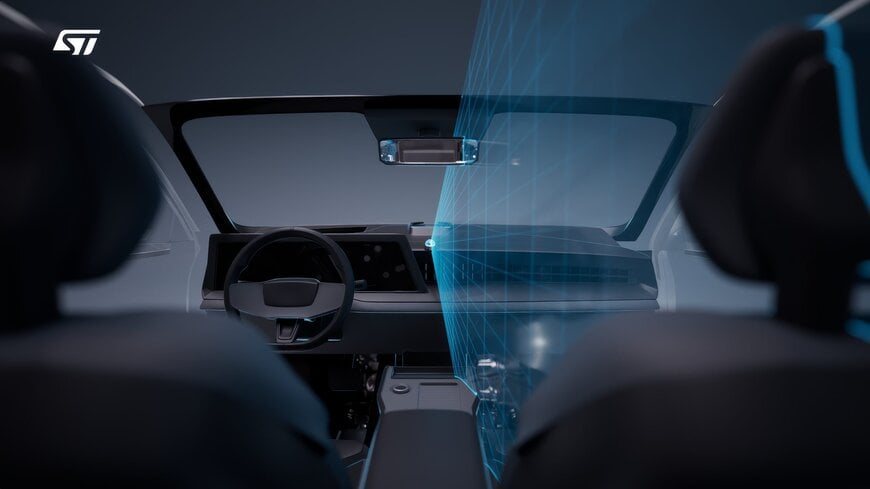
STMicroelectronics has introduced the ST SafeSense VD56GA, a new 1.1-megapixel image sensor designed for infrared in-cabin sensing in vehicles. The compact sensor targets OEMs and Tier-1 suppliers seeking to cost-effectively scale driver and occupant monitoring systems (DMS/OMS) across various vehicle classes. By utilizing the new "ST DeepNIR" backside-illuminated pixel architecture, the VD56GA offers 35 percent higher image sharpness (MTF) and nearly 60 percent greater infrared sensitivity compared to the previous generation. This ensures excellent optical resolution even under difficult installation conditions—such as being concealed behind displays.
Compact Design and Cost Reduction
Thanks to its extremely small CSP package (3.7 × 3.2 mm), the component is ideally suited for space-critical next-generation camera designs. The VD56GA aims to significantly lower total camera module costs: its high optical performance allows for the use of more affordable lenses and infrared illumination. At the same time, integrated image processing functions such as auto-exposure, dark calibration, and cropping eliminate the need for external processing resources. Sensor wafer manufacturing (front-end) takes place at the ST facility in Crolles, France, guaranteeing European automotive customers high supply chain resilience and long-term security of supply for high-volume series programs.
Additional Context: Technological Background and Market Dynamics
This section provides technological and market background not explicitly detailed in the original release.
Driver Monitoring Systems (DMS) are currently transitioning from a premium feature to a legally mandated standard equipment, largely driven by safety guidelines such as the EU's General Safety Regulation (GSR) and upcoming Euro NCAP test protocols. To precisely track the driver's face and eyes during night driving without blinding them with visible light, these systems use near-infrared (NIR) light, typically at a wavelength of 940 nanometers. The technical challenge: conventional silicon image sensors lose massive amounts of sensitivity in this infrared spectrum. By drastically increasing quantum efficiency in the NIR range, the sensor can capture more infrared photons. For automakers, this means they can install fewer and lower-power infrared LEDs to illuminate the cabin. This not only saves direct component and power costs but also solves one of the biggest challenges in camera design: thermal management. Less LED waste heat allows for smaller camera housings that can be seamlessly integrated into steering columns or dashboards.
Edited by Lekshman Ramdas, Induportals editor – adapted by AI.
www.st.com
