
STMicroelectronics Unveils Cost-Effective In-Cabin Image Sensor
The 1.1 MP SafeSense VD56GA enhances infrared sensitivity to scale driver monitoring across high-volume vehicle platforms.
www.st.com

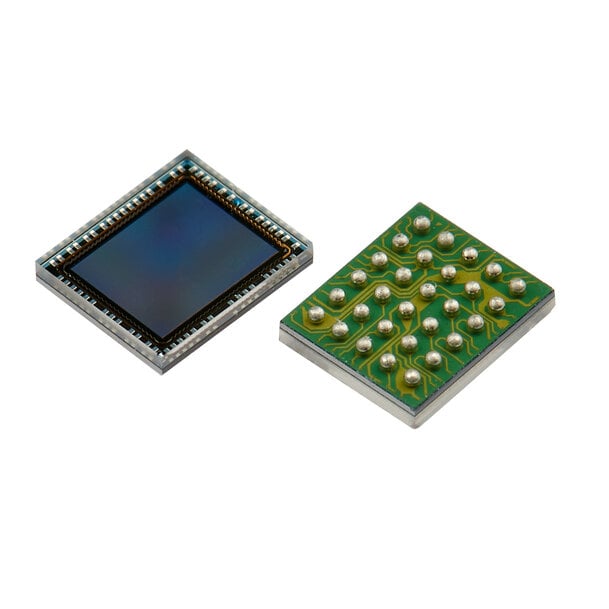
STMicroelectronics has introduced the ST SafeSense VD56GA, a new 1.1-megapixel automotive image sensor designed to make infrared in-cabin sensing more affordable and scalable for high-volume vehicle platforms. As automotive manufacturers look to deploy driver and occupant monitoring systems (DMS/OMS) beyond premium models, the VD56GA addresses the need for strong imaging performance without adding unnecessary system costs or design complexity.
Leveraging a new backside-illuminated pixel architecture dubbed ST DeepNIR, the sensor is optimized for infrared imaging. It delivers 35% higher modulation transfer function (MTF) sharpness and nearly 60% higher quantum efficiency compared to previous generations. Housed in a compact 3.7 mm x 3.2 mm CSP package, this enhanced optical resolution and infrared sensitivity allow the sensor to perform reliably in challenging environments, such as under-display camera installations.
To further reduce the overall cost of the camera module, the VD56GA integrates embedded image-processing functions—including mirror, crop, dark calibration, and auto exposure. This eliminates the need for external image-processing resources and allows for the use of lower-cost optics and simplified infrared illumination. Furthermore, support for both RAW and YUV output formats provides Tier 1 suppliers with the flexibility to adapt the device to various electronic architectures. Front-end manufacturing for the new sensor takes place at ST’s facility in Crolles, France, ensuring supply-chain resilience.
Additional Context
This section provides technological and market background not explicitly detailed in the original release.
The automotive industry is currently undergoing a massive shift regarding in-cabin monitoring, largely driven by stringent new safety regulations. Mandates such as the European Union’s General Safety Regulation (GSR) and updated Euro NCAP testing protocols now require advanced Driver Monitoring Systems (DMS) to detect drowsiness, distraction, and occupant presence across all new vehicle classes, not just luxury platforms. This regulatory push forces OEMs to drastically reduce the Bill of Materials (BOM) for these systems so they can be economically deployed in compact and economy cars.
By utilizing a highly sensitive near-infrared (NIR) sensor, automakers can illuminate the dark cabin using fewer, lower-power IR LEDs, which saves component cost and reduces thermal management issues. Furthermore, processing raw image data typically places a heavy computational burden on a vehicle's central electronic control unit (ECU). By moving fundamental image-processing tasks directly onto the sensor edge, the VD56GA frees up critical bandwidth and processing power, making it easier and cheaper to integrate into entry-level vehicle architectures.
Edited by Lekshman Ramdas, Induportals editor – adapted by AI.
www.st.com
