
electronics-journal.com
24
'26
Written on Modified on
COM-HPC Client Module with Integrated AI Accelerators for Edge Computing
Congatec has introduced the conga-HPC/cRX1 module to consolidate compute, graphics, and neural processing units for demanding industrial physical AI workloads.
www.congatec.com
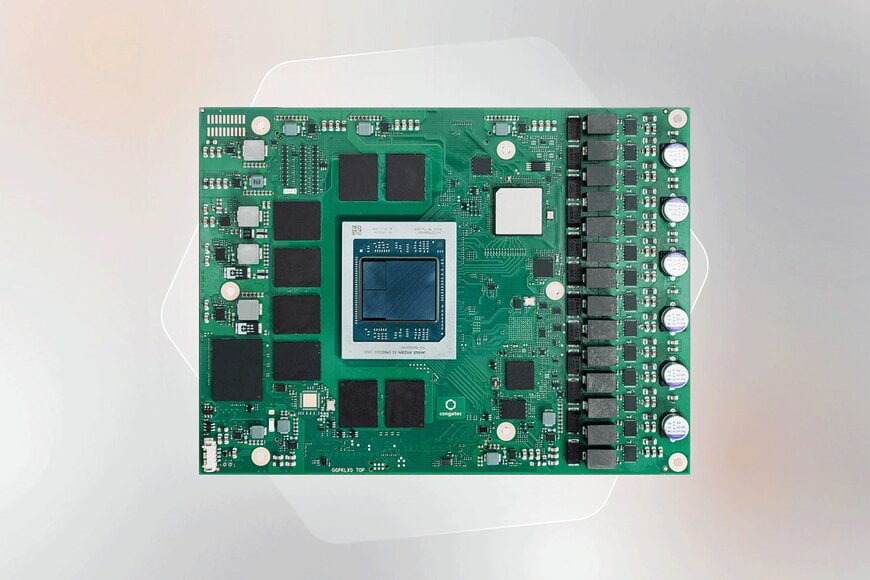
Congatec has announced the application-ready conga-HPC/cRX1, a COM-HPC Client Size C module featuring AMD Ryzen AI Embedded X100 Series processors designed for compute-intensive physical AI applications. The system targets industrial automation, medical technology, robotics, and autonomous commercial vehicles operating in smart farming, logistics, and forestry environments.
Integrated Architecture for Physical AI Workloads
Physical AI applications require real-time processing to unify sensing, control, and decision-making within dynamic operational environments. The conga-HPC/cRX1 addresses these computational requirements by integrating up to 16 AMD "Zen 5" CPU cores operating at clock frequencies up to 5.1 GHz. Sequential processing tasks, such as motion planning, real-time control, and sensor fusion, run on the CPU core array.
Parallel processing workloads, including environment perception and object detection, are offloaded to an integrated AMD Radeon RDNA 3.5 GPU containing up to 40 compute units. The GPU provides up to 59 TOPS of INT8 inference performance and 29.7 TFLOPS of FP32 compute capability, which allows local execution of Large Language Models (LLMs) and multi-stream visual analytics without requiring discrete expansion cards. For continuous background tasks such as speech recognition and continuous image analysis, a dedicated AMD XDNA 2 Neural Processing Unit (NPU) delivers up to 50 TOPS of energy-efficient AI processing.
Technical Specifications and Memory Infrastructure
The module is manufactured in the COM-HPC Client Size C form factor, measuring 120 mm × 160 mm. Thermal design power (TDP) is configurable from a 45 W base setting for power-sensitive applications up to 120 W for maximum computational throughput, with a standard base TDP set at 55 W. The system operates across the industrial temperature range of -40°C to +85°C.
To support high-data-throughput tasks such as general-purpose GPU (GPGPU) processing, the module incorporates up to 128 GB of unified LPDDR5X-8533 memory soldered directly to the board. Soldering memory components enhances mechanical stability against shock and vibration in mobile and heavy-machinery deployments. The unified memory architecture eliminates dedicated bus transfers between separate CPU and GPU memory pools, lowering data transfer latency. Optional on-board NVMe storage up to 512 GB provides direct access for local operating systems and AI model weights.
Industrial Interface Options and Cybersecurity Compliance
Peripherals and high-speed expansion boards connect via up to 24 PCIe Gen4 lanes. These lanes accommodate multi-gigabit industrial Ethernet adapters, fieldbus controllers, and wireless communication modules. Integrated external connectivity includes:
- 2x 2.5 GbE network interfaces
- Up to 4x USB 3.2 Gen2 ports and up to 8x USB 2.0 ports
- Up to 2x SATA 6 Gb/s interfaces
- 2x I²C, 2x UART, 12x GPIO, 1x SMBus, and 1x SPI channels
- Display support for up to four independent 4K monitors via the integrated GPU
Development and lifecycle processes for the conga-HPC/cRX1 comply with the IEC 62443-4-1 industrial cybersecurity standard, assisting equipment manufacturers in meeting the technical mandates of the EU Cyber Resilience Act taking effect in December 2027. Hardware-level security is supplemented by an integrated Trusted Platform Module (TPM 2.0).
Software Ecosystem and Workload Virtualization
Software development relies on the open-source AMD ROCm stack for high-performance computing and machine learning frameworks. Supported operating systems include Microsoft Windows 11, Windows 11 IoT Enterprise, and Linux distributions.
Preconfigured software options are offered through the aReady.COM initiative, including licensed ctrlX OS, Ubuntu Pro, and KontronOS implementations. Real-time control, human-machine interface (HMI), AI execution, and IIoT gateway operations can be consolidated onto a single physical module using aReady.VT, which integrates conga-zones hypervisor technology. Remote management, diagnostics, and data collection are managed through aReady.IOT software components.
Additional Context
This section details technical specifications and competitive benchmarking not included in the original product announcement.
In embedded computer-on-module architectures, high-performance edge processing historically required pairing an x86 host module with a discrete PCI Express accelerator board or utilizing proprietary System-on-Module (SOM) platforms such as Nvidia Jetson AGX Orin.
The congatec conga-HPC/cRX1 builds on the open PICMG COM-HPC Client Size C form factor standard, integrating an x86 CPU, GPU, and NPU into a single unit. It supports up to 128 GB of unified LPDDR5X-8533 memory, achieving up to 109 TOPS of combined AI performance (50 TOPS from the NPU and 59 TOPS from the GPU) across a configurable thermal design power range of 45 W to 120 W, while operating within industrial temperature ranges from -40°C to +85°C.
By comparison, traditional high-end architectures rely on separate x86 CPU modules connected to discrete PCIe GPU or NPU add-in cards. These split systems feature separate DDR5 system memory and discrete video memory, often consume 150 W to over 300 W, and operate within narrower thermal windows typically limited to 0°C to +60°C.
Alternative proprietary SOM designs, such as the Nvidia Jetson AGX Orin 64GB, utilize an integrated ARM CPU along with Ampere GPU architecture and deep learning accelerators (DLA). The Jetson AGX Orin provides 64 GB of LPDDR5 memory, delivers up to 275 sparse INT8 TOPS at lower power budgets ranging from 15 W to 60 W, and operates from -25°C to +85°C.
Integrating compute, graphics, and neural processing engines onto an open-standard COM-HPC module reduces total physical footprint, lowers thermal dissipation requirements, and removes mechanical points of failure associated with PCIe connector sockets in high-vibration industrial applications.
Edited by Evgeny Churilov, Induportals Media - Adapted by AI.
www.congatec.com
Software Ecosystem and Workload Virtualization
Software development relies on the open-source AMD ROCm stack for high-performance computing and machine learning frameworks. Supported operating systems include Microsoft Windows 11, Windows 11 IoT Enterprise, and Linux distributions.
Preconfigured software options are offered through the aReady.COM initiative, including licensed ctrlX OS, Ubuntu Pro, and KontronOS implementations. Real-time control, human-machine interface (HMI), AI execution, and IIoT gateway operations can be consolidated onto a single physical module using aReady.VT, which integrates conga-zones hypervisor technology. Remote management, diagnostics, and data collection are managed through aReady.IOT software components.
Additional Context
This section details technical specifications and competitive benchmarking not included in the original product announcement.
In embedded computer-on-module architectures, high-performance edge processing historically required pairing an x86 host module with a discrete PCI Express accelerator board or utilizing proprietary System-on-Module (SOM) platforms such as Nvidia Jetson AGX Orin.
The congatec conga-HPC/cRX1 builds on the open PICMG COM-HPC Client Size C form factor standard, integrating an x86 CPU, GPU, and NPU into a single unit. It supports up to 128 GB of unified LPDDR5X-8533 memory, achieving up to 109 TOPS of combined AI performance (50 TOPS from the NPU and 59 TOPS from the GPU) across a configurable thermal design power range of 45 W to 120 W, while operating within industrial temperature ranges from -40°C to +85°C.
By comparison, traditional high-end architectures rely on separate x86 CPU modules connected to discrete PCIe GPU or NPU add-in cards. These split systems feature separate DDR5 system memory and discrete video memory, often consume 150 W to over 300 W, and operate within narrower thermal windows typically limited to 0°C to +60°C.
Alternative proprietary SOM designs, such as the Nvidia Jetson AGX Orin 64GB, utilize an integrated ARM CPU along with Ampere GPU architecture and deep learning accelerators (DLA). The Jetson AGX Orin provides 64 GB of LPDDR5 memory, delivers up to 275 sparse INT8 TOPS at lower power budgets ranging from 15 W to 60 W, and operates from -25°C to +85°C.
Integrating compute, graphics, and neural processing engines onto an open-standard COM-HPC module reduces total physical footprint, lowers thermal dissipation requirements, and removes mechanical points of failure associated with PCIe connector sockets in high-vibration industrial applications.
Edited by Evgeny Churilov, Induportals Media - Adapted by AI.
www.congatec.com
