
electronics-journal.com
24
'26
Written on Modified on
TDK presents SMD common-mode chokes for up to 80 V/35 A
The EP21 series of flat-wire double chokes are designed for common-mode EMI filtering in DC-DC converters and low-voltage circuits.
www.tdk.com
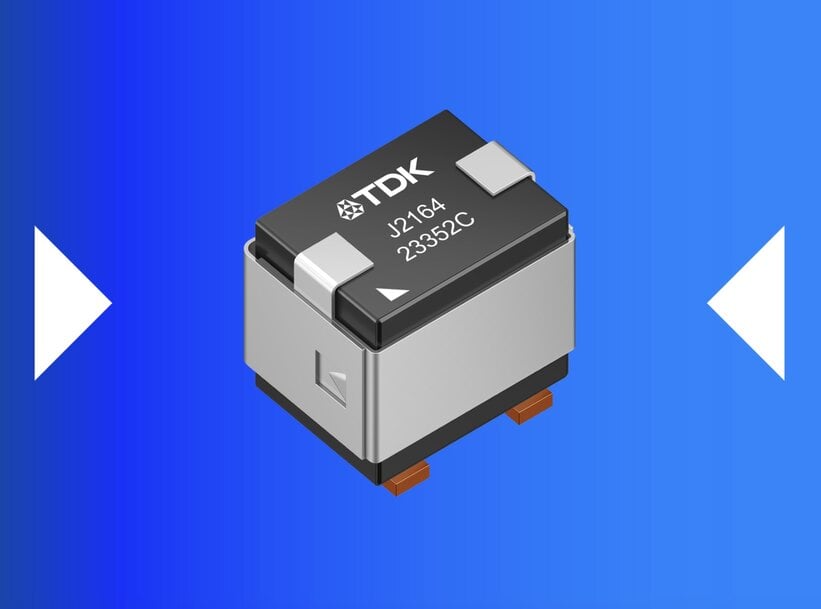
TDK Corporation has presented the EP21 series (ordering code: B82552J*J021) of surface-mount flat-wire double chokes designed for common-mode electromagnetic interference (EMI) filtering. The components are available in an SMD format for applications such as DC-DC converters or other low-voltage electromagnetic compatibility (EMC) protection circuits.
Physical Design and Dimensions
The EP21 series components feature dimensions of 23.8 x 17.7 mm, with heights ranging from 21.6 to 22.3 mm. To minimize board space, these components feature underbody termination.
The double chokes feature MnZn ferrite material, flat-wire winding, and surface-mount technology. A four-pin design is incorporated to enhance mechanical reliability.
Electrical Performance Specifications
The EP21 series double chokes handle rated voltages of 48 V (AC) or 80 V (DC) and high rated currents of 20.3 to 35 A without derating up to +70 °C. Current derating is required if the temperature exceeds +70 °C.
The DC resistance is as low as 0.44 mΩ, while the high rated inductance ranges from 160 to 640 µH, with an average stray inductance as low as 200 nH. Depending on the specific type, the maximum impedance occurs at frequencies between 500 kHz and 3 MHz.
Additional Context
This section details technical specifications not included in the original news release.
Common-mode chokes suppress electromagnetic interference (EMI) by offering high impedance to unwanted common-mode noise currents that flow in the same direction on both power or signal lines, while allowing differential-mode functional currents to pass through with minimal impedance.
The component utilizes a Manganese-Zinc (MnZn) soft ferrite core material, which provides high initial magnetic permeability in the kilohertz to low-megahertz frequency spectrum, making it effective for suppressing high-frequency conducted noise generated by switching power supplies.
The use of rectangular flat-wire windings rather than conventional round wire increases the copper fill factor within the core window area. This flat conductor geometry reduces internal direct current resistance and maximizes current-handling density within a compact frame size. Furthermore, flat-wire winding reduces high-frequency skin effect and proximity effect losses by offering a higher surface-area-to-cross-section ratio. Underbody terminations position solder pads directly beneath the component chassis, saving printed circuit board (PCB) surface area compared to external Gull-Wing or J-lead terminal configurations.
Edited by Romila DSilva, Induportals Editor, with AI assistance.
www.tdk-electronics.tdk.com
