
electronics-journal.com
24
'26
Written on Modified on
High-Temperature Signal Relays for High-Density Electronic Systems
Rutronik expands its electromechanical portfolio with an OMRON 125°C-rated component designed to mitigate thermal management challenges in compact industrial automation hardware.
www.rutronik.com
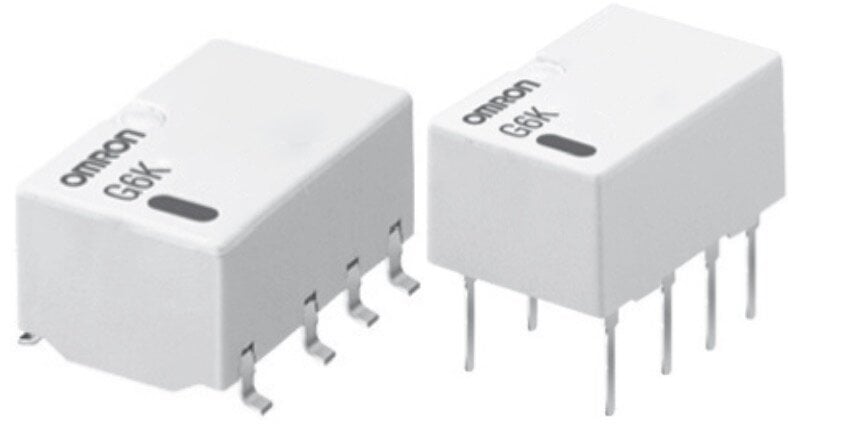
Rutronik announces the availability of the OMRON G6K-T1 Series, a family of signal relays engineered to operate in ambient temperatures up to 125°C for high-density electronics. This hardware targets reliable signal switching and thermal margin improvement across industrial automation, semiconductor test equipment, and building control architectures.
System Architecture and Thermal Management
As component density on printed circuit boards (PCBs) increases due to integrated processors and IoT connectivity, the available spatial footprint for thermal management decreases. The G6K-T1 relays address this constraint by functioning at elevated ambient temperatures, which reduces the structural requirement for external cooling mechanisms such as fans or expanded heat sinks. Operating continuously at 125°C, the components provide hardware designers with increased thermal headroom, facilitating more compact and fanless system architectures without compromising circuit stability or increasing total system cost.
Electromechanical Specifications and Board Integration
The relays feature a Double Pole Double Throw (DPDT or 2 Form C) contact configuration within a 10 by 6.5 by 5.2 millimeter physical footprint. Despite this compact volume, the hardware supports switching currents up to 2 A with a baseline power consumption of approximately 140 mW. To accommodate varied printed circuit board layouts, the series includes both surface-mount technology (SMT) and through-hole packaging options. Furthermore, the product line offers single-side stable and single-winding latching versions, alongside specialized -Y variants that provide a 2.5 kV impulse withstand voltage between the coil and contacts to ensure robustness in demanding electrical environments.
Galvanic Isolation in Industrial Applications
The integration of high-temperature signal relays supports sectors requiring prolonged operational reliability, specifically telecommunications, HVAC control systems, security infrastructure, and semiconductor testing facilities. In these environments, the electromechanical architecture of the G6K-T1 maintains complete galvanic isolation and ultra-low leakage current. These electrical parameters are critical for precise test and measurement instruments, where signal integrity cannot be compromised by the thermal noise or solid-state leakage currents often associated with alternative semiconductor-based switching technologies.
Additional Context
This section details technical specifications and competitive benchmarking not included in the original news release.
Within the electromechanical signal relay market, components are primarily benchmarked on maximum ambient operating temperature, physical footprint, and contact current ratings. Standard telecommunications and signal relays, such as the baseline Panasonic TX or TE Connectivity IM series, typically feature maximum operating temperatures of 85°C. For extreme thermal environments, competitors offer high-temperature variants; for example, the Panasonic TX-TH series supports operations up to 120°C. By achieving a 125°C continuous operating threshold in a 10 by 6.5 by 5.2 millimeter footprint with a 2 A switching capacity, the OMRON G6K-T1 operates at the upper thermal limit of the surface-mount signal relay category. This temperature rating allows it to compete directly in high-density industrial automation and test equipment applications where thermal derating normally forces engineers to specify larger electromechanical components or rely on complex solid-state alternatives.
Edited by Aishwarya Mambet, Induportals Editor, with AI assistance.
www.rutronik24.com
