
electronics-journal.com
08
'26
Written on Modified on
Faradized Pneumatic Test Interfaces for High-Frequency Component Validation
COTELEC introduces a shielded electromagnetic isolation platform designed to optimize signal integrity and streamline automated testing workflows in mass-production electronics manufacturing.
www.cotelec.fr
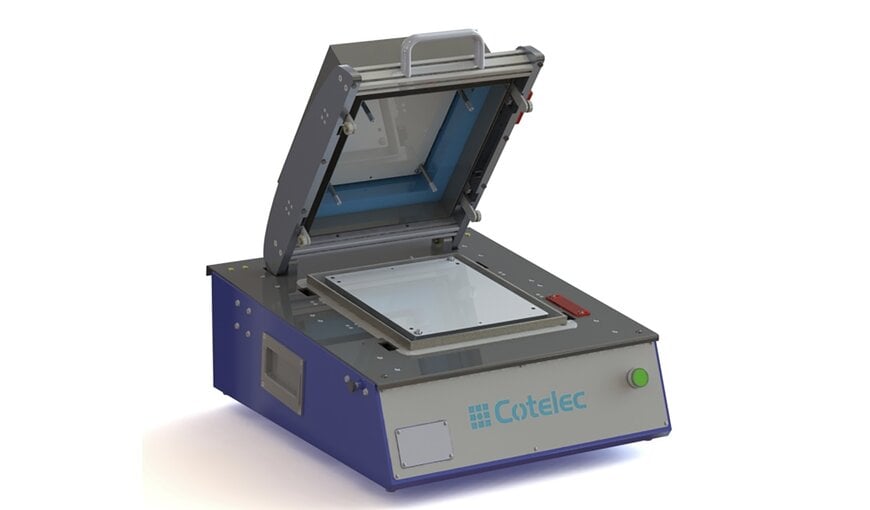
COTELEC is releasing the PF2SA-RF80-100, a pneumatically locked, faradized test interface engineered to evaluate electronic component performance across radio frequency (RF) and high-frequency (HF) bands. This hardware targets mass-production environments within the consumer electronics sector, specifically supporting the validation of Wi-Fi, Bluetooth, 5G, radar, and IoT modules.
Electromagnetic Isolation and Signal Integrity
In modern industrial automation, ensuring signal integrity during the quality assurance phase is critical for high-frequency device manufacturing. The test interface utilizes a Faraday cage architecture to physically isolate the testing environment from external electromagnetic interference (EMI). Available in configurations offering either -80 dB or -100 dB of attenuation, this isolation mechanism prevents cross-channel interference and protects sensitive transmitted data during testing. By blocking external RF signals, the interface maintains a controlled environment that ensures low insertion loss and minimizes the voltage standing wave ratio (VSWR) across wide frequency bands, ranging from direct current (DC) up to multi-gigahertz thresholds.
Hardware Architecture and System Integration
The interface was previously showcased at the Global Industrie 2026 exhibition in Paris, France (March 30 to April 2), highlighting its integration capabilities within automated test equipment (ATE) and manual test benches. The unit features a usable testing area of 220 mm by 250 mm, allowing for deployment as an in-line station or a standalone cell. To support diverse component specifications, the modular architecture accommodates standard RF connectors, including SMA, SMP, N-Type, MCX, and MMCX. This compatibility facilitates rapid adaptation to different production lines, reinforcing process stability without requiring complete hardware overhauls.
Pneumatic Actuation and Operator Ergonomics
From an operational standpoint, the interface incorporates a semi-automatic pneumatic locking mechanism characterized by automatic opening and manual closing sequences. The automatic release of the presser accelerates the removal of both compliant and non-compliant components, directly optimizing the production flow. Furthermore, this pneumatic assistance mitigates the physical strain associated with repetitive manual clamping, actively reducing the risk of musculoskeletal disorders (MSD) for operators managing high-volume test cycles. Constructed with high-resistance materials, the mechanical framework is engineered to withstand intensive, repetitive industrial use while experiencing minimal mechanical wear.
Additional Context
This section details technical specifications and competitive benchmarking not included in the original news release.
In the market for RF and high-frequency test fixtures, pneumatic faradized interfaces compete with shielded enclosures from manufacturers such as Ingun and Virginia Panel Corporation (VPC). Standard manual RF test boxes typically provide shielding effectiveness between -60 dB and -80 dB for frequencies up to 6 GHz. By offering an optional -100 dB isolation tier, the PF2SA-RF80-100 addresses more stringent testing requirements for sensitive millimeter-wave applications and high-density 5G modules. Furthermore, while basic RF enclosures require manual latching mechanisms that can slow down cycle times in mass production, the integration of semi-automatic pneumatic actuation provides a measurable advantage in throughput for automated test equipment (ATE) environments.
Edited by Aishwarya Mambet, Induportals Editor, with AI assistance.
www.cotelec.com
