
electronics-journal.com
29
'26
Written on Modified on
3D Hall-Effect Sensor for Automotive Motion Control
TDK introduces the HAL 13xy sensor family for speed and direction detection in automotive and industrial systems.
www.tdk.com
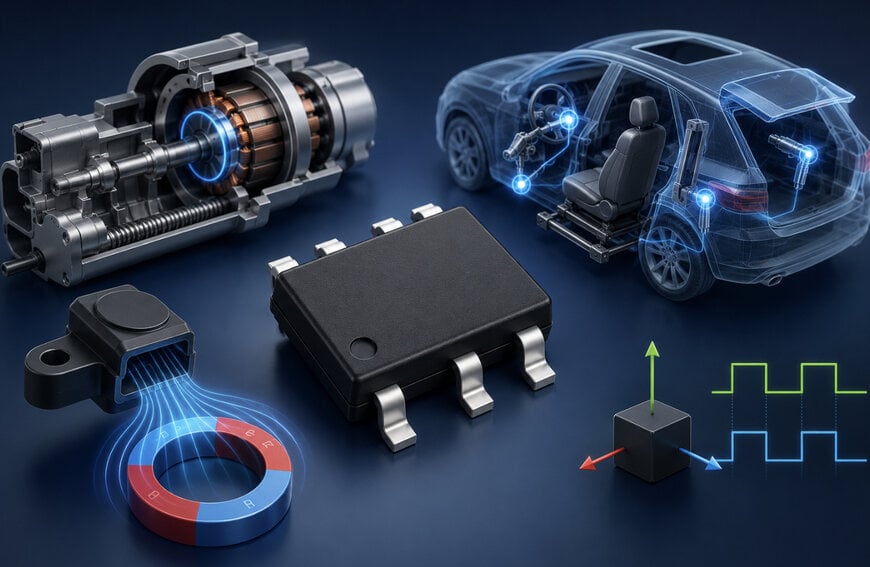
TDK Corporation has expanded its magnetic sensing portfolio with the HAL 13xy family, a factory-programmable Hall-effect switch sensor designed for speed and direction detection in automotive and industrial applications. Based on the company’s proprietary 3D Hall technology, the sensor integrates three orthogonal Hall elements within a single pixel cell, enabling simultaneous measurement of multiple magnetic-field components and supporting flexible system design for electric motors and position sensing applications.
3D magnetic sensing architecture for motor control
The HAL 13xy family incorporates three Hall elements positioned along the X, Y and Z axes. This configuration generates quadrature signals with a fixed 90-degree phase separation, independent of magnet pole spacing and air-gap variations. By measuring two magnetic-field components simultaneously, the sensor allows greater flexibility in the placement of sensors and magnets while maintaining reliable speed and direction detection. The architecture reduces mechanical design constraints compared with conventional Hall-effect sensing solutions that depend on precise magnetic alignment.
The dual-output design can be configured to provide either quadrature speed/speed signals or speed/direction outputs, supporting compact motor-control systems where space optimization and accurate position feedback are critical.
Automotive applications requiring position and speed sensing
The sensor family targets automotive systems that require precise motion control and position monitoring. Typical applications include seat-track motors, sunroof drives, tailgate motors, steering-column motors, steering turn-count sensing systems, valve-position monitoring and window-lift mechanisms with anti-pinch functionality.
The device is also suitable for industrial automation applications where rotational speed, direction sensing and compact motor integration are required.
Robust operation across extended environmental conditions
The HAL 13xy has been designed for operation in demanding automotive environments. The device supports a supply voltage range from 3.0 V to 24 V and operates at junction temperatures from –40 °C to 170 °C. Protection features include resistance to load-dump events up to 40 V, reverse-voltage protection down to –18 V, short-circuit protection and thermal protection mechanisms. According to TDK, switching points remain stable across temperature and supply-voltage variations, helping maintain measurement consistency under changing operating conditions.
The sensor also supports both static and dynamic magnetic fields up to 40 kHz and can be used with ferrite and rare-earth magnets through selectable temperature-coefficient configurations.
Functional safety and EMC compliance
The HAL 13xy family incorporates continuous built-in self-test (BIST) functionality and has been developed as a Safety Element out of Context (SEooC). The device is ASIL B ready in accordance with ISO 26262 requirements, supporting integration into safety-related automotive systems. For automotive qualification, the sensor complies with AEC-Q100 requirements and provides electromagnetic compatibility performance aligned with ISO and IEC standards.
Additional robustness characteristics include electrostatic discharge protection up to 4 kV Human Body Model (HBM), supporting reliable operation in electrically demanding environments.
Compact packaging for space-constrained designs
The sensor is housed in a compact 5-pin SOT23 package intended for applications where PCB space is limited. Combined with configurable sensing axes and programmable output options, the design provides a compact sensing solution for electric motor control, position detection and motion monitoring systems. TDK plans to begin volume production of the HAL 13xy family in October 2026. Engineering samples are currently available.
Additional Context: This section details technical specifications and competitive benchmarking not included in the original product announcement
The market for automotive Hall-effect position and speed sensors includes solutions from companies such as Infineon Technologies, Allegro MicroSystems, Melexis, Texas Instruments and TDK. Key performance criteria in this segment include magnetic-field sensitivity, temperature stability, EMC immunity, functional safety compliance and support for high-speed rotational sensing.
Three-dimensional Hall-effect sensing technologies provide advantages over conventional single-axis Hall sensors by enabling simultaneous measurement of multiple magnetic-field vectors. This capability can simplify mechanical integration and improve tolerance to magnet-placement variations in automotive actuator systems.
In automotive motion-control applications, ASIL-compliant sensors with integrated diagnostics and self-test functions are increasingly required to support safety-related functions such as steering systems, power actuators, electric seat adjustment and anti-pinch mechanisms. Extended operating temperatures above 150 °C junction temperature are also becoming important for sensor deployment in high-power electrified vehicle architectures.
Edited by Maria Brueva, Induportals editor – adapted by AI.
www.micronas.tdk.com
