
electronics-journal.com
29
'26
Written on Modified on
Automotive USB Type-C Charging Controller for 140W Power Delivery
Diodes Incorporated combines USB PD3.1 source control and synchronous buck regulation to reduce component count in vehicle charging architectures.
www.diodes.com
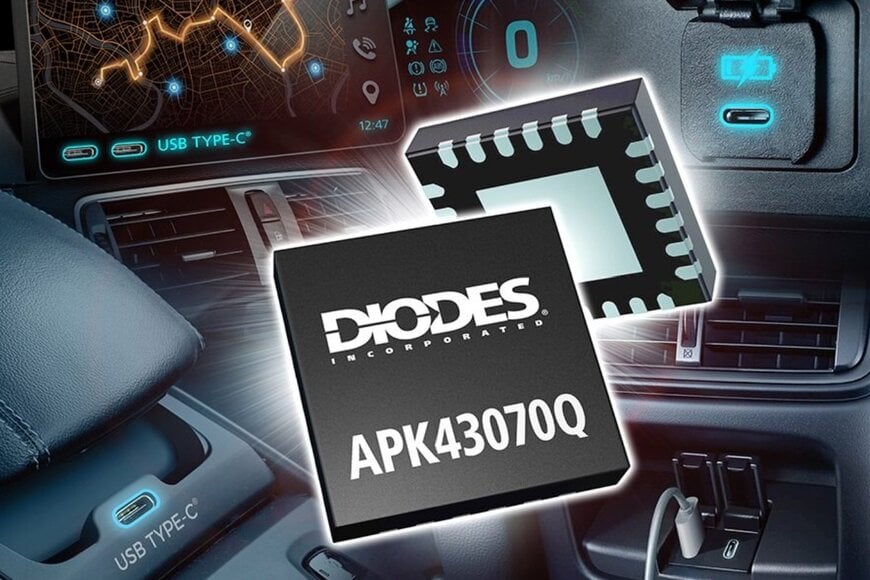
Automotive USB charging systems are evolving to support higher power levels for laptops, tablets, and other connected devices while maintaining reliability under vehicle electrical conditions. Diodes Incorporated has introduced the APK43070Q, a single-chip solution that integrates a synchronous buck controller with a USB Type-C Power Delivery (PD) 3.1 source controller for automotive charging modules.
Designed for automotive USB Type-C charging applications, the device combines power conversion and USB PD management in a single package. The approach reduces the number of external components required for high-power charging ports and supports both single-port and multi-port vehicle charging systems.
Integrated USB PD3.1 Power Management Architecture
The APK43070Q operates from a 4V to 36V input range, making it suitable for automotive electrical systems where voltage conditions can vary significantly. The controller supports USB PD3.1 Extended Power Range (EPR) with Adjustable Voltage Supply (AVS) operation up to 28V, as well as Standard Power Range (SPR) and Programmable Power Supply (PPS) modes up to 21V.
These capabilities allow automotive USB Type-C ports to deliver up to 140W of charging power, meeting the requirements of modern high-performance mobile devices and notebook computers. Support for multiple USB PD3.1 operating modes also enables compatibility with a broad range of USB-C devices while providing dynamic voltage negotiation.
Synchronous Buck Conversion for High-Power Charging
At the core of the device is a constant-frequency synchronous step-down controller designed for mid- to high-power charging applications. The architecture incorporates optimized dead-time control, high gate-drive strength, and elevated gate-drive voltage to improve switching performance when paired with external N-channel MOSFETs.
Using external MOSFETs gives system designers flexibility to select devices based on efficiency, thermal characteristics, and current-handling requirements. This can be particularly important in automotive environments where charging modules must operate within constrained thermal envelopes.
The controller also supports a VIN DC power pass-through mode. In this configuration, the high-side MOSFET functions as the VBUS switch, eliminating the need for an additional output switch stage. Reducing component count can lower bill-of-materials costs while simplifying thermal and power-path design.
Multi-Port Power Sharing Without an External MCU
A notable feature of the device is its integrated I2C communication interface with controller and target addressing capability. Through resistor-based configuration, the architecture can coordinate power sharing across as many as eight USB Type-C ports without requiring an external microcontroller.
For vehicle manufacturers implementing multiple charging outlets, this approach can simplify system architecture and reduce software development requirements. The ability to manage power distribution directly within the charging subsystem may also help streamline the design of multi-port charging platforms within the broader digital supply chain of connected vehicle electronics.
Protection Features for Automotive Reliability
Automotive charging systems must withstand electrical faults, connector misuse, and environmental conditions. To address these requirements, the APK43070Q integrates several protection mechanisms, including overvoltage protection, overcurrent protection, undervoltage protection, and overtemperature protection.
The device also includes connector moisture detection, a feature increasingly relevant in exposed vehicle cabin environments where liquid ingress can occur. In addition, the CC1/CC2 and DP/DN interface pins can tolerate short-to-VBUS fault events up to 30V, helping protect the charging subsystem from accidental wiring and connector faults.
Automotive USB-C Charging Applications
The growing adoption of USB PD3.1 is increasing power requirements in automotive charging systems. Earlier vehicle USB ports typically supported charging levels below 30W, while USB PD3.1 EPR extends power delivery capabilities to 140W. This allows a single vehicle charging port to support power-intensive devices such as professional laptops, mobile workstations, and advanced tablets.
By integrating USB PD source control, power conversion management, multi-port coordination, and protection functions into a single device, the APK43070Q addresses design challenges associated with high-power USB-C charging infrastructure in passenger vehicles, commercial vehicles, and connected mobility platforms.
Additional Context
This section details technical specifications and competitive benchmarking not included in the original news release.
The APK43070Q enters a market where automotive USB-C charging controllers are increasingly supporting USB PD3.1 power levels above 100W. Comparable solutions include integrated USB PD controller platforms from companies such as Texas Instruments, Infineon Technologies, and NXP Semiconductors, which offer combinations of USB Power Delivery management, DC-DC conversion, and automotive-qualified protection functions.
Key benchmark criteria in this segment include supported USB PD revision, maximum output power, automotive qualification level, input voltage range, external component count, fault protection coverage, and multi-port power management capability. The APK43070Q differentiates itself through the integration of USB PD3.1 source control and synchronous buck regulation within a single-chip architecture while supporting up to eight-port power-sharing configurations without an external microcontroller. This integration can reduce board space and system complexity compared with multi-chip implementations that require separate PD controllers, power stages, and supervisory MCUs.
Edited by Aishwarya Mambet, Induportals Editor, with AI assistance.
www.diodes.com
