
electronics-journal.com
27
'26
Written on Modified on
Keysight At IMS 2026
From June 7-12, in Boston, the company will showcase automated RF design simulation, environment emulation, and validation technologies to accelerate development across wireless, satellite, and 6G applications.
www.keysight.com
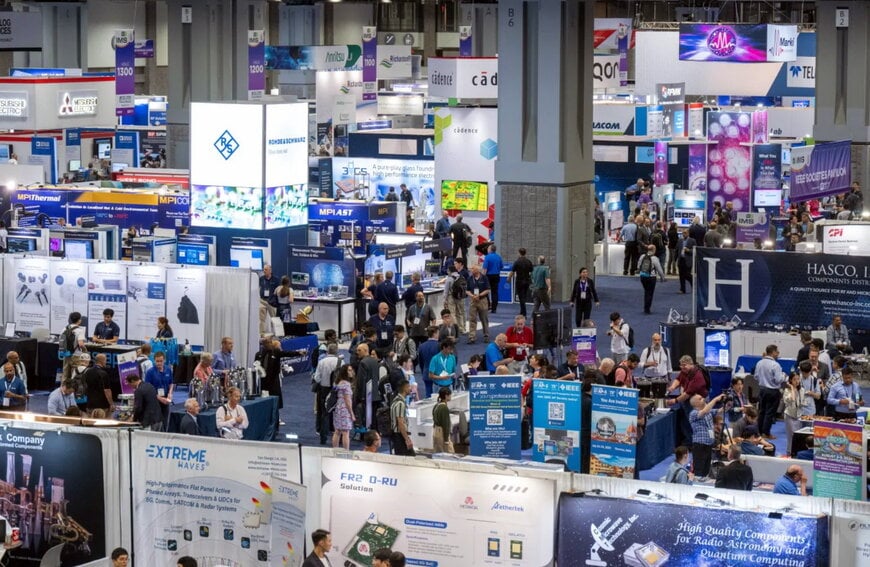
Keysight Technologies is deploying advanced signal analysis and emulation systems to optimize radio frequency spectrum utilization. The technical solution addresses complex design, emulation, and validation challenges across next-generation wireless networks, aerospace, satellite, and quantum computing infrastructure.
Operational Challenges in High-Frequency Spectrum Engineering
Modern digital infrastructure requires deploying networks that operate at higher frequencies, such as the V-band, sub-terahertz regimes up to 250 gigahertz, and emerging 6G waveforms. Engineers face significant challenges due to signal congestion, complex multi-input multi-output architectures, and severe signal degradation. Traditional development methods often struggle with isolated testing phases that fail to accurately capture real-world electromagnetic behaviors. This results in costly hardware iterations, delayed time-to-market, and increased operational risks during full-scale deployment.
Integrated Emulation and Analysis Architecture
The framework consists of an integrated three-zone workflow spanning advanced radio frequency design simulation, real-world environmental emulation, and comprehensive physical validation. The system balances automated design tasks with precise physical measurement instruments to establish a continuous verification pipeline.
Automated algorithms drive matching network optimization, filter synthesis, and automated design reuse, integrating Python-driven scripts directly into the Electronic Design Automation environment. This software layer interfaces with electromagnetic simulators to model complete signal chains from initial excitation down to multi-beam phased-array radiation performance.
At the hardware level, wideband signal analysis architecture enables high-speed validation of emerging waveforms. The hardware utilizes compact signal generators featuring 90 gigahertz native frequency extensions configured within a 2U form factor. The hardware maintains ultra-low phase noise and fast list-sweep switching capabilities, acting as a high-fidelity local oscillator source. For physical verification, the hardware architecture incorporates compact antenna test range chambers to perform over-the-air calibrations. The setup evaluates error vector magnitude, adjacent channel power ratios, and effective isotropic radiated power across active and passive devices.
Deployment and Systems Testing Performance
The deployment of these characterization and testing methodologies occurs across laboratory research, production manufacturing, and field environments. The integration into existing workflows relies on distributed, benchtop, and production-form-factor vector network analyzers performing both frequency-converter and non-converter testing procedures.
Systems validation is scheduled for demonstration at the IEEE MTT-S International Microwave Symposium from June 7 to June 12, 2026, in Boston, Massachusetts. Real-world resilience evaluation is achieved via comprehensive positioning, navigation, and timing emulation platforms. These testbeds combine high-fidelity signal generation with radio frequency propagation and terrain modeling to replicate navigation warfare threats, validating system integrity under adverse operational conditions.
Industrial Applications and Operational Benefits
The principal target areas encompass industrial automation, next-generation telecommunications, and aerospace defense systems. Within these fields, unified quantum circuit and electromagnetic simulation environments streamline superconducting qubit development, shifting test iterations from physical cryogenic environments to predictive software models.
Implementing these integrated workflows enhances overall process stability, shortens development lifecycles, and improves system maintainability by identifying design bottlenecks prior to physical fabrication. Precision characterization up to 250 gigahertz provides measurable data verification for artificial intelligence hardware infrastructure, ensuring reliable data throughput.
Edited by Evgeny Churilov, Induportals Media - Adapted by AI.
www.keysight.com
