
electronics-journal.com
27
'26
Written on Modified on
Microchip Unveils mSiC Power Modules For AI Data Centers
Microchip's new 3.3 kV HV-D3 mSiC power modules accelerate solid-state transformer adoption to deliver efficient, direct medium-voltage power for AI hyperscale facilities and heavy industrial applications.
www.microchip.com
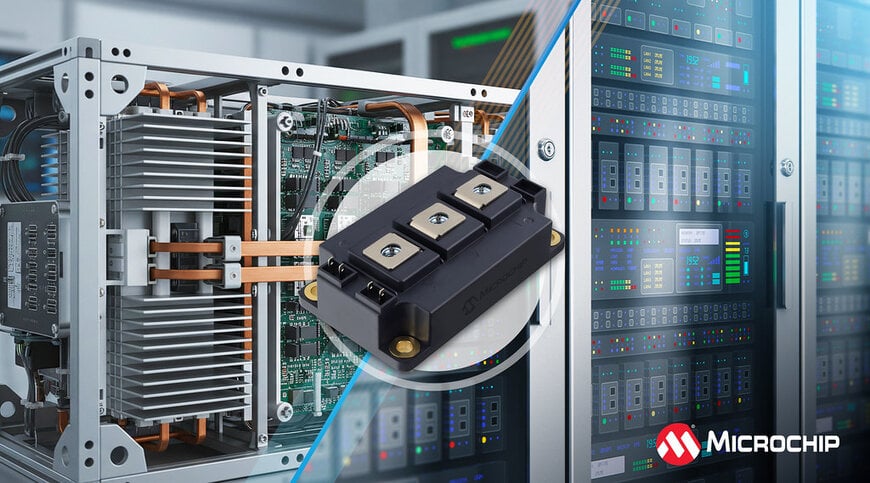
Microchip Technology has released its 3.3 kV HV-D3 mSiC power modules to facilitate the deployment of solid-state transformers within artificial intelligence hyperscale data centers and high-voltage industrial applications. This technical solution utilizes silicon carbide MOSFETs and Schottky diodes to enable direct power conversion from medium-voltage electrical grids to server infrastructure.
Technical Challenges in High-Voltage Data Center Power Supply
Artificial intelligence facilities requiring massive computing clusters face limitations tied to power availability and conversion efficiency. Traditional power distribution architectures rely on low-frequency, line-frequency transformers that require multiple conversion stages, resulting in increased thermal losses and larger physical footprints. Next-generation data center architectures are transitioning toward high-voltage direct current rack distribution. Solid-state transformers address these infrastructure challenges by reducing the number of power conversion steps, thereby decreasing energy dissipation and maximizing spatial efficiency inside power substations.
Material Specifications and Thermal Management
The power modules integrate 3.3 kV silicon carbide MOSFETs and Schottky diodes inside an industry-standard 62 mm housing. To support series connection safety in medium-voltage grid interfaces, such as 13.8 kV or 34.5 kV systems, the mechanical design features a Comparative Tracking Index rating of CTI 600 alongside extended creepage distances. The internal insulation provides a 6 kV isolation voltage. Thermal dissipation is managed via a silicon nitride substrate, chosen for its high thermal conductivity and mechanical robustness under continuous power-cycling conditions. This substrate allows designers to increase power density without implementing complex active cooling mechanisms.
Circuit Topologies and Industrial Applications
The semiconductor modules are produced in half-bridge and common-source topologies, available with or without anti-parallel Schottky diodes to serve current requirements between 100 A and 300 A. The switching characteristics of the mSiC technology are optimized to balance losses across both hard-switched and soft-switched topologies, which allows operations at higher frequencies. Beyond data center solid-state transformers, the modules are applicable to megawatt-level charging infrastructure for heavy-duty electric vehicles, auxiliary power units for rail transport, medium-voltage industrial motor drives, and defense power systems.
The implementation of 3.3 kV ratings allows system engineers to reduce the total number of series-connected semiconductor devices by approximately 50 percent compared to designs utilizing lower-voltage 1.2 kV or 1.7 kV silicon carbide alternatives. This reduction simplifies the gate driver architecture and improves overall system reliability.
Additional Context: Technical Specifications and Competitive Benchmarking
The 3.3 kV power semiconductor sector includes established options in the standard 62 mm footprint, primarily serving traction, renewable energy, and industrial drives. Microchip's module targets a specific current range of 100 A to 300 A, positioning it between high-power discrete components and high-current dual modules, which frequently operate at 400 A to 800 A within larger formats like the LinPak or XHP housings.
While competitors like Infineon and Mitsubishi Electric offer 3.3 kV silicon carbide solutions, their portfolios are traditionally optimized for high-current traction and large-scale grid inverters operating at 400 A to 800 A using aluminum nitride or silicon nitride substrates with standard 6 kV isolation. Microchip differentiates its portfolio by filling the lower 100 A to 300 A current gap in a standard 62 mm package. Furthermore, the mSiC technology is engineered specifically to balance switching losses in both hard-switched and soft-switched topologies, making it distinct for high-frequency solid-state transformers where minimizing high-frequency switching losses is essential for reducing the size of passive magnetic components.
Edited by Evgeny Churilov, Induportals Media - Adapted by AI.
www.microchip.com
