
electronics-journal.com
21
'26
Written on Modified on
European Consortium Launches Moore4Power Heterogeneous Semiconductor Integration Project
Infineon Technologies coordinates a 62-partner initiative to develop advanced power electronics systems utilizing heterogeneous integration and chiplet architectures for industrial applications.
www.infineon.com
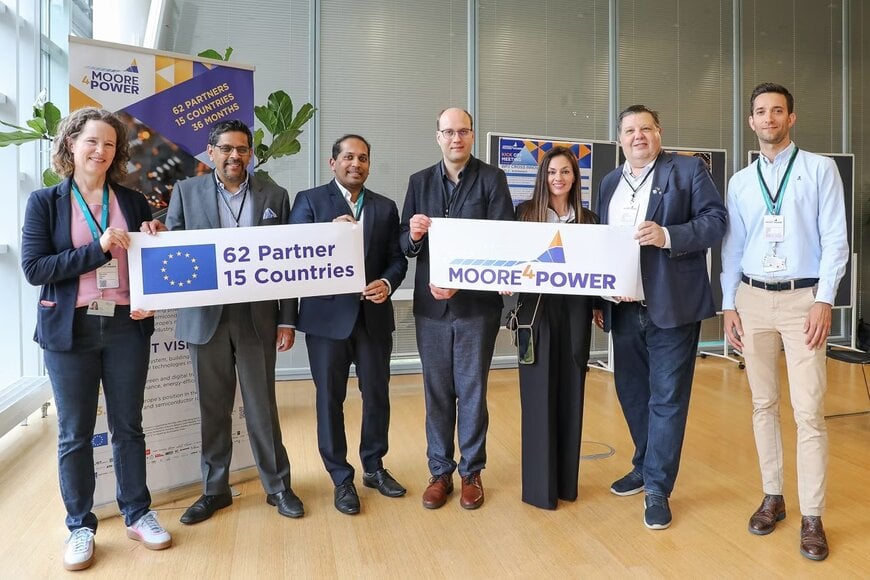
Kick-off event project Moore4Power (from left to right): Daniela Maier (Projectlead Infineon), Ganesh Chandramouli (Head of Innovation ALSTOM), Jain Chacko (Research Scientist at Fraunhofer ENAS), Joonas Leppanen (Senior Principal Engineer R&D at ABB Finland),Vicky Chatzidogiannaki (Director at INNOVATION DISCO), Jochen Koszescha (Project Coordinator Moore4Power Infineon), Iñigo Polo (General Technology Manager at INGETEAM)
Sixty-two partners from 15 European countries have initiated the Moore4Power project, a three-year research and development initiative focused on advancing smart power electronics. Coordinated by Infineon Technologies AG, the consortium includes research institutes, large enterprises, and small and medium-sized enterprises. The €91 million project, co-funded by participating nations and the Horizon Europe Chips Joint Undertaking program, addresses the physical and economic boundaries of traditional semiconductor scaling. By transitioning from isolated component scaling to system-level integration, the collaboration aims to optimize energy conversion systems for renewable energy generation, electrified mobility, and industrial infrastructure.
Heterogeneous Integration and Power Chiplet Architecture
The technical foundation of the Moore4Power project relies on heterogeneous integration, which consolidates distinct semiconductor technologies within a single system. The architecture combines silicon (Si), silicon carbide (SiC), and gallium nitride (GaN) materials alongside embedded sensing, control systems, and communication interfaces. This structure allocates specific tasks to the semiconductor material best suited for those electrical and thermal demands, optimizing overall system efficiency and power density. The consortium utilizes power chiplet technology to design scalable hardware, enabling modular product configurations. This approach builds upon the framework established by the preceding PowerizeD project to standardize system integration at competitive manufacturing parameters.
Digital Prototyping and Lifecycle Tracking
To accelerate industrialization, the participating organizations are integrating artificial intelligence-assisted modeling, digital twins, and automated workflows into the engineering phase. Parallel hardware and software co-design methodologies are utilized to reduce simulation durations while improving physical accuracy. This digital framework is designed to shorten the development timeline from initial fabrication samples to validated datasheet releases to a single week. Additionally, the project introduces a Digital Product Passport embedded directly into power modules via wireless access. This passport logs continuous lifecycle data, including operating conditions and state of health, providing a technical basis for predictive maintenance protocols, component reuse, and controlled material recovery.
Target Applications and Operational Metrics
The developed hardware modules will undergo validation under real-world operational conditions across multiple industrial sectors. In wind energy infrastructure, the integrated power electronics operate within the core of the turbines to optimize energy conversion rates and maximize grid output. For electric mobility charging networks, the hardware is engineered to support near-loss-free bidirectional charging configurations, targeting energy efficiency levels up to 99 percent. In railway propulsion applications, the integration of these mixed-material semiconductor systems is specified to reduce drivetrain energy losses by at least 30 percent, directly lowering the operational energy demands of electrified rail transit.
Edited by an industrial journalist, Lekshman Ramdas, with AI assistance.
www.infineon.com
Sixty-two partners from 15 European countries have initiated the Moore4Power project, a three-year research and development initiative focused on advancing smart power electronics. Coordinated by Infineon Technologies AG, the consortium includes research institutes, large enterprises, and small and medium-sized enterprises. The €91 million project, co-funded by participating nations and the Horizon Europe Chips Joint Undertaking program, addresses the physical and economic boundaries of traditional semiconductor scaling. By transitioning from isolated component scaling to system-level integration, the collaboration aims to optimize energy conversion systems for renewable energy generation, electrified mobility, and industrial infrastructure.
Heterogeneous Integration and Power Chiplet Architecture
The technical foundation of the Moore4Power project relies on heterogeneous integration, which consolidates distinct semiconductor technologies within a single system. The architecture combines silicon (Si), silicon carbide (SiC), and gallium nitride (GaN) materials alongside embedded sensing, control systems, and communication interfaces. This structure allocates specific tasks to the semiconductor material best suited for those electrical and thermal demands, optimizing overall system efficiency and power density. The consortium utilizes power chiplet technology to design scalable hardware, enabling modular product configurations. This approach builds upon the framework established by the preceding PowerizeD project to standardize system integration at competitive manufacturing parameters.
Digital Prototyping and Lifecycle Tracking
To accelerate industrialization, the participating organizations are integrating artificial intelligence-assisted modeling, digital twins, and automated workflows into the engineering phase. Parallel hardware and software co-design methodologies are utilized to reduce simulation durations while improving physical accuracy. This digital framework is designed to shorten the development timeline from initial fabrication samples to validated datasheet releases to a single week. Additionally, the project introduces a Digital Product Passport embedded directly into power modules via wireless access. This passport logs continuous lifecycle data, including operating conditions and state of health, providing a technical basis for predictive maintenance protocols, component reuse, and controlled material recovery.
Target Applications and Operational Metrics
The developed hardware modules will undergo validation under real-world operational conditions across multiple industrial sectors. In wind energy infrastructure, the integrated power electronics operate within the core of the turbines to optimize energy conversion rates and maximize grid output. For electric mobility charging networks, the hardware is engineered to support near-loss-free bidirectional charging configurations, targeting energy efficiency levels up to 99 percent. In railway propulsion applications, the integration of these mixed-material semiconductor systems is specified to reduce drivetrain energy losses by at least 30 percent, directly lowering the operational energy demands of electrified rail transit.
Edited by an industrial journalist, Lekshman Ramdas, with AI assistance.
www.infineon.com
