
electronics-journal.com
10
'26
Written on Modified on
Frame Grabber Enables Space Radiation Camera Testing
BitFlow hardware supports NASA’s evaluation of infrared imaging systems under high-energy ion exposure, validating data acquisition reliability for space instrumentation.
www.bitflow.com
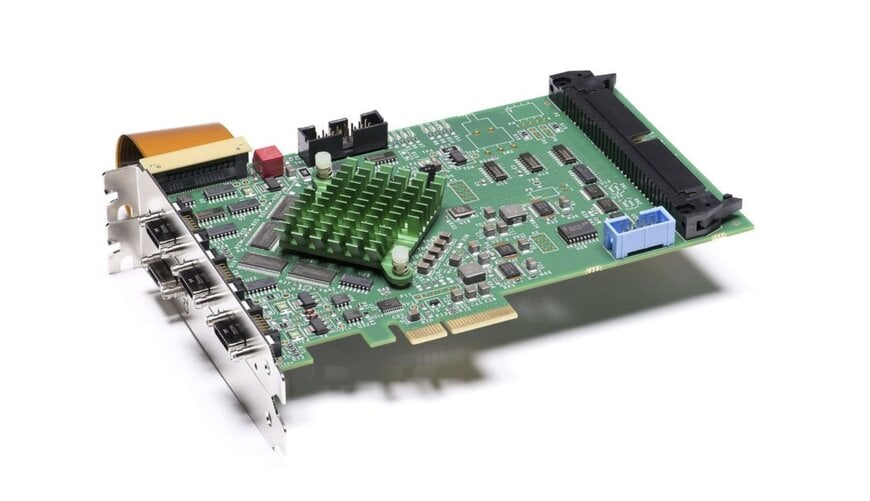
Spaceborne imaging systems must maintain functional integrity under ionizing radiation, requiring ground-based validation of both sensors and data acquisition chains. In this context, NASA implemented a system-level radiation test setup integrating a commercial infrared camera and frame grabber, with BitFlow’s Axion-CL used as the primary interface.
High-energy ion exposure for infrared imaging systems
Radiation testing targeted shortwave infrared (SWIR) imaging systems intended for atmospheric observation missions such as the Aerosol Radiometer for Global Observation of the Stratosphere (ARGOS). The campaign focused on qualifying a commercial off-the-shelf (COTS) camera for operation in space environments where single event effects (SEE) can disrupt sensor output and system communication.
The device under test was the Princeton Infrared Technologies (PIRT) 1280MVCam, based on a backside-illuminated, substrate-removed InGaAs focal plane array. It provides a resolution of 1280×1024 pixels, a 12 μm pixel pitch, and 14-bit analog-to-digital conversion, parameters relevant for detecting fine variations in atmospheric scattering.
Testing was conducted at the NASA Space Radiation Laboratory (NSRL) at Brookhaven National Laboratory. The camera was exposed to heavy ion beams including iron (Fe), silver (Ag), and terbium (Tb), with energies up to 575 MeV per nucleon.
Data acquisition under continuous radiation load
Within the test architecture, the BitFlow Axion-CL frame grabber functioned as the sole interface between the irradiated camera and the host control system. Using the Camera Link standard, it handled both high-throughput image data and bidirectional command communication over a unified interface.
This configuration enabled continuous real-time data acquisition during irradiation runs. Engineers monitored pixel-level anomalies associated with single event functional interrupts (SEFIs) while simultaneously accessing system configuration registers before and after exposure cycles.
The setup required maintaining signal integrity across extended physical distances. The camera operated directly in the ion beam, while the frame grabber and host system were placed in a shielded area, connected via approximately 100-foot Ethernet links and signal extenders. The Camera Link interface preserved stable communication despite this distributed layout and sustained radiation-induced disturbances at the device level.
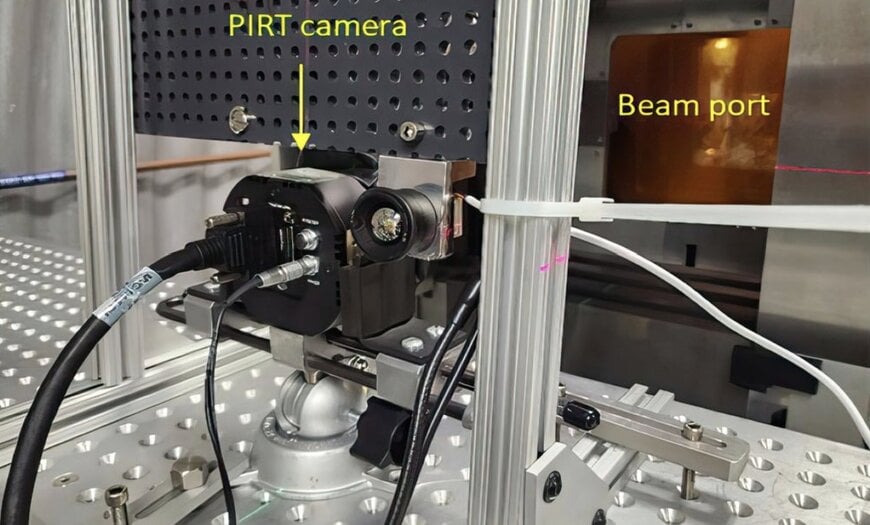
Camera system positioned in beam line. Laser beams are part of NSRL alignment system (Photo courtesy of NASA)
System-level behavior and failure thresholds
The test campaign produced measurable insights into system resilience. Persistent SEFIs were observed at the lowest tested LET thresholds, indicating sensitivity to ion-induced disruptions even under limited exposure. Communication failures occurred at relatively low fluence levels, providing data for component screening in future mission designs.
Across seven irradiation runs, the acquisition chain remained operational from initial exposure through to final system failure of the camera. Continuous data capture allowed full characterization of degradation behavior, forming the basis of a NASA Technical Memorandum under the Electronic Parts and Packaging (NEPP) Program.
Implications for space-qualified imaging systems
The results inform the selection and qualification of imaging components for missions involving radiation-intensive environments. For ARGOS, which measures stratospheric aerosols using limb-scattering techniques, maintaining consistent imaging and telemetry is critical for data accuracy.
The use of a COTS camera combined with a validated acquisition interface reflects an approach toward reducing development cycles while ensuring reliability through system-level testing. The demonstrated ability to sustain synchronized control and data transfer under high LET exposure conditions supports integration into broader aerospace data acquisition workflows.
Edited by Aishwarya Mambet, Induportals Editor, with AI assistance.
www.bitflow.com
