
electronics-journal.com
08
'26
Written on Modified on
High-Capacitance MLCCs Enable Compact Automotive Electronics
Murata Manufacturing expands its MLCC portfolio with high-capacitance components designed to support ADAS systems and improve PCB space efficiency in automotive applications.
www.murata.com
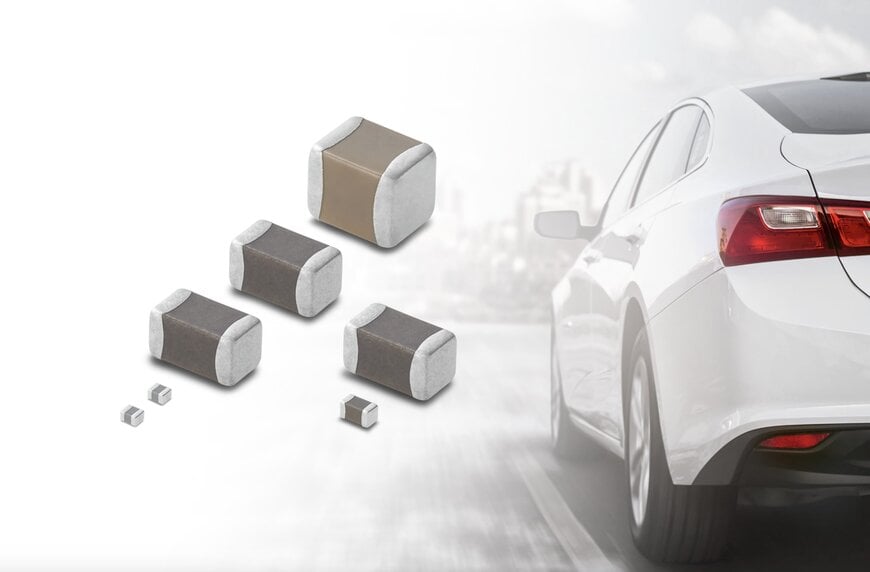
Murata Manufacturing has introduced a series of automotive-qualified multilayer ceramic capacitors (MLCCs) designed to deliver higher capacitance within smaller form factors. The components target in-vehicle electronics, where increasing system complexity and space constraints require improved power stability and compact design.
Increasing Capacitance for Advanced Automotive Systems
The growth of advanced driver assistance systems (ADAS) and autonomous driving (AD) technologies has led to a higher density of electronic control units and integrated circuits in vehicles. These systems demand stable voltage supply despite fluctuations, increasing the need for high-capacitance components in IC peripheral circuits and power lines.
At the same time, the number of MLCCs mounted on printed circuit boards (PCBs) continues to rise, making space constraints a critical design limitation. This has driven demand for components that combine higher capacitance with reduced footprint.
Miniaturisation with Higher Capacitance Density
The newly introduced MLCCs address these challenges by achieving higher capacitance values in smaller package sizes. In low-voltage applications (2.5–4 Vdc), capacitance values of 100 µF are now available in 1206 size packages (3.2 mm × 1.6 mm), a reduction from previous implementations requiring larger 1210 formats. This corresponds to an approximate 36% reduction in PCB mounting area.
In smaller form factors, such as the 0201 size (0.6 mm × 0.3 mm), capacitance has been increased beyond the conventional 1–2.2 µF range, supporting higher performance in space-constrained IC circuits.
For medium-voltage applications (25 Vdc), typically used in automotive power lines, the new components achieve 1 µF capacitance in a 0402 size (1.0 mm × 0.5 mm), compared to earlier designs requiring 0603 packages. This enables a PCB area reduction of approximately 61%, supporting higher mounting density.
Material and Process Innovations
The performance improvements are enabled by advances in ceramic material formulation and manufacturing processes, including particle refinement and improved uniformity. These developments allow higher dielectric performance within reduced volumes while maintaining reliability standards required for automotive environments.
All components are qualified according to AEC-Q200, ensuring compliance with automotive reliability requirements for passive electronic components.
Impact on Automotive System Design
Higher capacitance within smaller footprints supports stable operation of both IC peripheral circuits and vehicle power lines, particularly in systems exposed to voltage fluctuations. This contributes to improved performance of ADAS and AD systems, where reliability and signal integrity are critical.
Reducing the number of required capacitors also lowers PCB material usage and can decrease manufacturing energy consumption. This aligns with broader efforts to improve efficiency within the automotive data ecosystem, where electronic system density and performance continue to increase.
Supporting High-Density Automotive Electronics
The expanded MLCC portfolio demonstrates how component-level innovation can address system-level challenges in modern vehicles. By combining miniaturisation with increased capacitance, these components enable more compact PCB designs while maintaining electrical stability.
As automotive electronics evolve toward higher integration and functionality, such developments support more efficient design strategies within the broader digital supply chain, helping manufacturers balance performance, space, and reliability requirements.
Edited by Romila DSilva, Induportals Editor, with AI assistance.
