
electronics-journal.com
01
'26
Written on Modified on
Low-RDS(on) MOSFETs optimize automotive power efficiency
STMicroelectronics introduces Smart STripFET F8 MOSFETs to reduce conduction losses and improve thermal performance in automotive power distribution and battery management systems.
www.st.com
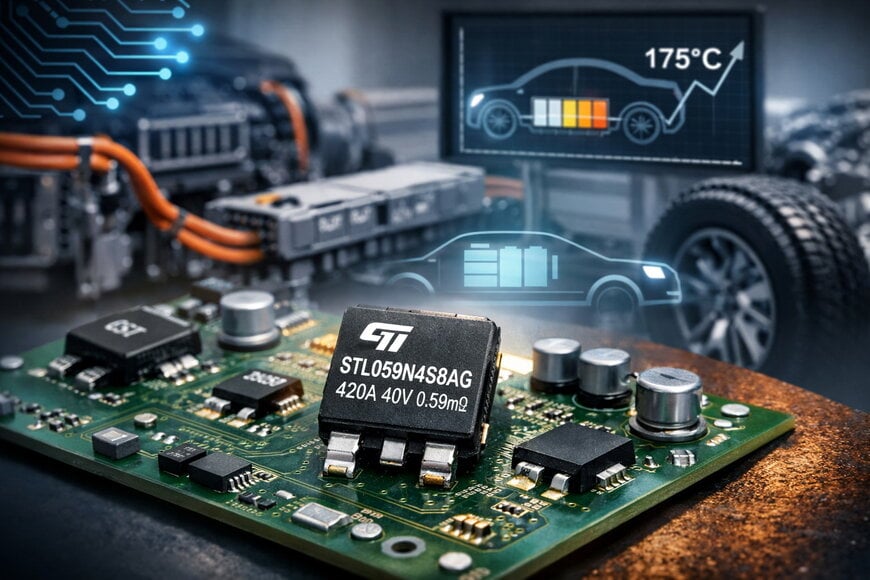
STMicroelectronics has released a new series of low-RDS(on) N-channel MOSFETs based on its Smart STripFET F8 technology, designed to improve conduction efficiency and thermal behavior in space-constrained automotive applications such as power distribution units and battery management systems.
Conduction efficiency in high-current automotive systems
The first device in the series, STL059N4S8AG, is specified for 40V operation with a continuous current rating of 420A and a typical RDS(on) of 0.59mΩ. These characteristics directly address efficiency constraints in high-current paths, where conduction losses (I²R) significantly impact system-level performance. Lower on-resistance reduces power dissipation during both steady-state operation and transient load conditions, which is critical in applications such as automotive power distribution and electrified drivetrain subsystems.
The device is packaged in a PowerFLAT 5x6 housing, enabling reduced PCB footprint while maintaining effective thermal dissipation. This is achieved through low thermal resistance and optimized heat spreading, supporting operation up to a maximum junction temperature of 175°C. The package also incorporates wettable flanks, allowing automated optical inspection (AOI) in automotive assembly lines, and the device is qualified according to AEC-Q101 standards.
Smart STripFET F8 technology and silicon optimization
The Smart STripFET F8 technology builds on STMicroelectronics’ established STripFET trench-based architecture, introducing a modified trench gate structure that improves channel conductivity and silicon utilization. This results in a reduced die size for a given current rating, which contributes to both cost efficiency and integration in compact electronic control units.
The technology is optimized for applications where minimizing conduction losses is a primary design constraint. In high-current automotive power distribution networks, these MOSFETs can be paired with STi²Fuse VIPower gate drivers, which provide programmable protection features such as adjustable circuit breaking. This combination enables protection of PCB traces, connectors, and wiring harnesses under fault conditions, supporting system-level robustness.
Impact on battery management and vehicle efficiency
In battery management systems, MOSFETs are used in charge/discharge paths, cell balancing circuits, and protection mechanisms. The reduction in RDS(on) improves efficiency during both charging and discharging cycles by lowering resistive losses, which in turn reduces thermal load and improves energy utilization. At vehicle level, this contributes to more efficient delivery of stored battery energy to onboard systems, supporting extended driving range under equivalent operating conditions.
Product roadmap and scalability
The STL059N4S8AG is available in automotive-qualified production. Additional devices based on the same Smart STripFET F8 platform are planned, including variants with different current and resistance characteristics, such as a 350A device with 0.75mΩ RDS(on) and a 780A device with 0.35mΩ RDS(on). This range enables scalability across different current requirements within the automotive data ecosystem, from distributed power nodes to centralized battery architectures.
Edited by Evgeny Churilov, Induportals Media - Adapted by AI.
www.st.com
