
electronics-journal.com
27
'26
Written on Modified on
Compact Automotive Power Management IC Enhances Redundant Rail Safety
Toshiba Electronic Devices & Storage Corporation introduces a new high-side switch designed to improve power control reliability in automotive systems.
www.global.toshiba
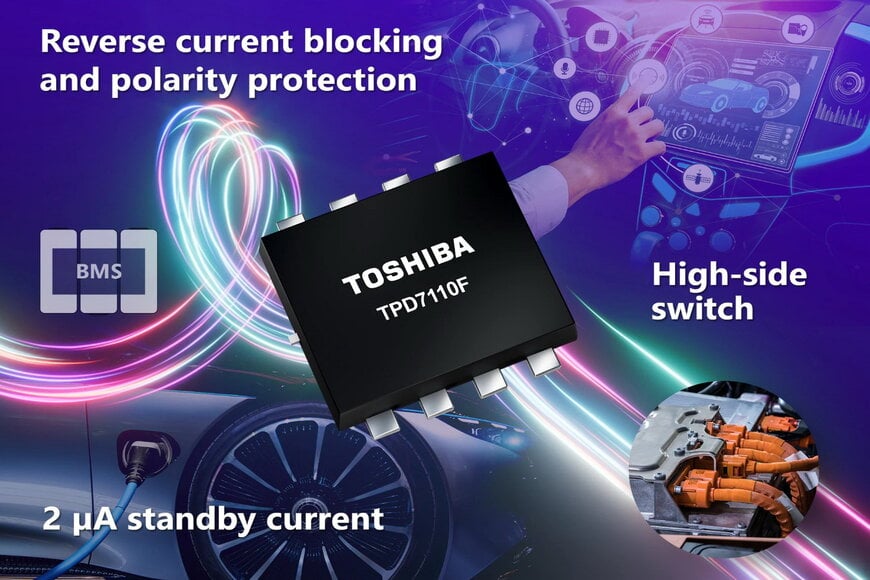
Toshiba Electronic Devices & Storage Corporation has released the TPD7110F, a compact intelligent power management IC tailored for automotive control modules that require safe and efficient power sequencing, space-constrained layouts, and support for redundant power rails commonly found in modern automotive data ecosystems. The device combines ideal diode control with reverse-polarity and current blocking functions to address design challenges in battery-powered vehicle subsystems.
Technical Context and Relevance
Automotive electronic control units (ECUs) such as body control modules (BCMs), battery management systems (BMS), and display units demand robust power management capable of preventing damage from incorrect battery connection and managing multiple supply paths for functional safety. Traditional discrete solutions occupy significant printed circuit board (PCB) area and often require external components to implement ideal diode configurations, increasing system cost and complexity. The TPD7110F integrates key power control functions into a single package, enabling designers to meet automotive workload profiles with a reduced component count.
Design and Functional Features
At the heart of the TPD7110F is an ideal diode controller that combines an internal charge pump with an external N-channel MOSFET to form a low-loss conduction path, comparable to a discrete ideal diode arrangement but in a smaller form factor. By adopting Toshiba’s PS-8 package (2.9 mm × 2.8 mm), the controller requires roughly half the PCB mounting area of conventional MSOP-8 solutions, a measurable reduction that supports high-density automotive power boards.
A built-in reverse-current-blocking function monitors the drain-source voltage (V_DS) of the connected MOSFET and actively prevents current flow from load back to the battery — an essential mechanism in redundant rail architectures where improper current paths can compromise safety or battery health. Designers can also disable this feature in systems where bidirectional energy flow is required, such as energy recuperation circuits in advanced BMS designs.
Impact on System Efficiency and Integration
The TPD7110F’s low quiescent current — typically 100 µA in active operation and 2 µA in standby — helps minimize parasitic load on automotive power networks, contributing to improved energy efficiency in always-on ECUs. By eliminating the need for external capacitors and reducing discrete components, the IC simplifies supply chain considerations for automotive OEMs and tier-1 suppliers working within digital supply chains that prioritize compact, highly integrated solutions.
Use Cases and Application Areas
The controller’s feature set targets multiple automotive subsystems where power integrity and space savings are priorities. In BCMs, the device can manage power switches for lighting, access, and comfort functions while protecting against incorrect battery hook-ups during service or replacement. In BMS applications, it supports safe power rail transitions and isolation of battery packs during diagnostics. The unit’s suitability for head-up displays and other infotainment modules underscores its versatility across voltage-sensitive electronics where board density and reliability are critical.
Competitive Context
While various manufacturers offer high-side switch and ideal diode controllers, objective differentiation in this class is typically based on package size, current consumption, protection features, and integration level. The TPD7110F’s combination of a charge pump-based ideal diode architecture, reverse-current blocking, low quiescent current, and a 2.9 mm × 2.8 mm package positions it at the compact end of the spectrum for automotive power management ICs, enabling system designers to reduce PCB footprint without compromising safety functionality.
www.global.toshiba
