
electronics-journal.com
06
'26
Written on Modified on
Toshiba Launches New Linear Image Sensors For High Speed Scanning
The newly developed sensors provide high-resolution performance and enhanced sensitivity, specifically designed to improve the efficiency and accuracy of industrial automated inspection systems.
www.global.toshiba
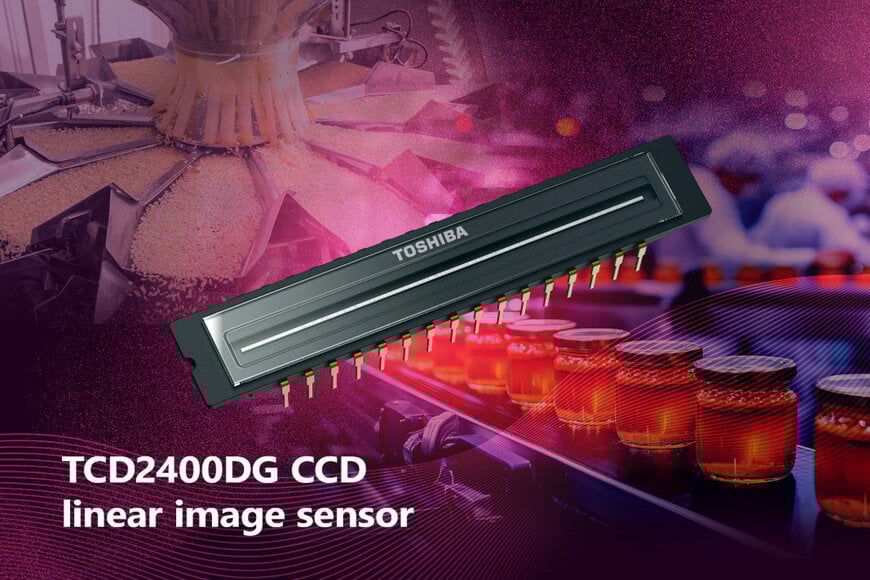
Toshiba Electronics Europe GmbH has released the TCD2400DG, a lens-reduction type Charge Coupled Device (CCD) linear image sensor designed for high-performance industrial imaging. The sensor is optimized for integration into line scan cameras used in high-speed applications, including food sorting, agricultural grain processing, and industrial quality control.
Performance Specifications and Readout Efficiency
A primary challenge in the digital supply chain for industrial automation is the processing of massive image data volumes in real-time. The TCD2400DG addresses this by achieving a maximum line rate of 22.7 kHz—more than double the 10.5 kHz rate of the previous TCD2564DG model. This performance is supported by a maximum data rate of 100 MHz, utilizing a 50 MHz master clock frequency across two channels.
By increasing the readout speed, the sensor allows inspection equipment to identify objects passing at high velocities with higher precision. The architecture features 4,096 picture elements arranged in three independent lines (RGB), each with a 7 µm pitch. This design enables the acquisition of high-resolution color images without the processing delays associated with color interpolation in Bayer element arrays, which is critical for systems requiring immediate pass/fail judgments.
Simplified System Integration and EMI Reduction
To streamline the development of industrial hardware, the TCD2400DG integrates the timing generator and CCD driver—components that were previously mounted as external circuits. This integration offers several technical advantages for engineers:
- Reduction in Component Count: Eliminating the external driver reduces the total bill of materials (BOM) and saves PCB real estate.
- Simplified Wiring: The internal configuration reduces the number of signal lines required to drive the sensor, minimizing complex timing adjustments between signals.
- Mitigation of Interference: High-speed electronic operations often generate electromagnetic interference (EMI). By reducing external wiring, the sensor helps suppress EMI, ensuring more stable operation in sensitive industrial environments.
Application in the Automotive Data Ecosystem and Industrial Sorting
While primarily targeted at automated optical inspection (AOI) for food and plastics, the sensor's high-speed data capabilities are relevant for broader industrial sensing and the evolving automotive data ecosystem, where high-resolution scanning of components is necessary for quality assurance. The TCD2400DG is housed in a WDIP32 package and operates within a voltage range of 3.1 V to 3.5 V for digital components and 9.5 V to 10.5 V for the analog supply.
Comparative Technical Context
Compared to the existing TCD2564DG, the TCD2400DG provides a 116% increase in line rate efficiency. While CMOS sensors are often used for general-purpose imaging, Toshiba utilizes CCD technology in this application to maintain high signal integrity and minimize the random noise often associated with the high-speed capture of fast-moving industrial subjects.
www.global.toshiba
While primarily targeted at automated optical inspection (AOI) for food and plastics, the sensor's high-speed data capabilities are relevant for broader industrial sensing and the evolving automotive data ecosystem, where high-resolution scanning of components is necessary for quality assurance. The TCD2400DG is housed in a WDIP32 package and operates within a voltage range of 3.1 V to 3.5 V for digital components and 9.5 V to 10.5 V for the analog supply.
Comparative Technical Context
Compared to the existing TCD2564DG, the TCD2400DG provides a 116% increase in line rate efficiency. While CMOS sensors are often used for general-purpose imaging, Toshiba utilizes CCD technology in this application to maintain high signal integrity and minimize the random noise often associated with the high-speed capture of fast-moving industrial subjects.
www.global.toshiba
