
electronics-journal.com
04
'26
Written on Modified on
Toshiba Launches Low Noise Sine Wave Drive Controllers For Motors
The new TC78B043 series offers high-efficiency, low-vibration control for three-phase brushless DC motors, featuring non-volatile memory and SPI for easy parameter adjustment in diverse applications.
www.global.toshiba
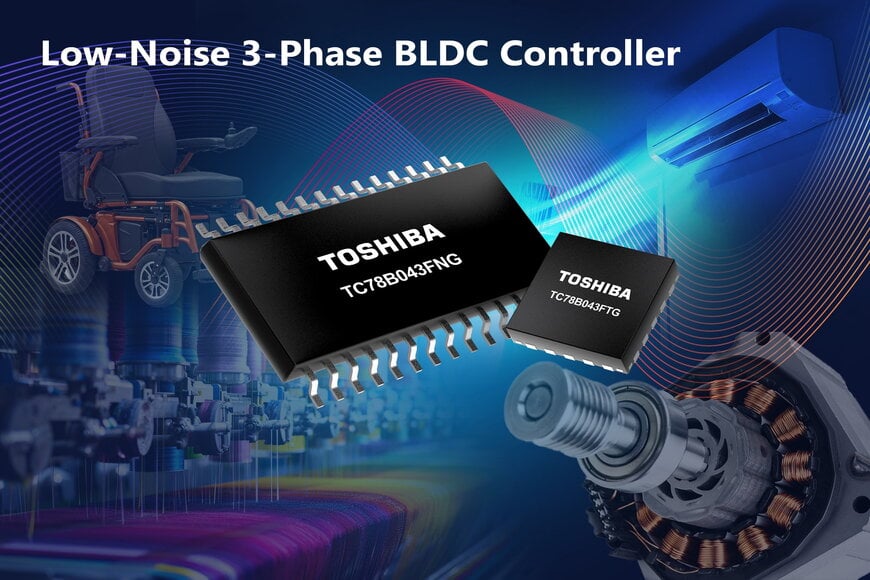
The shift toward electrification in automotive body systems requires motor control solutions that prioritize noise reduction and energy efficiency. Toshiba has released two new sine-wave drive controllers designed for three-phase brushless DC (BLDC) motors, offering a standardized platform to replace traditional brushed motor architectures in applications such as pumps, fans, and thermal management systems.
Advanced Sine-Wave Drive and Vibration Suppression
The newly developed controllers utilize a high-resolution sine-wave drive mechanism to provide smooth current delivery to motor windings. Unlike conventional square-wave driving methods, which can induce torque ripple and acoustic noise, this sine-wave approach minimizes vibration during both start-up and continuous operation. This technical refinement is critical for cabin comfort applications where mechanical noise must be kept to a minimum.
To ensure peak performance across different motor hardware, the devices feature an integrated non-volatile memory (NVM). Engineers can program specific speed settings and control parameters—such as lead angle adjustment—directly into the IC via a Serial Peripheral Interface (SPI). This programmability allows the controller to be tuned to the specific inductance and back-EMF characteristics of the motor, maintaining high-efficiency operation across a varied digital supply chain of hardware components.
Integrated Protection and System Robustness
The controllers are engineered for harsh environments, operating within a supply voltage range of 6V to 23V and an ambient temperature window of -40°C to +115°C. To reduce the total bill of materials (BOM) and simplify PCB layouts, the ICs integrate a 5V regulator. This internal rail provides a stable power source for external logic circuits or Hall sensors, eliminating the requirement for an auxiliary voltage regulator.
System reliability is maintained through a suite of hardware-based diagnostic functions. The devices include:
- Thermal Shutdown: Prevents silicon damage during over-temperature events.
- Under-Voltage Lockout (UVLO): Ensures the system only operates within safe voltage thresholds.
- Over-Current Detection and Current Limiting: Protects the motor windings and power stages from electrical stress.
- Lock Protection: Automatically detects and manages motor stall conditions to prevent sustained high-current draws.
Application in the Automotive Data Ecosystem
By utilizing the SPI for configuration and monitoring, these controllers integrate seamlessly into modern vehicle architectures where decentralized motor control is managed by a central electronic control unit (ECU). This connectivity supports the broader automotive data ecosystem by providing digital feedback on motor status and allowing for real-time adjustments to operating parameters.
The high level of integration and programmable memory makes these devices suitable for a wide range of industrial and automotive actuators. By standardizing on a single controller architecture that can be digitally optimized for different motor types, manufacturers can streamline their procurement processes and reduce the complexity of the digital supply chain.
www.global.toshiba
By utilizing the SPI for configuration and monitoring, these controllers integrate seamlessly into modern vehicle architectures where decentralized motor control is managed by a central electronic control unit (ECU). This connectivity supports the broader automotive data ecosystem by providing digital feedback on motor status and allowing for real-time adjustments to operating parameters.
The high level of integration and programmable memory makes these devices suitable for a wide range of industrial and automotive actuators. By standardizing on a single controller architecture that can be digitally optimized for different motor types, manufacturers can streamline their procurement processes and reduce the complexity of the digital supply chain.
www.global.toshiba
