
Will fine circuit traces soon become ubiquitous? Examples of 3D-MID applications reveal almost limitless potential
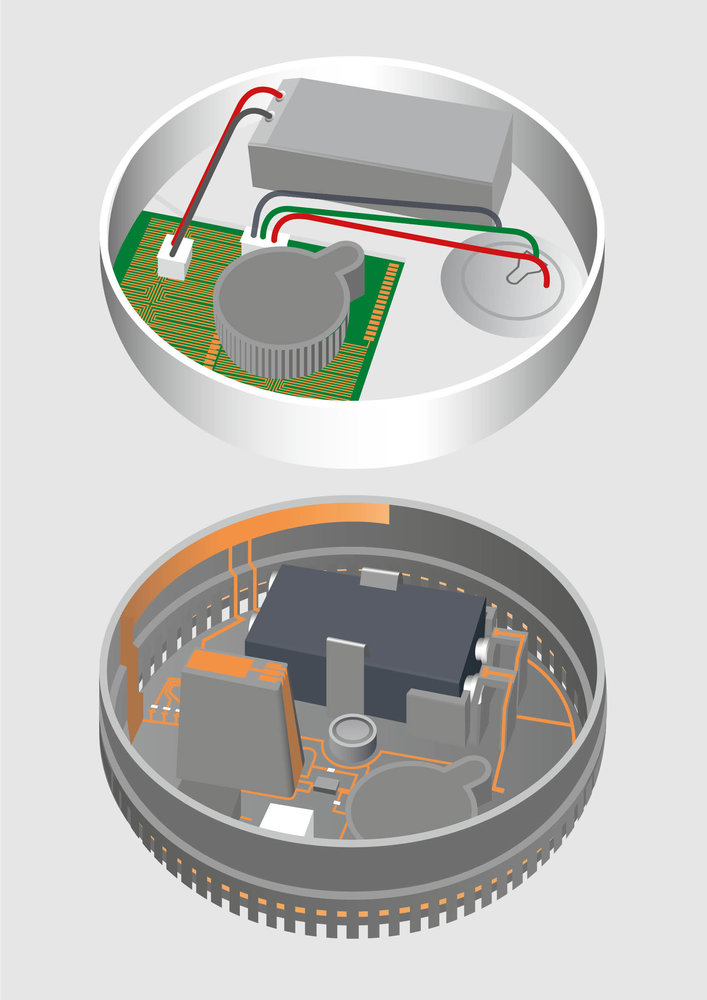
3D-MID technology is already in everyday use, for example in the latest generation of smoke
detectors. Design simplification and the integration of switches and cables save hardware and
assembly costs.
In the manufacture of industrial applications, more and more industry sectors are turning to a new technology
as an alternative to classic PCBs. The revolution is called 3-D MID (Moulded Interconnect Devices or
Mechatronic Integrated Devices) – injection-moulded plastic parts with conductive traces integrated by using
laser direct structuring (LDS). This technique adds power to the trend towards miniaturisation in the
electronics industry and provides product developers with new design opportunities.
The projects which Multiple Dimensions, one of the world’s foremost suppliers in this field, have realized
illustrate the diversity of possible applications for 3D-MID. They simplify the operation of household
appliances, improve driver experience in power steering systems and open up new ways of saving space –
for example in sensing and industrial electronics.
Johannes Schmid, Managing Director of Multiple Dimensions explains how these fine, golden traces on
formed plastic are transforming industrial production. The basis of all 3D-MID applications is a thermoplastic
material: "Using injection- moulding, we first manufacture the part to fit the customer’s application. We use
different types of thermoplastic, which contain an additive that can be activated by laser," says Mr. Schmid,
describing the underlying principles of the technology. A laser ray then engraves the surface of the plastic
and activates the additive. A copper bath then follows, which lets the conductive traces form directly on the
thermoplastic. Depending on the type of application, the MID parts may have to be extremely robust or
temperature-resistant. "Some even have to be acid or sweat-resistant, for example applications for hearing
aids or headphones," continues the Swiss executive. In a final step, a barrier layer of nickel is applied and
then conditioned with a thin layer of gold to ensure good solderability.
What differentiates the company from the competition is that it produces traces in almost microscopically
small dimensions. "Our manufacturing expertise is capable of competing with anyone in the world, especially
our uniquely fine trace width and the narrow spacing between traces.” Most suppliers are currently working
with 300 - 400 μm spacing between traces. "At Multiple Dimensions however the technological limit for trace
width is 80 μm," states Schmid. "These fine structures are now often used in Point of Sales (POS) terminals
as a protection from hacking attacks. The fine traces allow attacks on the data in the payment cards to be
detected."
From washing machines to steering wheels
It is the trace width and spacing between the traces that differentiates the top players in the new 3D-MID
technology from the rest of the pack. It is the main factor affecting the degree of miniaturisation and it is
decisive in terms of the number of functions that can be integrated in a component.
There are already many concrete examples of applications using the technology: "We manufacture for a
range of very diverse industries. I’m sure you are familiar with the rotary switches for programme selection in
washing machines. These switches are normally made of a whole kit of small mechanical parts – with our
3D-MID technology none of these are now needed.” The washing programme is selected using a capacitive
switch, i.e. virtually touch-free. This has far-reaching consequences: Unlike with a mechanical solution, there
is no friction to wear out the parts. "Our operator control device has a much simpler design, costs less to
produce and on top of that, it has a longer service life," says Schmid.
The Swiss company manufactures sensors for the automotive industry which are used to measure the torque
and position of steering wheels. "Depending on the position and the measured value, the drive of the power
steering is increased or decreased. The more accurate the measurement, then the more directly the vehicle
response is felt.” Just like in the example of the washing-machine, the conventional solution contains
numerous mechanical parts. When all these parts work together, deviations and tolerances cumulate and
impair the driving experience. “We are able to eliminate an entire chain of tolerances,” explains Schmid. The
technology not only saves components and costs, it also makes the application more precise and efficient.
And last but not least, it increases the user’s driving pleasure.
A maximum amount of functionality in minimal space
Exceptional functional integration in a minimum of space is demonstrated by a solution currently produced by
Multiple Dimensions for a toy manufacturer. For enhanced player experience, an electronic circuit has been
built into a tiny space in a plastic component – including a battery, a capacitive switch and an LED. "There
simply would not have been enough space there for a printed circuit board. Here too, the operating control
device, in this case a capacitive switch, is totally wear-free, and there is no mechanical contact."
In future, the new 3D-MID technology will also be used in human-like robots. In Biel currently, experts from
Multiple Dimensions are equipping the fingertips of a robotic hand (in the size of a human hand) with
conductive traces. The surface of the robot’s tactile organ is covered with sensors, their pressure signals are
routed centrally to a connector. "Thanks to our 3D technology, we can place the required electronics
accurately in spite of the complexity of working with a curved surface," Schmid remarks, emphasising the
advantages of three-dimensional processing.
The trend towards miniaturisation is growing in importance in everyday life
Customers of Multiple Dimensions benefit from the potential of the new technology at many levels, including
financially. "We don’t just offer our state-of-the-art methodology and expertise that is unique in the world
today; we also deliver it at a lower cost than many of our competitors." All production steps are fully
automated and performed in-house at Multiple Dimensions. “We cover the complete process chain, from the
injection-moulding process to laser processing and galvanisation, and even go as far as populating the
electronic components. The saves transport costs and, most of all, time; savings that we are happy to pass
on to our customers,” declares Johannes Schmid.
The Managing Director of Multiple Dimensions is convinced that as far as the development potential of
3D-MID technology is concerned, the end of the road is still a long way off. "Advances in miniaturisation
which are being made in all areas of our industrial society, combined with the trend to intelligent connectors
for Industry 4.0, ensure that 3D-MID technology will be used even more widely in future.”
An example of 3D-MID in a smoke detector
The current generation of smoke detectors are ideal candidates for a technological update using 3D-MID.
The enclosure is made of plastic, the conducting traces can be applied directly and the printed circuit board
completely eliminated. Cables and connector plugs, and even the battery holder can be integrated into the
moulded part. In production, complex soldering processes are eliminated and the assembly as a whole is
simplified, due to the small number of parts. Another advantage is the easy integration of additional
functions. For example, a capacitive switch can now be used, replacing the previously-used mechanical
switch.
Multiple Dimensions AG
Multiple Dimensions is world’s leading technology enterprise specializing in the development of customized
molded interconnect devices and their pro-duction. Multiple Dimensions AG maintains close partnerships
with its custom-ers across the entire process chain, from device design through large-scale se-ries parts
production. Multiple Dimensions AG is worldwide represented.
