
electronics-journal.com
11
'26
Written on Modified on
Anritsu Launches Tensor VNA Series at IMS 2026
Anritsu has announced the launch of its new Tensor Vector Network Analyzer (VNA) platform, engineered to manage advanced active and passive device characterization.
www.anritsu.com
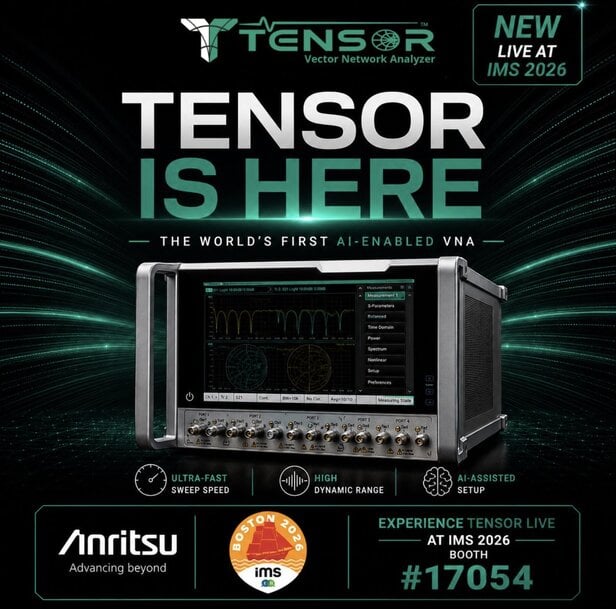
ANRITSU announces the launch of its new Tensor Vector Network Analyzer (VNA) at the IEEE MTT S International Microwave Symposium (IMS) 2026, taking place June 7–12, in Boston, Massachusetts.
Hardware Integration and Core Architecture
The primary structural innovation of the Tensor VNA platform lies in its multi-source physical layout. The system introduces a standard 1 source-per-port hardware architecture, deploying four independent radio frequency (RF) sources inside a standard 4-port VNA frame. This configuration permits users to execute multiple discrete component measurements—such as verifying parallel amplifiers, mixers, or multi-stage frequency converters—simultaneously within a single physical test setup.
The independent source distribution eliminates external switch matrix routing overhead, optimizing native output power levels, reducing trace noise, and maximizing instrument dynamic range across broad frequency spans. This hardware design allows a standard 2-port VNA model to natively execute amplifier two-tone intermodulation distortion testing, while a 4-port model can simultaneously run 2-2 tone amplifier or mixer evaluations without requiring supplementary external test sets. Additionally, the platform can be configured with an optional secondary internal local oscillator (LO), providing the phase and group delay tracking necessary for comprehensive vector mixer measurements.
Millimeter-Wave Capability and Throughput Optimization
The Tensor VNA architecture provides native scalability to address high-frequency and millimeter-wave (mmWave) applications. Utilizing Anritsu’s compact mmWave extension modules, the standalone platform covers a frequency spectrum extending from 54 GHz to 220 GHz. For sub-terahertz (sub-THz) research, the system supports open interfacing with third-party waveguide band components, allowing frequency expansion up to 1.1 THz to satisfy emerging signal integrity, semiconductor, and aerospace requirements.
To streamline lab operations from initial research and development through high-volume production validation, the platform incorporates a modern software architecture that delivers ultrafast sweep speeds and enhanced data transfer rates. These rapid measurement sequences shorten overall development cycles and lower test times while preserving data repeatability.
Artificial Intelligence Integration and User Interface
The system features an integrated artificial intelligence (AI) engine developed to serve as a conversational companion within the test workspace. The built-in AI assistant interprets natural human language to provide localized configuration suggestions, reducing measurement uncertainty and simplifying the execution of intricate multi-port test parameters.
This automation ecosystem is combined with a modernized user interface designed to simplify instrument parameterization and integration into established automated test scripts. The official launch occurred during the IEEE MTT-S International Microwave Symposium (IMS 2026) held from June 7 to 12 in Boston, Massachusetts, where the system was demonstrated live to the global microwave engineering community.
Additional Context
This section details technical specifications not included in the original news release.
Vector Network Analyzers (VNAs) evaluate the scattering parameters (S-parameters) of electrical networks by injecting a known sinusoidal stimulus and measuring the forward and reflected vector traveling waves. Traditional multiport VNAs utilize a single internal RF signal source multiplexed across multiple test ports via a network of solid-state or mechanical coaxial switches. This conventional switch-based method introduces insertion losses, limits the maximum available output power, and requires sequential port pulsing, which lowers throughput during multi-channel or differential test sequences.
By utilizing a dedicated fractional-N synthesizer and phase-locked loop (PLL) circuit for every test port, a true source-per-port architecture provides concurrent, phase-coherent signal generation across all channels. This allows for the simultaneous extraction of full cross-frequency S-parameters and multi-tone intermodulation products, boosting the intermediate frequency bandwidth (IFBW) efficiency and dynamic range, which often exceeds 140 dB above 2 GHz.
In frequency conversion and mixer characterization, two distinct testing methodologies are deployed depending on the receiver architecture:
- Scalar Mixer Measurements (SMM): Calculate conversion loss or gain by comparing the absolute amplitude of the input radio frequency (RF) signal with the resulting output intermediate frequency (IF), treating the phase relationship as an uncalibrated variable.
- Vector Mixer Measurements (VMM): Require a second independent internal local oscillator (LO) to establish a rigid phase reference between the VNA source and the internal receivers.
This dual-LO configuration enables the VNA to execute advanced phase-matching calibration techniques, such as the open-short-load-thru (SOLT) variant or standard reciprocal mixer methods. By tracking the exact phase change over a modulated frequency span, the instrument calculates absolute group delay, which is defined as the negative derivative of the phase transfer function with respect to angular frequency. This metric is critical for identifying phase distortion and group delay ripples in communication transponders, aerospace electronics, and high-speed digital interconnect networks.
Edited by Romila DSilva, Induportals Editor, with AI assistance.
Edited by Romila DSilva, Induportals Editor, with AI assistance.
