
ST's 80V STripFET F8 MOSFETs target AI servers, industrial and automotive power conversion
Housed in PowerFLAT 5x6 packages, the industrial and automotive-qualified devices optimize intermediate-voltage conversion for high-end servers, DC/DC converters, and motor drives.
www.st.com
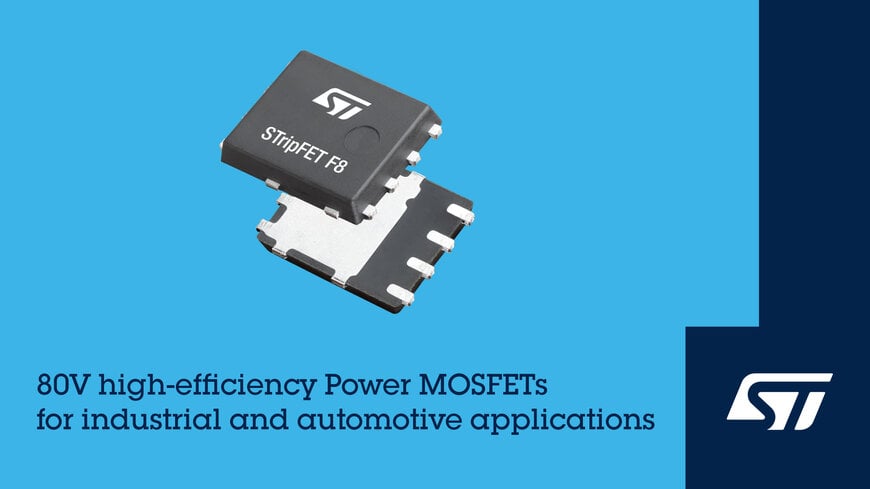
STMicroelectronics has expanded its STripFET F8 silicon power MOSFET portfolio by introducing seven new 80V devices housed in the compact PowerFLAT 5x6 package. Encompassing both industrial and automotive-qualified variants, the MOSFETs are engineered for high-end servers, DC/DC converters, and motor drives.
Bridging intermediate rail voltages with enhanced trench gate technology
Supplementing STMicroelectronics' existing 40V and 100V product ranges, the 80V rating enables power electronics designers to optimize efficiency and switching performance in applications working at intermediate rail voltages. Built on ST's STripFET F8 enhanced trench gate structure, the devices pair very low on-resistance (RDS(on)) with reduced internal capacitances and gate charge to support rapid switching transitions with minimal losses. Higher switching frequencies allow engineers to specify smaller capacitive and magnetic passive components, raising overall system power density.
Key electrical and thermal specifications
- Drain-current ratings: Covers 126A to 220A across the new 80V series.
- On-resistance and gate charge: Features maximum RDS(on) values ranging from 1.6mΩ to 4.5mΩ and typical gate charge (Qg) as low as 47nC.
- Thermal and avalanche ruggedness: All devices undergo 100% avalanche testing and support a maximum operating junction temperature of 175°C for harsh operating conditions.
Part numbers, availability, and pricing
Four industrial variants—STL190N8F8, STL180N8F8, STL130N8F8, and STL110N8F8—are currently in production, priced from $0.47 to $0.88 for orders of 1,000 pieces. Two automotive-qualified components, the STL185N8F8AG and STL115N8F8AG, are also in production and priced from $0.46 to $0.95.
Additional Context:
This section explains general principles of 48V intermediate bus architectures in AI data centres and shielded-gate trench MOSFET design not included in the original press release.
In modern AI server racks and 48V mild-hybrid automotive electrical systems, nominal 48V power rails can experience inductive voltage spikes and transient overshoots well above the nominal level during rapid load steps. A 100V MOSFET provides generous voltage margin but typically has higher on-resistance per unit of silicon area, whereas a 60V device may offer insufficient margin against such transients. An 80V rating can therefore offer a practical balance between transient voltage headroom and low RDS(on) for 48V-to-12V or 48V-to-point-of-load DC/DC converters.
Trench-gate MOSFET architectures etch vertical gate electrodes into the silicon die to increase channel density and eliminate junction field-effect transistor (JFET) resistance. Incorporating charge-balance structures within the trench can reduce Miller capacitance (Crss) and total gate charge (Qg), minimizing switching energy losses (Eon and Eoff) when operating synchronous buck or resonant LLC converters at frequencies of several hundred kilohertz.
Edited by an industrial journalist, Lekshman Ramdas, with AI assistance.
