
electronics-journal.com
24
'26
Written on Modified on
IEC 60730 Class C MCUs for appliance safety
Microchip AVR SD MCUs received UL Recognition for Components to IEC 60730-2-5 Class C, simplifying certification of gas appliance and boiler controls.
www.microchip.com
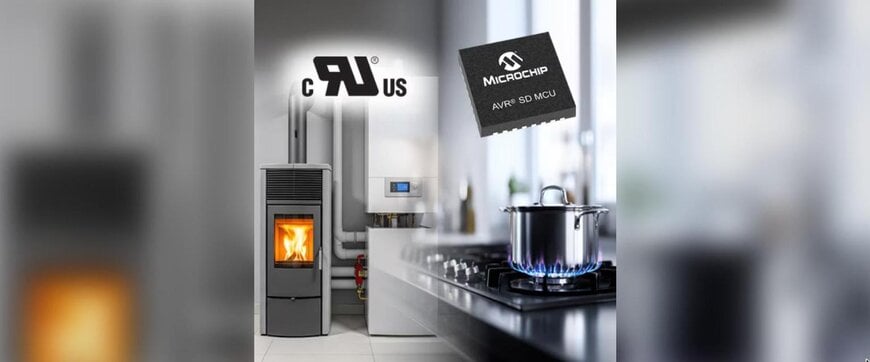
Automatic electrical controls in furnaces, boilers and gas-fired appliances must detect microcontroller faults that could otherwise lead to hazardous conditions such as uncontrolled ignition or overheating. Under IEC 60730, demonstrating this fault coverage has typically required extensive software self-test libraries. Microchip Technology has announced that its AVR SD family of microcontrollers has achieved UL Recognition for Components to the UL/CSA/IEC 60730-2-5 Class C standards for automatic electrical controls for household appliances and similar use.
What IEC 60730 Class C Requires
IEC 60730 classifies control software by the consequences of a fault. Class C applies to controls intended to prevent special hazards, where unsafe operation could create dangerous conditions, including furnaces, boilers and gas-fired appliances requiring advanced fault detection and safety monitoring. Component-level recognition provides developers with an independently evaluated foundation that can simplify end-system certification. The recognition applies to the evaluated MCUs within the defined scope and conditions of acceptability and does not constitute certification of a complete appliance or end system.
Hardware Safety Architecture of the AVR SD MCUs
More than 20 dedicated hardware safety features reduce reliance on software diagnostics and safety libraries, which lowers code and memory overhead. These include a dual-core lock-step architecture, in which two cores execute the same instructions and their outputs are compared to detect faults in real time; SECDED error-correcting code on memories, which corrects single-bit errors and detects double-bit errors; autonomous fault monitoring; and a centralised error controller capable of initiating an automatic safe-state response. Peripheral redundancy, such as dual onboard ADCs, allows analogue measurements to be cross-checked.
“The AVR SD MCUs integrate hardware-based solutions that were evaluated as safeguards against microelectronic faults and errors for IEC/UL/CSA 60730 Function Class B and C applications,” said Vladimir Ivetic, senior staff engineer of Functional Safety in the Appliances, HVAC and Lighting group at UL Solutions.
Safety Framework Software and Development Process
The AVR SD Safety Framework coordinates initialisation, fault-injection diagnostics, watchdog supervision, error response, safe-state transitions and reset recovery. Configurable source code and safety, compliance and verification collateral support IEC 60730 Class C certification activities.
UL Solutions evaluated the safety-related hardware architecture, diagnostic capabilities and fault-management mechanisms against IEC 60730-2-5 Class C. The devices and software were developed under a functional safety management system certified by TÜV Rheinland, with processes aligned to ISO 26262 and IEC 61508, and are designed to support applications targeting ASIL C and SIL 2.
“The AVR SD family was purpose-built for functional safety applications, integrating key safety mechanisms directly into hardware so engineers can focus more on application development and less on implementing and maintaining safety functions through software,” said Greg Robinson, corporate vice president of Microchip's MCU, development tools and wireless business units.
Applications in Appliances, HVAC and Industrial Controls
Typical uses include gas burner and boiler controls, furnaces and other appliance and HVAC systems where a fault could cause a hazard, as well as industrial and automotive designs targeting SIL 2 or ASIL C. More information is available on Microchip's functional safety solutions page.
Additional Context
This section details technical specifications and competitive benchmarking not included in the original product announcement.
IEC 60730 Annex H defines software classes A, B and C. Class B covers controls that prevent unsafe operation of the controlled equipment, such as thermal cut-outs in washing machines, while Class C covers controls that prevent special hazards such as explosion in gas burner systems. Class C typically requires redundant or dual-channel structures with comparison, which is why lock-step cores and redundant ADCs are relevant. Other MCU suppliers, including Renesas, NXP and Texas Instruments, provide IEC 60730 Class B self-test libraries for their general-purpose MCUs; Class C support with hardware lock-step in an 8-bit MCU family is less common.
Edited by Evgeny Churilov, Induportals Media - Adapted by AI.
www.microchip.com
