
electronics-journal.com
08
'26
Written on Modified on
Anritsu validates chamberless testing for 60 GHz radar devices
The near-field measurement solution eliminates large anechoic chambers while maintaining regulatory certification correlation for sensor production.
www.anritsu.com
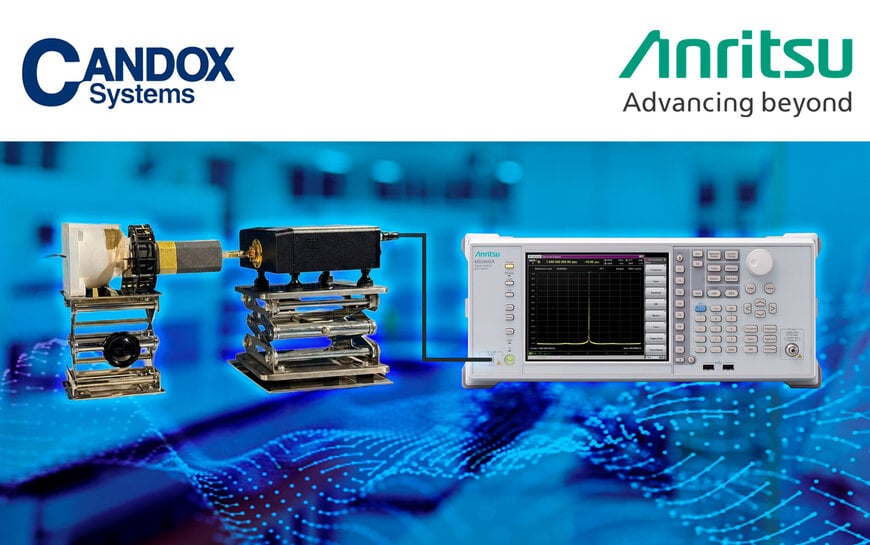
Anritsu Corporation, in collaboration with CANDOX Systems Inc., has successfully validated a chamberless production testing solution for 60 GHz radar and sensor devices. Evaluated alongside independent certification body TÜV Rheinland Japan Ltd., the system utilizes near-field measurement techniques to eliminate the need for large anechoic chambers on the manufacturing floor. This approach allows electronics manufacturers to significantly reduce test system footprints and capital expenditures while ensuring that production line measurements correlate directly with the certification standards specified under Japan’s Radio Act.
Correlating near-field data with regulatory standards
As the 60 GHz radar and sensing market expands into industrial equipment, security systems, and motion detection, manufacturers face the challenge of scaling production without proportionally scaling the massive physical footprint of traditional RF testing infrastructure. The new testing methodology combines Anritsu’s millimeter-wave signal analyzer with CANDOX Systems’ specialized 60 GHz near-field probe. By comparing standard far-field certification measurements with near-field probe data, engineers established precise difference calculations. Applying this difference data ensures that highly compact, chamberless testing environments can reliably replicate the stringent measurement accuracy of traditional regulatory setups, accelerating production efficiency.
Additional Context: Near-field to far-field transformations at 60 GHz
The 60 GHz frequency band (V-band) is characterized by very short wavelengths of approximately 5 millimetres. Traditional antenna characterization and regulatory testing require measuring the device's radiated emissions in the "far-field" region, where the electromagnetic wave front is planar and the angular field distribution is independent of distance. At millimeter-wave frequencies, capturing these far-field patterns traditionally dictates placing the device inside a bulky, RF-absorbent anechoic chamber to prevent multipath signal reflections. Near-field testing circumvents this by placing a specialized probe just millimetres from the device's antenna array to capture phase and amplitude data before the waves fully form into their far-field pattern. By utilizing advanced near-field to far-field (NF-to-FF) mathematical transformations, the test system can accurately calculate the far-field radiation pattern—including beamforming characteristics and Effective Isotropic Radiated Power (EIRP)—based solely on the near-field data. This allows manufacturers to validate regulatory compliance directly on automated production lines without moving the devices into an isolated, room-sized chamber.
Edited by Lekshman Ramdas, InduPortals editor – adapted by AI.
www.anritsu.com
