
electronics-journal.com
28
'26
Written on Modified on
Compact AC-DC Power Supplies
High-Power-Density AC-DC Power Supplies for Medical and Industrial Systems.
www.tdk.com
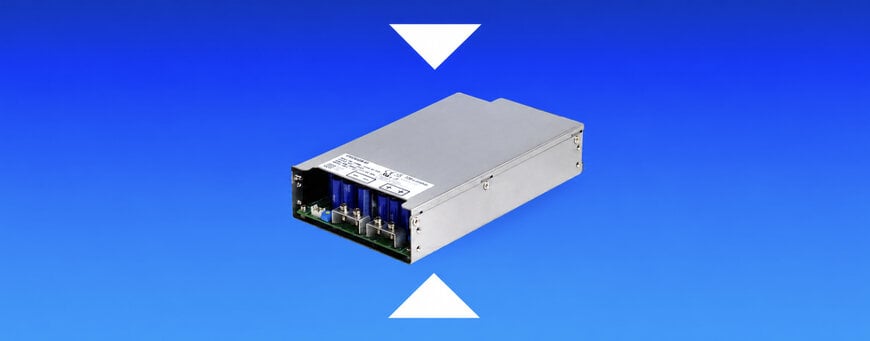
TDK Corporation introduced the TDK-Lambda CUS1600M and CUS2000M AC-DC power supply series, addressing the engineering challenge of delivering high electrical power within space-constrained medical, laboratory, and industrial environments without compromising energy efficiency or acoustic performance.
Modern medical and industrial equipment often requires high electrical power in restricted physical volumes while adhering to strict thermal, acoustic, and safety standards. High power conversion efficiency and low audible noise are critical in hospital and laboratory settings, where cumulative device noise disrupts patient recovery and thermal management challenges limit system miniaturization.
Operating Principle and System Architecture
The TDK-Lambda CUS1600M and CUS2000M series achieves a power density of up to 33.3 W per cubic inch within a compact 203.2 x 114.3 x 42.5 mm enclosure. Operating at conversion efficiencies of up to 95 percent, the power supplies minimize internal thermal dissipation, reducing energy consumption and carbon emissions during continuous industrial and clinical operation.
Acoustic optimization is managed via an integrated variable-speed fan control algorithm, which limits audible noise emission to as low as 35 dBA under operating loads. Electrical isolation complies with IEC 60601-1 and IEC 62368-1 standards, incorporating 2 × MOPP insulation and maintaining a leakage current below 0.250 mA to ensure patient safety in clinical environments. Electromagnetic compatibility is satisfied through Class B conducted and radiated EMI compliance under EN55032, EN55011-B, and FCC-B standards. Standard system integration features include remote sense, remote on/off control, a Power Good signal, and a dedicated 5 V, 2 A auxiliary standby output.
Industrial Application Areas
The power supply series is engineered for deployment across multiple demanding technical sectors, including:
• Medical imaging, aesthetic, and surgical systems
• Clinical care, in-vitro diagnostics, and analytical instrumentation
• Laboratory automation and semiconductor fabrication equipment
• Precision test and measurement instrumentation
Technical Specifications
The TDK-Lambda CUS1600M and CUS2000M power supplies deliver maximum output power levels of up to 1600 W and 2000 W respectively, achieving an elevated power density of up to 33.3 W per cubic inch within a compact physical footprint measuring 203.2 by 114.3 by 42.5 mm. The units operate at conversion efficiencies reaching up to 95 percent and incorporate variable-speed fan control to maintain audible noise emissions as low as 35 dBA. For electrical safety and regulatory compliance, the series is certified to IEC 60601-1 and IEC 62368-1 standards featuring 2 × MOPP isolation, while maintaining an earth leakage current of less than 0.250 mA. Electromagnetic compatibility is validated against Class B conducted and radiated limits in accordance with EN55032, EN55011-B, and FCC-B specifications. Standard system integration features comprise remote sense capabilities, remote on/off control, a Power Good output signal, and an independent 5 V, 2 A auxiliary standby output.
Additional Context:
This section details technical specifications and competitive benchmarking not included in the original product announcement.
In high-power industrial and medical power conversion, balancing volumetric power density with rigorous safety isolation remains a primary engineering trade-off. Standard 1.5 kW to 2 kW enclosed AC-DC supplies historically operated in the 88% to 92% efficiency range, resulting in higher thermal waste and requiring larger cooling apparatuses or noisier high-RPM fans.
The achievement of 95% efficiency in the CUS1600M and CUS2000M series reduces total thermal dissipation by roughly 25% to 37% compared to previous-generation architectures, directly easing thermal management constraints in enclosed chassis designs. Furthermore, maintaining leakage currents below 0.250 mA while supporting 2 × MOPP isolation simplifies compliance with stringent medical leakage standards, reducing development cycles for original equipment manufacturers.
Edited by Sucithra Mani, Induportals editor – adapted by AI.
www.lambda.tdk.com
