
electronics-journal.com
21
'26
Written on Modified on
Hardware-Aware AI Assistant for Embedded Development
Infineon releases a localized machine learning extension for code editors that bridges the gap between generic artificial intelligence agents and physical microcontroller configurations.
www.infineon.com
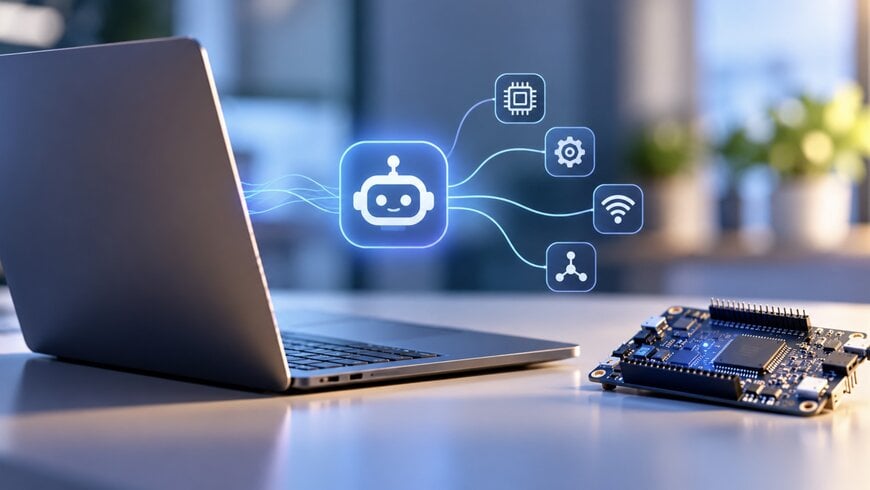
Infineon Technologies AG introduces the ModusToolbox AI Assistant for Microsoft Visual Studio Code, a software extension designed to supply artificial intelligence coding agents with hardware-specific context for microcontroller development. The tool targets connected Internet of Things (IoT) applications requiring precise peripheral, graphics, and connectivity programming by ensuring AI-generated code functions correctly on physical hardware.
Overcoming Hardware Abstraction Constraints in Embedded Systems
Embedded software development requires exact hardware configurations, where incorrect pin assignments or missing clock initializations routinely lead to extensive debugging on physical boards. General-purpose AI assistants often generate syntactically correct code that fails during board bring-up because they lack device-specific context and frequently call deprecated Application Programming Interfaces (APIs). To resolve this engineering bottleneck, the new extension aligns AI suggestions with the developer’s actual target device, board, and peripheral setup for PSOC Edge and PSOC Control microcontrollers.
Local Context Analysis and Toolchain Integration
The extension operates by evaluating the workspace project structure, board support packages, installed middleware, code examples, and available tools entirely locally on the developer's machine. By extracting this environmental data, the extension supplies the AI agent with specific development skills for peripherals such as General-Purpose Input/Output (GPIO), Inter-Integrated Circuit (I2C), Serial Peripheral Interface (SPI), Universal Asynchronous Receiver-Transmitter (UART), and Direct Memory Access (DMA), alongside real-time operating system (RTOS) functions. This targeted hardware-specific context reduces token consumption and yields valid, executable code.
Sam Geha, Executive Vice President of IoT – Compute & Wireless Business at Infineon, notes the functional impact of the release: “With the ModusToolbox AI Assistant, developers can combine the productivity of generative AI with the device-specific knowledge needed to build for our microcontrollers and wireless products. Because project context is processed locally, customers retain control of their development data while accelerating the path from concept to deployment.”
Before generating code, the assistant outputs a reviewable project plan that defines the target device, board, libraries, and project structure. This workflow also supports migrating existing codebases to other microcontroller architectures. Developers can execute system setup tools, such as the Device Configurator and Library Manager, directly from the AI chat interface. The extension functions alongside established AI environments, including GitHub Copilot, Cursor, and Windsurf, while its local processing architecture accommodates restrictive corporate IT security policies.
Additional Context
This section details technical specifications and competitive benchmarking not included in the original news release.
Within the embedded software development sector, AI coding aids are evaluated based on their ability to interface accurately with proprietary Hardware Abstraction Layers (HALs). Standard AI coding tools evaluate syntax and logic but lack visibility into specific memory maps, pin multiplexing states, or clock tree configurations. By injecting localized Board Support Package (BSP) data directly into the prompt context window of existing AI engines, this architecture reduces hallucinated API calls and compilation errors. Competitive approaches in the market typically involve either entirely proprietary, IDE-bound Large Language Models (LLMs) or completely generic cloud assistants. This specific implementation occupies a middle tier by acting as a local context aggregator that conditions third-party AI models to write hardware-accurate C and C++ code for embedded targets.
Edited by Aishwarya Mambet, Induportals Editor, with AI assistance.
www.infineon.com
